ProductAlso reported elsewhere2 publishers3 min readPublished
Ultra Robotics raises $62 million to sell a plug-in robot for mixed-item warehouse sorting
Ultra Robotics raised $62 million over two rounds to sell OP1 Operator, a robot built to split mixed inbound containers into single-type bins. A warehouse weighing a pilot has only Ultra's own figures on setup time and daily throughput to plan around.
The Product Desk
What happened
- Fortune reported that $50 million of the money came from a Series A led by Framework Ventures, according to SiliconANGLE.
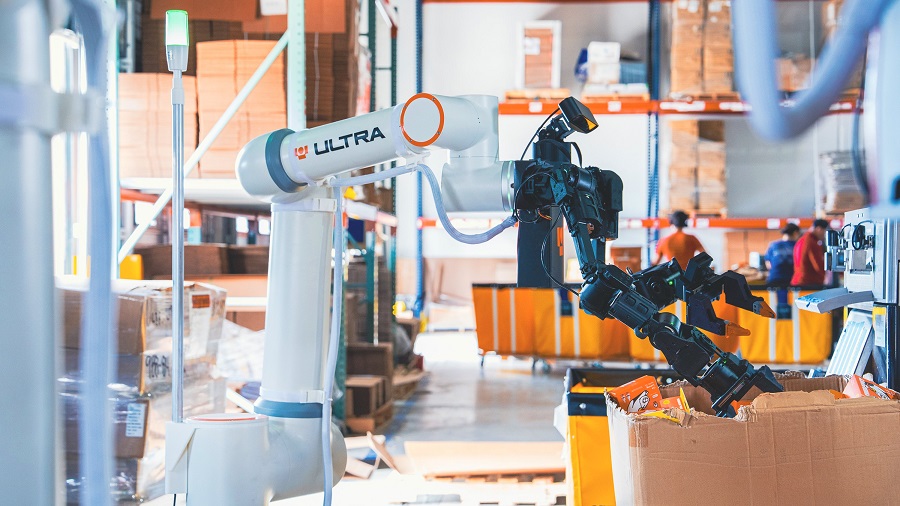
- OP1 Operator looks like a humanoid robot mounted on the end of a traditional robotic arm and grips items with prongs shaped like a forklift's.
- Ultra says the robot also handles final packing, placing kitted items in envelopes or plastic bags, sealing them and adding a shipping label.
- The unit has no motor, so workers roll it between warehouse sections on a wheeled base whose wheels lock once it is in place.
- Ultra claims a single OP1 unit can process up to 1,000 items a day once it is up and running.
Compiled by The Product DeskSomething wrong?How this is made
Why it matters
- decision Ultra's claimed ceiling is per unit, so a station sorting well over 1,000 mixed items a day has to budget for a second robot before the pilot has proved the first.
- constraint Every spot the robot works needs a wall outlet and a network drop, so facilities and IT are part of the rollout before operations sees a single sorted bin.
- exposure A pilot site sends its own sensor data to Ultra for model training by design, so data terms belong in the pilot contract.
- cost With setup time and throughput both resting on Ultra's word, the pilot site pays for the floor time it takes to check them.
A carton arrives at receiving with parts for one laptop series packed together. Before any of it ships, someone on the dock splits the contents into bins, one component type to a bin [6]. Ultra Robotics says OP1 Operator can take over that split [7].
The robot does more than the split. By Ultra's account, the same unit also kits orders, pulling items from several containers into one parcel, and then packs them [7][8]. On the dock today, people split mixed containers by hand [6]. The three-job pitch asks a team to assume that one machine covers the inbound split and the outbound packing as well.
Each spot where the robot works needs two things. OP1 runs from a standard wall outlet, so nobody charges or swaps batteries, and a second cable connects it to the local network [10]. That cable also carries the robot's sensor data. OP1 shares the data with other robots, and Ultra uses it to improve the AI models behind its hardware [14]. A site running a pilot sends floor data to the vendor as part of normal operation. The arm reaches up to 10 feet, high enough to pull stock off shelves, and it can pick up an item it drops [5].
Ultra says its models need little configuration from customers, so a unit can be set up in a few hours [15]. The daily ceiling of 1,000 items comes to 125 an hour across one eight-hour shift, or about 42 an hour if the unit runs around the clock [16][17]. Both the setup time and the throughput are Ultra's figures. The announcement does not include a price or name a customer.
Y Combinator and NextView Ventures jointly led the seed round [3]. Subtracting the reported Series A from the $62 million total leaves about $12 million for the seed [1][2][13]. Ultra says the new capital will pay for engineering and for wider adoption of its robots [12]. "The robots that are actually changing the world are the ones doing valuable work for real people," said founder and chief executive Jon Miller Schwartz. "And this isn't some far-off dream. It's happening right now." [11]
Sort candidate stations on two lines. One is daily mixed-item volume, under or over the 1,000 items Ultra claims for one unit. The other is whether the work stays in one spot with an outlet and a network drop, or moves around the building. The cleanest pilot is a fixed spot under 1,000. It needs one unit, and the test is whether setup takes hours and the daily count holds. Put a fixed spot over 1,000 in the pilot and you learn whether one unit is enough or you are buying two. Low-volume work that moves means someone rolls the robot and re-plugs both cables at every move [9][10]. Leave the last box, high-volume work that moves, until the first pilot has produced its own numbers.
I'd start with the fixed inbound station under 1,000, measured on two numbers: items correctly sorted per day, and hours from delivery to the first correct bin. The tradeoff is that this pilot will not test kitting or packing, two of the three jobs Ultra is selling [7][8].
What to watch
- Ultra naming paying customers or deployment counts for OP1 Operator.
- Customer-measured throughput set against Ultra's claim of up to 1,000 items a day per unit.
- Published pricing or pilot terms, including who controls the sensor data each unit sends back to Ultra.
Clarity's read
What the record supports and how the coverage leans. The claims behind it follow.
Reality
- Evidence35
- Adoption
- Insufficient
- Hype gap+30
- Incentives65
- Confidence40
Claim ledger
Ranked by verification strength, evidence, and original report placement.
- [1]
Ultra Robotics Corp. announced it has raised $62 million in funding over two rounds.
- [2]
Fortune reported that Ultra received $50 million of the capital through a Series A investment led by Framework Ventures.
- [3]
Ultra's seed round was jointly led by Y Combinator and NextView Ventures.
- [4]
Ultra sells a warehouse robot called OP1 Operator, which resembles a humanoid robot attached to the end of a traditional robotic arm and uses a pair of grippers shaped like forklift prongs.
- [5]
OP1 Operator has a vertical reach of up to 10 feet, enabling it to take merchandise off warehouse shelves, and it can pick up an item that falls to the ground.
- [6]
Inbound warehouse shipments often combine many types of items in the same container, for example components from the same laptop series; warehouse operators separate the contents into bins that each contain a single type of component.
- [7]
Ultra says OP1 Operator can automate separating mixed containers into single-type bins, and can also perform kitting, mixing items from different warehouse containers into the same parcel.
- [8]
OP1 Operator handles final packaging: it places kitted items into a package, seals it and adds a shipping label; Ultra says it supports packaging types including envelopes and plastic bags.
- [9]
OP1 Operator is mounted on a flat wheeled base with no engine; workers move it between warehouse sections by rolling it manually, and the wheels lock once it is in place to prevent tipping.
- [10]
OP1 Operator plugs into a standard wall outlet, removing the need to charge and maintain batteries, and a second cable links it to the local network.
- [11]
"The robots that are actually changing the world are the ones doing valuable work for real people. And this isn't some far-off dream. It's happening right now."
ReportedSupportedSource: Jon Miller Schwartz, Ultra founder and chief executive, quoted by SiliconANGLEView cited source - [12]
Ultra will use the new capital to finance engineering initiatives and expand adoption of its robots.
- [13]
The seed round accounts for about $12 million of the $62 million total.
- [14]
OP1 Operator's computer uses the network connection to share onboard sensor data with other robots, and Ultra uses the data to enhance the AI models that power its hardware.
- [15]
Ultra says its AI models do not require extensive configuration by customers, so OP1 Operator can be set up in a few hours.
- [16]
Ultra claims a single OP1 Operator unit can process up to 1,000 items per day once it is up and running.
- [17]
Ultra's claimed 1,000 items a day equals 125 items an hour over one eight-hour shift, or about 42 an hour over 24 hours.
Sources
2 independent publishers whose own reporting we read for this story.
- runtimewire.comUltra raises $50M to put warehouse robots on more floors
1 article · October 9, 2026
- siliconangle.comWarehouse robot maker Ultra Robotics bags $62M
1 article · October 9, 2026
Topics and entities
Follow any of these and your For You feed starts watching them — no settings page required.
Topics
- Warehouse AutomationFollow
- Robotics startup fundingFollow
Entities
- Ultra RoboticsFollow
- OP1 OperatorFollow
- Framework VenturesFollow
- Y CombinatorFollow
- NextView VenturesFollow
- Jon Miller SchwartzFollow
- FortuneFollow