Product1 publisher2 min readPublished
FINTOP leads Santé's $15M round for AI that tells liquor stores what to discount
Santé raised a $15M Series A led by FINTOP to push its software for nearly 1,000 independent liquor stores into AI pricing and marketing. For each store owner, the choice is which of those agents may act without sign-off and which may only suggest.
The Product Desk · Product desk
Drafted by a language model from the sources cited here and checked against its claim ledger before publication. How we use AISend a correction
What happened
- Santé's stores together sell about $2B of merchandise a year, a gross merchandise volume figure that counts store sales and not Santé's own revenue.
- The Series A comes after a $7.6M seed round that Santé announced earlier this year.
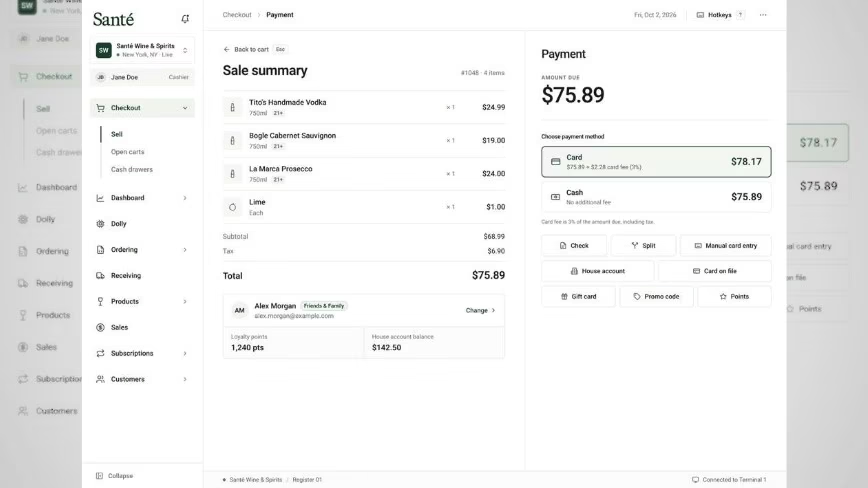
- The platform runs checkout, inventory, e-commerce, delivery orders, marketing and subscriptions, and tracks wine vintages, bottles and kegs, and mix-and-match case discounts.
- Santé says its invoice tool scans distributor invoices and updates stock quantities and unit costs within minutes.
- US spirits supplier revenue fell 2.2% to $36.4B in 2025 even as volume rose 1.9%, according to the Distilled Spirits Council.
Compiled by The Product DeskSomething wrong?How this is made
Why it matters
- constraint Every markdown the merchandising agent proposes inherits whatever is wrong in the store's cost and stock records, so a shop with stale books gets its wrong decisions made faster.
- cost With supplier revenue per unit down about 4% in 2025, each discount an owner accepts gives up per-bottle profit in a market already earning less for every unit sold.
- exposure Because the marketing agent sends its own email and text campaigns, a mistake in a promotion goes straight to the store's regular customers.
A bottle that has sat unsold since spring is cash the store cannot spend. Deciding when to discount it, and whether to order another case, takes information and time that an independent retailer may struggle to pull together [15].
Darren Fike, Santé's chief executive, started with the operational side of that problem. "When we started Santé, our mission was to eliminate the operational headaches that plague independent wine and liquor retailers," he said [6]. The aim now, he said, is to "build a growth engine that proactively drives sales, re-engages lapsed customers, and actively boosts the bottom line of our customers" [7].
The Next Web wrote that the round signals a move from software that cuts administrative work to software that brings in business [16]. Bonfire Ventures, Operator Collective, Y Combinator and Veridical Ventures all came back for it [2]. The base it starts from averages about $2M a year in merchandise sales per store [17], and Santé has disclosed $22.6M in funding this year [18]. The report does not describe how the staffing tool in the pitch works [3], or say how many stores use the agents and keep using them.
In my view, the owner's first test is plainer than the pitch: whether the unit cost on the screen matches the invoice on the counter.
One way to decide what to switch on is to sort each feature on two axes. The first is whether it suggests or acts. The merchandising agent proposes prices and promotions for slow-moving stock [9]. The marketing agent groups shoppers by purchase history and launches its own email and text campaigns [10]. The second axis is whether a feature's input is refreshed by the system, the way invoice scanning refreshes unit costs [8], or rests on records someone keys in by hand.
Markdowns priced against this week's invoice cost sit in the safest box. The system feeds them, and the owner reads them before anything changes. Suggestions built on hand-kept shelf counts belong one box over, as a reason to walk the aisle before repricing. Campaigns to shoppers grouped by checkout history act on their own but draw on data the till records, so the first few sends are the check. Promotions for a particular vintage or a mix-and-match case deal also go out on their own, and where those vintage and case records were entered by hand, they keep a person's sign-off [12].
What to watch
- Santé reporting how many of its nearly 1,000 stores have switched on the merchandising and marketing agents, and how many still use them a quarter later.
- How the staffing tool in Santé's pitch works, and whether it sets shifts itself or recommends them to the owner.
- Whether stores that follow the merchandising agent's markdowns sell slow stock faster without losing margin per bottle.