ScienceNot yet confirmed elsewhere1 publisher3 min readPublished
Ultra-processed meal lifts insulin more than a nutrient-matched minimally processed meal in 32 adults
Virginia Tech researchers found higher insulin in 32 adults after an ultra-processed meal than after a nutrient-matched minimally processed one. The within-person design points at processing, though one 300-calorie meal tracked for three hours cannot say which feature of the food mattered.
The Scientist · Science desk
Evidence map. Supported: the meals were matched for nutrition and energy; insulin rose higher and stayed higher after the ultra-processed meal; that meal also raised metabolic rate and fat burning. Insufficient: altered physical structure as the mechanism; food additives as a cause.
- Supported The two meals were matched for nutritional composition and energy, at 300 calories each., claim 8
- Supported Insulin rose significantly higher after the ultra-processed meal and stayed higher for about two hours; both meals returned to near-baseline levels by the three-hour mark., claim 14
- Supported The ultra-processed meal triggered a higher metabolic rate and greater fat burning during the three-hour window, but less carbohydrate burning than the minimally processed meal., claim 1
- Insufficient evidence "These mechanisms might involve altered nutritional availability as a result of altered physical structure in ultra-processed foods," the researchers said in a briefing., claim 20
- Insufficient evidence Another possibility is that commercial food additives in ultra-processed foods affect the metabolic response; the researchers intend to examine this next., claim 21
| Claim | State | Claim number |
|---|---|---|
| The two meals were matched for nutritional composition and energy, at 300 calories each. | Supported | 8 |
| Insulin rose significantly higher after the ultra-processed meal and stayed higher for about two hours; both meals returned to near-baseline levels by the three-hour mark. | Supported | 14 |
| The ultra-processed meal triggered a higher metabolic rate and greater fat burning during the three-hour window, but less carbohydrate burning than the minimally processed meal. | Supported | 1 |
| "These mechanisms might involve altered nutritional availability as a result of altered physical structure in ultra-processed foods," the researchers said in a briefing. | Insufficient evidence | 20 |
| Another possibility is that commercial food additives in ultra-processed foods affect the metabolic response; the researchers intend to examine this next. | Insufficient evidence | 21 |
What happened
- Each of the 32 participants ate both 300-calorie meals, one ultra-processed and one minimally processed, on separate days and in random order.
- Blood glucose followed broadly similar curves after both meals, though it stayed elevated for longer after the ultra-processed one.
- Insulin stayed higher after the ultra-processed meal for about two hours, and both meals had returned near baseline by the three-hour mark.
- The ultra-processed meal also produced a higher metabolic rate and more fat burning, with less carbohydrate burning, over the three hours.
- In a separate brain-scan session, striatum activity while viewing food pictures was associated with how participants burned carbohydrate after the meals.
Why it matters
- decision Two near-identical nutrition panels gave different insulin responses here, so anyone ranking foods by label alone has reason to treat the label as an incomplete guide to how a meal is handled.
- constraint With one small meal tracked for three hours, the study cannot tell dietitians whether repeated insulin gaps of this kind affect diabetes risk or long-term health.
- precedent If the planned additive study finds an effect, the broad category of processing would narrow to named ingredients that can be tested one at a time.
DiFeliceantonio, a Virginia Tech neuroscientist whose team reported the work in Nature Metabolism, framed the experiment as a problem of controls [3]. "We know that the majority of ultra-processed foods are high in fat, they're high in sugar, they're low in fiber, and they're low in protein," she said [11]. "But if we artificially hold all of those things constant, is there something about the processing that leads to a different outcome?" [12]
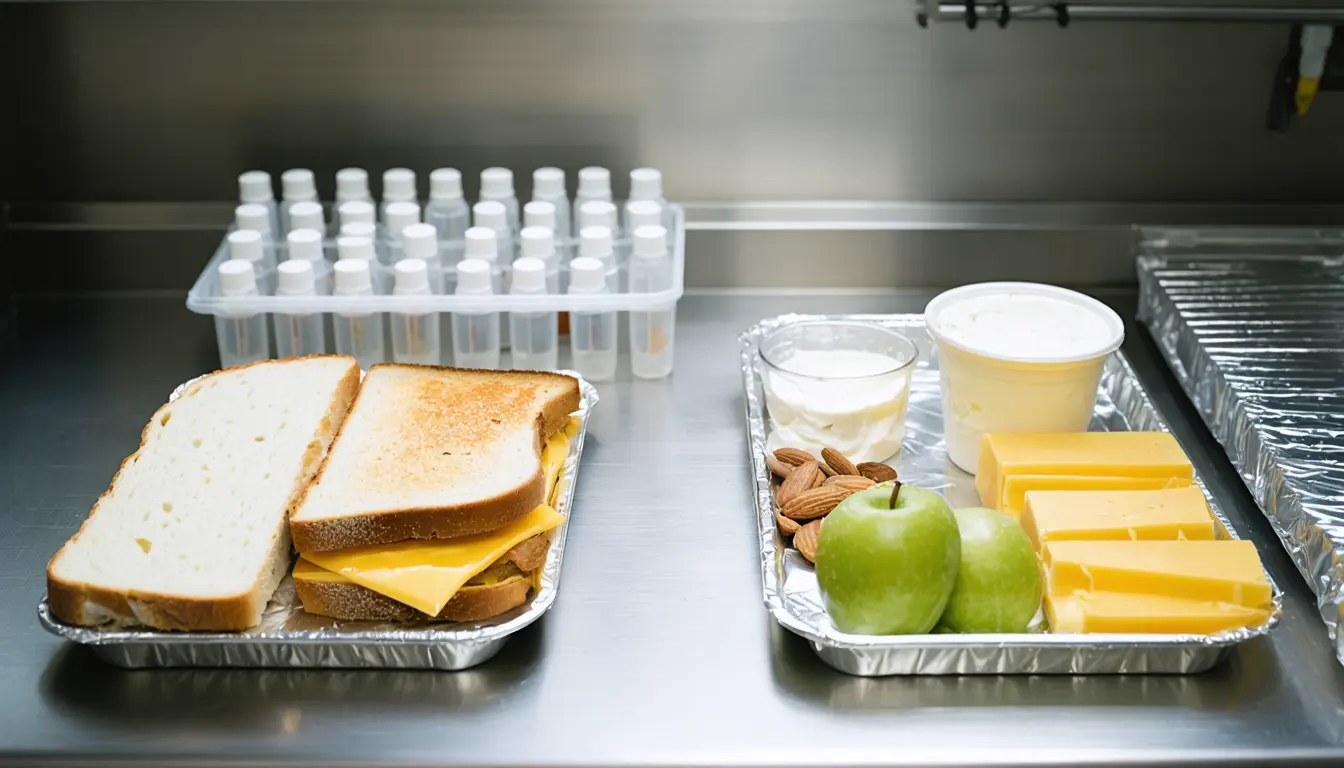
Her team's answer was a pair of plates that look nothing alike. One held deli turkey, instant mashed potatoes, a chocolate chip cookie, frosted wheat cereal, veggie chips and a small peanut butter and jelly sandwich on white bread [6]. The other held a hard-boiled egg, a banana, cranberries, cheese and sea salt [7]. "The two meals are matched within 1 percent of carbs, fat, proteins, calories, water, and salt," said Zach Hutelin, the study's first author [9]. "If these meals had a nutritional label, they would be practically identical." [10] Because each person ate both, their response to one plate is set against their own response to the other, so differences between people drop out of the comparison [5].
The thing this doesn't tell you is which difference between the plates produced the effect. Hutelin's matching list names carbohydrate as a whole, while DiFeliceantonio's list of things to hold constant also named sugar and fiber [9][11]. The ingredients differ too: cookie and frosted cereal on one side, egg and fruit on the other [6][7]. We think the cleaner test would process the same ingredients two ways. As run, the study compares two particular meals that differ in more than their processing.
ScienceAlert's account describes the insulin rise as significantly higher and does not give the figures [14]. Hutelin put it more loosely. "What we noticed with the ultra-processed food is that insulin response was much higher and blood sugar stays a little bit higher for a little bit longer," he said [15]. He also said, "We were shocked when every single metabolic metric differed." [2] Those metrics come from a single 300-calorie meal eaten by healthy-weight adults whose average age was 26 [8][4].
The brain-imaging arm is correlational by design. Participants viewed pictures of food in an MRI scanner in a session apart from the meals, and the striatum link was found among those who did both [16]. Of the 57 adults recruited, 25 did not take part in the meal test [18]. The researchers suggest that how the body burns fuel may be tied to cues about the food, possibly including how processed it is [17]. The reported result is an association between two measurements and does not show which way any influence runs [16].
For a cause, the team points first to food structure. "These mechanisms might involve altered nutritional availability as a result of altered physical structure in ultra-processed foods," the researchers said in a briefing on the study [20]. Commercial food additives are the other candidate, and the group intends to examine them next [21].
What to watch
- The team's planned study of commercial food additives, the first test of a specific candidate cause for the insulin gap.
- The full Nature Metabolism paper's insulin figures, and whether fiber and sugar were matched alongside total carbohydrate.
- Any version of the test that processes the same ingredients two ways, or repeats the meals over weeks.
Clarity's read
What the record supports and how the coverage leans. The claims behind it follow.
Reality
- Evidence55
- Adoption
- Insufficient
- Hype gap+20
- Incentives
- Insufficient
- Confidence45
Claim ledger
Ranked by verification strength, evidence, and original report placement.
- [1]
The ultra-processed meal triggered a higher metabolic rate and greater fat burning during the three-hour window, but less carbohydrate burning than the minimally processed meal.
- [2]
"We were shocked when every single metabolic metric differed," Hutelin said.
ReportedSupportedSource: Zach Hutelin, via ScienceAlert2 sources— create a free account to open themView cited source - [3]
The study was reported in Nature Metabolism by a team led by Virginia Tech neuroscientist Alex DiFeliceantonio.
- [4]
The researchers recruited 57 healthy-weight adults with an average age of 26 years.
- [5]
Of the 57 recruits, 32 took part in an eating experiment in which they ate two separate meals on two separate days, in a randomized order.
- [6]
The ultra-processed meal included deli turkey, instant mashed potatoes, a chocolate chip cookie, frosted wheat cereal, veggie chips, a small white-bread peanut butter and jelly sandwich, and a small serving of water.
- [7]
The minimally processed meal included a hard-boiled egg, banana, cranberries, cheese and some sea salt.
- [8]
The two meals were matched for nutritional composition and energy, at 300 calories each.
- [9]
"The two meals are matched within 1 percent of carbs, fat, proteins, calories, water, and salt," said Zach Hutelin, Virginia Tech biomedical researcher and the study's first author.
- [10]
"If these meals had a nutritional label, they would be practically identical." (Zach Hutelin)
- [11]
"We know that the majority of ultra-processed foods are high in fat, they're high in sugar, they're low in fiber, and they're low in protein," said Alex DiFeliceantonio.
- [12]
"But if we artificially hold all of those things constant, is there something about the processing that leads to a different outcome?" (Alex DiFeliceantonio)
- [13]
Blood samples taken over the three hours after each meal showed generally similar blood glucose responses, though glucose remained elevated for longer after the ultra-processed meal.
- [14]
Insulin rose significantly higher after the ultra-processed meal and stayed higher for about two hours; both meals returned to near-baseline levels by the three-hour mark.
- [15]
"What we noticed with the ultra-processed food is that insulin response was much higher and blood sugar stays a little bit higher for a little bit longer." (Zach Hutelin)
- [16]
In a separate experiment, participants viewed pictures of ultra-processed and non-ultra-processed foods under functional MRI; among those who also did the meal phase, striatum activity was associated with how they burned carbohydrates in the meal session.
- [17]
The researchers suggest the way the body burns food for fuel could be linked to specific cues about the foods being eaten, and possibly their level of processing.
- [18]
25 of the 57 recruited adults did not take part in the meal-eating experiment.
- [19]
"Collectively, our findings support the hypothesis that food processing might influence metabolic responses and reward processing through mechanisms extending beyond caloric content and macronutrient composition," the researchers said in a briefing.
- [20]
"These mechanisms might involve altered nutritional availability as a result of altered physical structure in ultra-processed foods," the researchers said in a briefing.
- [21]
Another possibility is that commercial food additives in ultra-processed foods affect the metabolic response; the researchers intend to examine this next.
Sources
1 independent publisher whose own reporting we read for this story.
- sciencealert.comScientists Gave People 2 Nearly Identical Meals. One Triggered Much More Insulin.
1 article · October 11, 2026
Topics and entities
Follow any of these and your For You feed starts watching them — no settings page required.
Entities
- Virginia TechFollow
- Zach HutelinFollow
- Nature MetabolismFollow
- Alex DiFeliceantonioFollow