LeadershipNot yet confirmed elsewhere1 publisher2 min readPublished
Third Army Corps credits massed artillery for holding 176 sq km retaken near Lyman
Ukraine's Third Army Corps says it retook 176 sq km near Lyman and held it with "one of the largest artillery formations of any corps." Both figures trace to the unit, and no source splits the credit between drones and guns.
The Board Room · Leadership desk
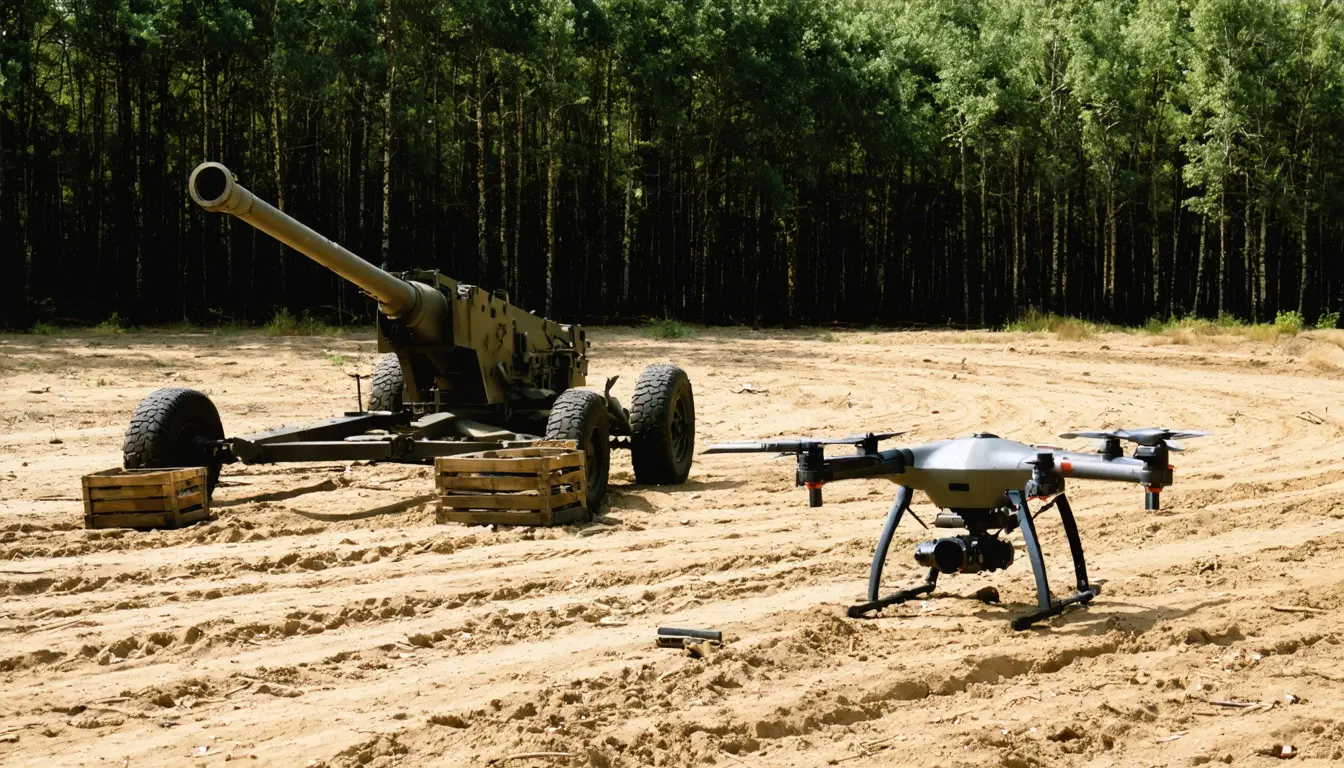
Key figures: around 95% of Russia's front-line losses came from drones, Mykhailo Fedorov said in July; about 5% came from all other causes, artillery included; the Third Army Corps says 176 square kilometers were recaptured near Lyman by the end of September.
| Figure | Value | Note | Claim |
|---|---|---|---|
| Drone share of Russia's front-line losses, around | 95% | Mykhailo Fedorov, in July | 7 |
| Other causes, artillery included, about | 5% | if drones account for around 95% | 15 |
| Recaptured near Lyman by end of September | 176 sq km | per the Third Army Corps, lead unit | 1 |
What happened
- The Institute for the Study of War wrote on Friday that Ukrainian forces "heavily relied on artillery strikes in order to prevent Russian forces from regaining lost positions during Operation Vivaldi."
- Drones found the targets and artillery destroyed them, the Third Army Corps said, so the two arms worked as one system.
- The unit said HIMARS strikes destroyed more than 20 artillery guns and two Buk air defense systems, and hit Russian command posts at battalion level or higher.
- The Third Army Corps also said last month that it air-deployed explosive-laden ground robots behind Russian lines, and claimed to be the first in the world to do so.
Why it matters
- constraint A drone share of around 95% of Russian losses cannot size an artillery budget, because loss share measures destruction and the Third Army Corps credits its guns with a different job: keeping Russian reserves from returning.
- cost Keeping fire going after guns are lost takes more guns than the front strictly requires. A budget built around drones alone does not pay for that surplus.
- decision Anyone trading artillery money for drone money this quarter has to account for Vivaldi, where on the unit's telling the two were used together. If outside tallies bear the account out, next quarter's review inherits the same trade-off with firmer evidence.
The unit's account concerns holding ground. It said the 52nd Separate Artillery Brigade and the rocket artillery units of multiple brigades kept multiple settlements under fire [11], and that "Russian forces could not bring up reserves, equipment, or ammunition to try to restore their lost positions" [12]. In the same update it said the artillery "deprived the enemy of the ability to maneuver or return fire, allowing the Third Corps' assault troops to keep pushing forward" [10].
A July statistic from Ukraine's then defense minister sits awkwardly beside this. Mykhailo Fedorov said drones accounted for around 95% of Russia's front-line losses [7]. If so, about 5% came from everything else, artillery included [15].
The Vivaldi evidence runs largely through the unit itself. The 176 square kilometers is the Third Army Corps' own tally [1], and the Institute for the Study of War assessment cited a Third Army Corps update [8], so at least part of the think tank's support comes from the unit. The unit did not say how many systems per kilometer it fielded.
Outside analysts reach a similar view on general grounds. RAND wrote last month that strike drones "cannot independently solve every tactical problem," and that heavy artillery has remained indispensable against hardened, protected infrastructure [2]. Ben Jarvis, the UK's minister of state for security, said in June that "there are some who hold the view that we should trade everything in the locker for drones. I understand the temptation, but there are important distinctions to make" [3]. Vivaldi is a worked example for his side of that argument.
The trade-off is a budget line. Money for drones and robots competes with money for guns and for the surplus of guns the unit says it fielded. We think the Vivaldi account supports funding the holding job separately from the finding job, and the evidence supports no more than that. Kyiv's own direction is consistent with it: Ukraine's commander-in-chief announced plans in June to modernize the artillery forces [4]. A buyer deciding this quarter can fund both on this evidence. How much goes to each would have to come from independent accounts of the operation.
What to watch
- Whether the Third Army Corps or an independent analyst publishes the number of systems per kilometer, or an apportionment of the 176 sq km between drones and artillery.
- Whether Russian forces mount counterattacks near Lyman that test if the retaken positions stay held.
- Whether the artillery modernization Ukraine's commander-in-chief announced in June names specific new systems or funding.
Clarity's read
What the record supports and how the coverage leans. The claims behind it follow.
Reality
- Evidence30
- Adoption
- Insufficient
- Hype gap+25
- Incentives60
- Confidence50
Claim ledger
Ranked by verification strength, evidence, and original report placement.
- [1]
Operation Vivaldi is unfolding near the city of Lyman; Ukrainian forces had recaptured 176 square kilometers of territory by the end of September, according to the Third Army Corps, the lead unit.
- [2]
RAND analysis published last month said that while strike drones offer operational agility, they "cannot independently solve every tactical problem"; heavy artillery has remained indispensable against hardened, protected infrastructure, the authors wrote.
- [3]
Ben Jarvis, the UK's minister of state for security, said in June that "there are some who hold the view that we should trade everything in the locker for drones. I understand the temptation, but there are important distinctions to make."
- [4]
In June, Ukraine's commander-in-chief announced plans to modernize the artillery forces, describing artillery as one of the main tools on the modern battlefield; Ukraine is developing multiple new artillery systems.
- [5]
The Institute for the Study of War wrote on Friday that reports indicate Ukrainian forces "heavily relied on artillery strikes in order to prevent Russian forces from regaining lost positions during Operation Vivaldi."
ReportedContestedSource: Institute for the Study of War2 sources— create a free account to open themView cited source - [6]
The Third Army Corps said it had assembled one of the largest artillery formations of any corps, deploying so many systems per kilometer of the front that fire could be maintained continuously, even if individual guns were knocked out.
ReportedContestedSource: Third Army Corps update, cited by ISW2 sources— create a free account to open themView cited source - [7]
In July, Mykhailo Fedorov, then Ukraine's defense minister, said that drones accounted for around 95% of Russia's front-line losses.
ReportedContestedSource: Mykhailo Fedorov2 sources— create a free account to open themView cited source - [8]
The ISW assessment cited an update from the Third Army Corps about the artillery formation assembled for the operation.
ReportedContestedSource: Business Insider describing the ISW assessment2 sources— create a free account to open themView cited source - [9]
Drones worked with artillery to find targets that the artillery then destroyed, the Third Army Corps said.
- [10]
The unit said: "The artillery deprived the enemy of the ability to maneuver or return fire, allowing the Third Corps' assault troops to keep pushing forward."
- [11]
The Third Army Corps said the 52nd Separate Artillery Brigade and the rocket artillery units of multiple brigades were able to keep multiple settlements under fire.
- [12]
The unit said: "Russian forces could not bring up reserves, equipment, or ammunition to try to restore their lost positions."
- [13]
The Third Army Corps said strikes by Ukrainian HIMARS destroyed more than 20 artillery guns, two Buk air defense systems, and two transport-loading vehicles, and also struck Russian command posts at battalion level or higher.
- [14]
The Third Army Corps said last month that it was using aerial drones to drop explosive-laden robots behind Russian lines, saying it was the first in the world to begin air-deploying ground robotic systems.
- [15]
If drones account for around 95% of Russia's front-line losses, about 5% came from all other causes, artillery included.
Sources
1 independent publisher whose own reporting we read for this story.
- businessinsider.comUkraine's Operation Vivaldi shows why artillery still matters in a drone fight
1 article · October 13, 2026
Topics and entities
Follow any of these and your For You feed starts watching them — no settings page required.
Topics
- Artillery warfareFollow
- Drone warfareFollow
- Russia-Ukraine WarFollow
Entities
- Third Army CorpsFollow
- Operation VivaldiFollow
- Institute for the Study of WarFollow
- RAND CorporationFollow
- HIMARSFollow
- Mykhailo FedorovFollow
- Ben JarvisFollow