Ultra Ethernet Consortium releases UEC 1.1 with a scale-up profile and in-network collectives
Ultra Ethernet Consortium released UEC 1.1 on October 12, adding scale-up support, in-network collectives and programmable congestion control. It gives teams planning AI fabrics a published feature list to check vendors against.
The Watch · Security desk
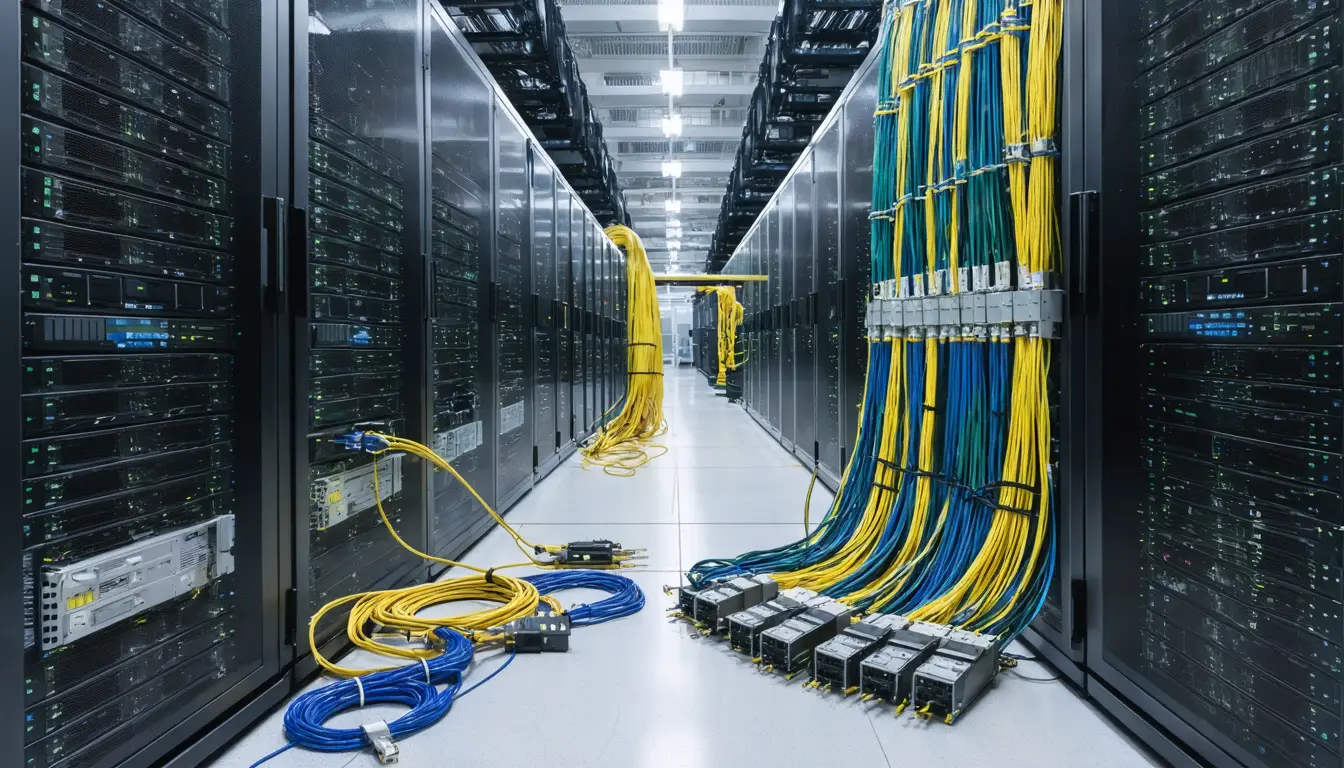
The 20-byte IPv4 header is about 30 percent of the 66 bytes of standard Ethernet overhead with IPv4 and UDP, before any transport header or payload. The optional UFH replaces the separate IP header and carries addressing in the existing 12-byte Ethernet MAC header.
| Figure | Value | Note | Claim |
|---|---|---|---|
| IPv4 header's share of standard Ethernet overhead | 30% about | 21 | |
| Standard Ethernet overhead, IPv4 and UDP | 66 bytes | before any transport header or payload | 7 |
| Existing Ethernet MAC header | 12 bytes | carries addressing under optional UFH | 6 |
What happened
- The new Unified Local profile covers short-range links between accelerators, which often use one tier of switches or none.
- The optional Unified Forwarding Header drops the separate IP header and carries addressing in the existing 12-byte Ethernet MAC header.
- Congestion Signaling adds a 4-byte or 8-byte tag to packets that every switch on the path can update.
- Programmable Congestion Management runs congestion control and load balancing algorithms as programs loaded onto the endpoint.
- UEC is working with the Open Compute Project to bring the scale-up technologies into the next version of its ESUN specification.
Why it matters
- What it limits constraint The Local profile is designed for a lossless fabric built with priority flow control or credit-based flow control, so a scale-up design needs one of the two to use it.
- Who has to decide decision INC and CSIG need switches to do new work and PCM needs endpoints that load programs, so a vendor comparison splits into switch questions and NIC questions.
- What's now possible capability Operators can update congestion control and load balancing as AI workloads change, where the 1.0 algorithm was fixed in the NIC.
In scale-up traffic the messages are small and the packet rates are high, so the overhead carried on each packet counts [18]. Over IPv4 and UDP, a standard Ethernet frame spends 66 bytes on overhead before any transport header or payload [7]. The IPv4 header that the Unified Forwarding Header replaces is 20 of those bytes [8], about 30 percent [21]. Idle reduction adds a smaller cut: the average minimum frame spacing falls from 84 bytes to a constant 80, 4 bytes between frames [9][22]. Tom Emmons, chair of the UEC Technical Advisory Committee, told Network World the release adds "a simplified transport protocol appropriate for scale-up networks, along with a number of options to improve packet efficiency" [19].
The congestion changes start from a thin signal. ECN carries one bit. It signals that some queue along the path is filling up, without saying which one or how full it is [13]. The CSIG tag carries a single value, for example the maximum queueing delay or the minimum available bandwidth recorded up to that hop, and the receiver returns it to the sender in an acknowledgment [12]. UEC's two baseline algorithms, NSCC and RCCC, remain and can use CSIG signals [16]. INC also puts work on switches: they perform reduction operations such as allreduce for a group of endpoints [10].
UEC 1.0, published in June 2025, defined a transport protocol, congestion control mechanisms and a modern RDMA approach [2]. Version 1.1 builds on that base, and its RDMA verbs extensions expose the Ultra Ethernet transport to applications [20].
Network World's account does not say which vendors have switches or NICs that implement any of the 1.1 features. We think the spec can shape a request for proposals today and cannot yet rank shipped hardware.
What to watch
- Vendor statements of UEC 1.1 support: switch silicon for INC and CSIG, and NICs that load PCM programs.
- The next ESUN release from OCP, and whether it carries the Local profile, the Unified Forwarding Header and idle reduction.
- Any measured results for the Unified Forwarding Header and idle reduction on real scale-up traffic.
Clarity's read
What the record supports and how the coverage leans. The claims behind it follow.
Reality
- Evidence50
- Adoption
- Insufficient
- Hype gap−5
- Incentives
- Insufficient
- Confidence60
Claim ledger
Ranked by verification strength, evidence, and original report placement.
- [1]
The Ultra Ethernet Consortium released UEC 1.1 on October 12.
- [2]
The UEC published its 1.0 specification in June 2025; it defined a transport protocol, congestion control mechanisms and a modern RDMA approach.
- [3]
UEC 1.1 adds scale-up support, in-network collectives and programmable congestion control.
- [4]
The Unified Local profile covers short-range interconnects between accelerators, which often use one tier of switches or none.
- [5]
The Unified Local profile is designed for a lossless fabric built with priority flow control (PFC) or credit-based flow control (CBFC).
- [6]
The optional Unified Forwarding Header (UFH) replaces the separate IP header and carries addressing in the existing 12-byte Ethernet MAC header.
- [7]
A standard Ethernet frame carrying IPv4 and UDP data has 66 bytes of overhead before any transport header or payload.
- [8]
A standard IPv4 header uses 20 bytes.
- [9]
Optional idle reduction shrinks the required gap between frames: minimum frame spacing falls from an 84-byte average to a constant 80 bytes.
- [10]
With in-network collectives (INC), switches perform reduction operations such as allreduce for a group of endpoints.
- [11]
Congestion Signaling (CSIG) adds a 4-byte or 8-byte tag to packets, and every switch on the path can update it.
- [12]
The CSIG tag holds one value, such as the longest queueing delay or the least available bandwidth seen so far, and the receiver returns the value to the sender in an acknowledgment.
- [13]
An explicit congestion notification (ECN) mark is a single bit; it says a queue somewhere on the path is filling, but not where or by how much.
- [14]
In UEC 1.0 the algorithm that reacts to the congestion signal is fixed in the NIC and cannot be updated as AI workloads change.
- [15]
Programmable Congestion Management (PCM) runs congestion control and load balancing algorithms as programs loaded onto the endpoint.
- [16]
UEC's two baseline algorithms, Network Signal-based Congestion Control (NSCC) and Receiver-Credit Congestion Control (RCCC), remain and can use CSIG signals.
- [17]
UEC is working with the Open Compute Project (OCP) to bring its scale-up technologies into the next version of the Ethernet for Scale-up Networking (ESUN) specification.
- [18]
Scale-up traffic consists of small messages at high packet rates, so per-packet overhead matters.
- [19]
Tom Emmons, Chair of the UEC Technical Advisory Committee, told Network World that UEC 1.1 includes "a simplified transport protocol appropriate for scale-up networks, along with a number of options to improve packet efficiency."
- [20]
UEC 1.1 includes extensions to the RDMA verbs programming interface that expose Ultra Ethernet transport to applications.
- [21]
The 20-byte IPv4 header is about 30 percent of the 66 bytes of standard Ethernet overhead.
- [22]
Idle reduction cuts the minimum frame spacing by 4 bytes.
Get this ledger inside ChatGPT. Ask about any of our stories and the answer brings its figure, each claim’s verdict and the sources. Free, no account.
Sources
1 independent publisher whose own reporting we read for this story.
Topics and entities
Follow any of these and your For You feed starts watching them — no settings page required.
Entities
- Ultra Ethernet ConsortiumFollow
- Open Compute ProjectFollow
- Tom EmmonsFollow
- Network WorldFollow