ProductIndependently confirmed3 publishers2 min readPublished
Nvidia hands the Open Compute Project its Vera Rubin rack and compute tray designs
Nvidia contributed its Vera Rubin rack and compute tray designs to the Open Compute Project at the project's Global Summit in San Jose. Nvidia says builders get common blueprints for racks, networking, power and cooling; the benchmark figures released alongside are its own.
The Product Desk
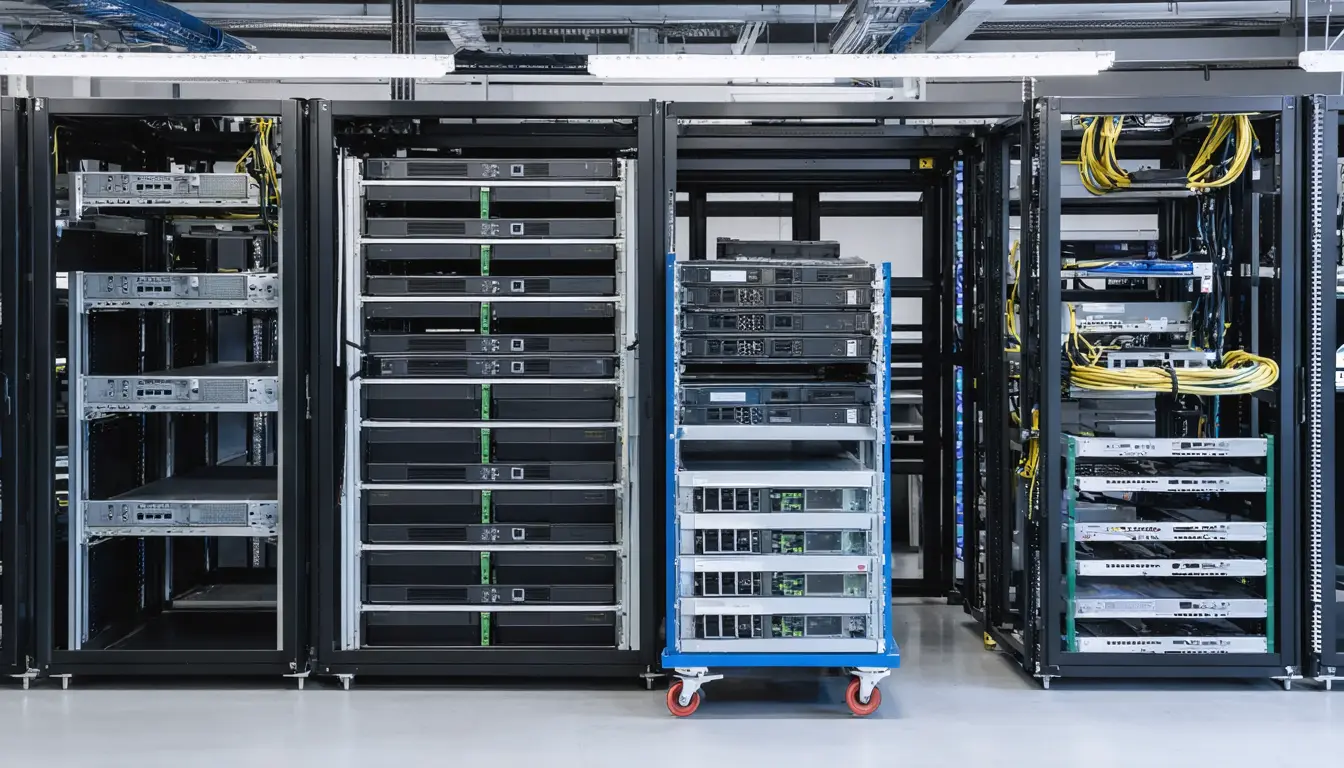
Key figures: Vera CPUs 1.8 times the previous Grace generation on Terminal-Bench, per Nvidia; Spectrum-6 Ethernet switching chip, 102.4 terabits per second; USFP designed for future 400-gigabit-per-second-per-lane fabrics; USFP power efficiency gain 1.3 times, per Nvidia.
| Figure | Value | Note | Claim |
|---|---|---|---|
| Vera CPU vs Grace on Terminal-Bench, Nvidia's claim | 1.8 times | 16 | |
| Spectrum-6 switch chip | 102.4 Tbps | 11 | |
| USFP future lane target | 400 Gbps per lane | 13 | |
| USFP power efficiency | 1.3 x, Nvidia claim | 14 |
What happened
- MGX 1.2 supplies open components for quickly scaling and bind-mating liquid cooling and rack-level interconnect on high-power AI systems.
- Nvidia claims Vera CPUs run about twice as fast as the Grace generation on several workloads, and 1.8 times as fast on Terminal-Bench, a test of agent tasks in code containers.
- Meta is adopting Nvidia's Spectrum-6 Ethernet switch for its next-generation AI factory network, connected directly to Vera Rubin deployments.
- Nvidia will support Google's Falcon Transport in Spectrum-X Ethernet, starting with future ConnectX-10 SuperNICs and later BlueField hardware.
- Nvidia and Cisco are defining the USFP optical module, with four times the bandwidth density of 200G OSFP and, by Nvidia's claim, 1.3 times the power efficiency.
Why it matters
- constraint Shared rack interfaces do not open the network side. Meta's Spectrum-6, Falcon support in Spectrum-X and the USFP module are Nvidia products or Nvidia-led specifications, so dependence on Nvidia stays in the network layer.
- decision Teams planning Vera Rubin builds have to choose between designing around MGX 1.2 power and I/O bay interfaces and keeping their own layouts. Nvidia's case for the first is easier field installation.
- exposure A buyer sizing agent-orchestration CPU capacity on Vera is working from Nvidia's own 2x and 1.8x claims until someone else runs the same tests.
The first person to feel MGX 1.2 is the installer on the loading dock, standing next to a liquid-cooled rack that has to be plumbed and powered. For that person, Nvidia's offer is modularity. SiliconANGLE reports that MGX 1.2 adds standardized power and fanless, liquid-cooled I/O bays, changes it says can simplify both manufacturing and installation in the field [5].
The pitch is speed. Joe DeLaere, whom SiliconANGLE identifies as AI Infrastructure Solutions Lead, said: "The real bottleneck for the industry right now is how fast the world can manufacture and deploy AI factories" [8]. The thing delivered is a set of designs and components, and SiliconANGLE's account does not say what license applies or when parts ship.
The rack also has a CPU story. SiliconANGLE describes CPUs as the orchestrators that do most of the behind-the-scenes work while GPUs do the parallel execution [9]. DeLaere put the agent case this way: "Between model calls, agents need to do orchestration" [7].
Across the partnerships, SiliconANGLE writes, Nvidia is seeking to become the backbone for networking as well as supply the blueprints [15]. Spectrum-6, the switch chip Meta is adopting, is a 102.4 terabit-per-second part [11].
That mix of open and Nvidia-owned pieces is why we'd sort any Vera Rubin rack line item before talking price. One axis asks whether the interface is published in the open project or sits inside an Nvidia product or an Nvidia-led specification such as USFP [13]. The other asks whether the part gates install day.
Published and gating (the liquid-cooling connections, power and I/O bays, if they are as described): we'd ask for the designs and fit-test a sample before committing. Published and not gating: buy on price. Nvidia-only and gating: write delivery dates and a fallback into the contract. Nvidia-only and not gating: treat it as an ordinary vendor choice and decide later.
Most of the effort belongs in the first box. The tradeoff is that the box is only as good as the contribution package, so the first task is to read what was actually published.
What to watch
- What the Open Compute Project actually publishes for Vera Rubin: the license, the drawings and the test specifications third-party builders can use.
- Independent results for Vera against Grace, especially the 1.8x Terminal-Bench figure Nvidia supplied.
- Dates for ConnectX-10 SuperNICs with Falcon support and for a finished USFP specification.
Clarity's read
What the record supports and how the coverage leans. The claims behind it follow.
Reality
- Evidence50
- Adoption20
- Hype gap+20
- Incentives75
- Confidence62
Perspective Coverage
3 publishers- Builder
- Builder 38%
- Operator
- Operator 35%
- Investor
- Investor 27%
Claim ledger
Ranked by verification strength, evidence, and original report placement.
- [1]
Nvidia announced new partnerships and contributions to the open-source community at the Open Compute Project Global Summit in San Jose.
- [2]
Nvidia contributed key Vera Rubin rack and compute tray designs to the Open Compute Project through the Nvidia MGX architecture.
- [3]
The contribution will give system builders common blueprints for AI factories to develop future rack layouts, networking design, power and cooling systems.
- [4]
Through MGX 1.2, Nvidia is providing open components that let engineers quickly scale and bind-mate liquid cooling and interoperable, rack-level interconnect infrastructure for high-power AI systems.
- [5]
MGX 1.2 adds modularity for liquid-cooled fanless I/O bays and standardized power, making it possible to streamline manufacturing and field installation.
- [6]
The racks feature the Vera CPU rack design and extend the Nvidia MGX architecture beyond accelerated computing to handle intense agentic AI tasks.
- [7]
"Between model calls, agents need to do orchestration," DeLaere said.
ReportedSupportedSource: Joe DeLaere, quoted by SiliconANGLE3 sources— create a free account to open themView cited source - [8]
"The real bottleneck for the industry right now is how fast the world can manufacture and deploy AI factories," AI Infrastructure Solutions Lead Joe DeLaere said.
ReportedSupportedSource: Joe DeLaere, AI Infrastructure Solutions Lead, quoted by SiliconANGLE2 sources— create a free account to open themView cited source - [9]
CPUs are the orchestrators that do most of the behind-the-scenes work in deployed AI systems, while the GPUs do the parallel execution for the AI work.
- [10]
Meta is adopting the Nvidia Spectrum-6 Ethernet switch for its next-generation AI factory network, which will connect directly to Vera Rubin deployments.
- [11]
Spectrum-6 is Nvidia's 102.4 terabit-per-second Ethernet switching chip.
- [12]
Nvidia is adding support for Google's Falcon Transport to its Spectrum-X Ethernet networking ecosystem, beginning with the future ConnectX-10 SuperNICs, with the roadmap extending to BlueField hardware.
- [13]
Nvidia and Cisco are jointly defining a new optical module format, the Ultra-dense Small Form Factor Pluggable (USFP), designed to support future 400-gigabit-per-second-per-lane networking fabrics.
- [14]
The USFP design will offer four times the bandwidth density of the existing 200G OSFP form factor, and Nvidia is claiming a 1.3-times improvement in power efficiency.
ReportedSupportedSource: SiliconANGLE; efficiency figure is Nvidia's claim2 sources— create a free account to open themView cited source - [15]
Across these partnerships, Nvidia is seeking to build out not just the CPU-scale for AI factory blueprints but also become the backbone for networking.
ReportedSupportedSource: SiliconANGLE's characterization2 sources— create a free account to open themView cited source - [16]
Nvidia claims its Vera CPUs deliver around twice the performance of its previous Grace generation on several workload benchmarks, and a 1.8-times improvement on Terminal-Bench, which measures practical agent tasks involving code containers.
Sources
3 independent publishers whose own reporting we read for this story.
- datacenterdynamics.comNvidia opens up Vera Rubin rack and tray designs to OCP
1 article · October 12, 2026
- nvidianews.nvidia.comOCP Global Summit: Amid Ecosystem Adoption, NVIDIA Opens Vera Rubin Architecture to Help Scale AI Factories Worldwide
1 article · October 12, 2026
- siliconangle.comNvidia tackles AI factory scaling bottlenecks with open rack designs and networking advances
1 article · October 12, 2026
Topics and entities
Follow any of these and your For You feed starts watching them — no settings page required.
Topics
- Open Compute ProjectFollow
- AI Data Center InfrastructureFollow
- Agentic AI computeFollow
- Data Center NetworkingFollow
- Direct-to-Chip Liquid CoolingFollow
Entities
- GoogleFollow
- Nvidia Vera CPUFollow
- Cisco SystemsFollow
- NvidiaFollow
- Meta PlatformsFollow
- Vera RubinFollow
- NVIDIA MGXFollow
- Joe DeLaereFollow
- Open Compute ProjectFollow