Science1 publisher3 min readPublished
Quantinuum's 98-qubit Helios lands on schedule, and the question moves to shuttling
The trapped-ion roadmap has now delivered 32, 56 and 98 qubits in consecutive generations. What matters next is whether ion transport through junctions keeps scaling.
The Scientist · Science desk
Drafted by a language model from the sources cited here and checked against its claim ledger before publication. How we use AISend a correction
What happened
- Helios is a trapped-ion quantum computer, meaning it uses charged atoms suspended in free space by electromagnetic fields.
- Helios operates using 98 qubits, which makes it the largest trapped-ion quantum computer built so far.
- Quantinuum, the company behind Helios, is based in Cambridge, UK and Broomfield, Colorado.
- Quantinuum demonstrated earlier machines operating on 32 qubits in 2023 and 56 qubits in 2025.
- The generation-over-generation qubit growth is 1.75x twice in a row (56/32 = 1.75; 98/56 = 1.75), and 3.06x from 32 to 98.
Compiled by The ScientistSomething wrong?How this is made
Why it matters
Quantinuum has built Helios, a 98-qubit trapped-ion machine that the phys.org account describes as the largest of its type constructed so far [1][2]. The headline number is less interesting than the cadence behind it: the same company demonstrated 32 qubits in 2023 and 56 in 2025, which works out to 1.75 times per generation, twice consecutively, and 3.06 times over the span [4][5].
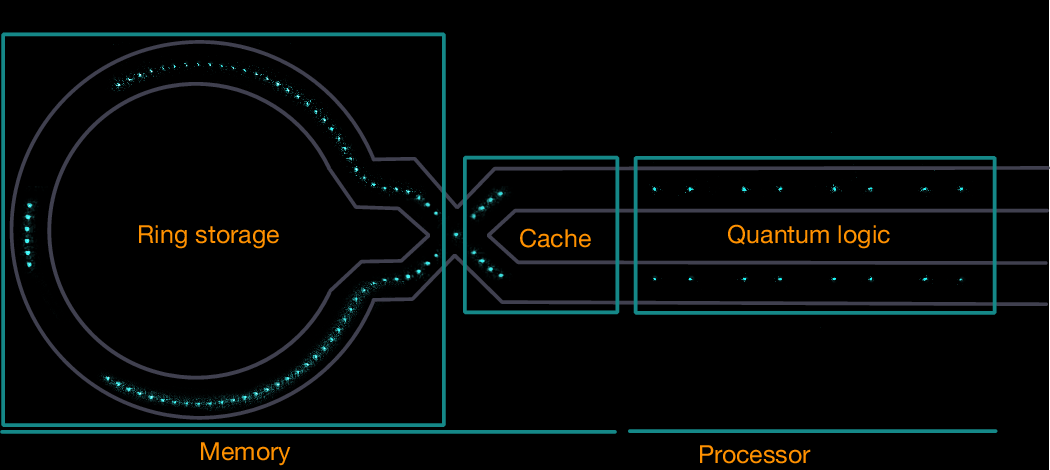
Compounding on a published schedule is the rarest thing in this sector, and it is worth understanding what is actually compounding. Helios and its predecessors use a QCCD, or quantum charge-coupled device, an architecture invented in 2002 that splits storage from processing much as a classical machine splits drives from a CPU [6]. Ions are physically transported by electric fields from the storage region to the processing region, where laser pulses execute the gates [8]. Helios is laid out like a rosette: a storage ring, two processing streamers, and a four-way X junction where they meet [7]. This is the opposite of the superconducting approach, where qubits sit still and control signals move in time [9].
The architecture buys three things, according to the same account: gates that do not disturb neighbouring qubits, which suppresses crosstalk; mid-circuit measurement and reset, so errors can be caught early; and connectivity between distant qubits, since ions can be fetched from and returned to different parts of memory within limits [10][11][12]. Helios is reported to demonstrate all three [13].
Two changes made that possible. The X junction lets the machine move several things at once, where earlier QCCD systems could only shuttle data along a single line or loop [14]. Exploiting that second dimension required new classical control software, called Helios runtime, which plans the routing [15]. That is the load-bearing detail for anyone evaluating vendors. Qubit count in a QCCD is downstream of how many ions you can keep in motion, through how many junctions, under a scheduler that does not stall. A roadmap that has hit 1.75 times twice is a claim about transport engineering and compilation, not about trap fabrication alone.
The performance claim needs the caveat attached. The write-up says Helios can run computations that no existing supercomputer can reproduce by known methods within reasonable time and power [16], and then notes that the computations to date have been random benchmark tests, so the practical significance remains limited [17]. Both statements come from the same source, and the second is the one an operator should price in.
Distance to usefulness: the article puts even optimistic estimates for commercially and scientifically meaningful quantum computation at the order of a million qubits [18]. Going from 98 to a million is a factor of about 10,200; at 1.75 times per generation that is roughly 17 more generations, and at one generation every two years, on the pace from 2023 to 2025, about 34 years [20]. The UK National Quantum Strategy's Mission 1 targets a fault-tolerant machine capable of a trillion operations [19].
What to watch: whether the next machine adds junctions rather than simply more ions per existing junction; whether the runtime's scheduling overhead grows faster than qubit count; and whether the demonstrations move off random circuits. If the fourth generation lands at roughly 170 qubits with a second junction, the compounding argument holds. If it lands with the same rosette and more ions, transport is the ceiling.