Science1 publisher3 min readPublished
Researchers argue two Etruscan painted tombs were staged for sound and sight
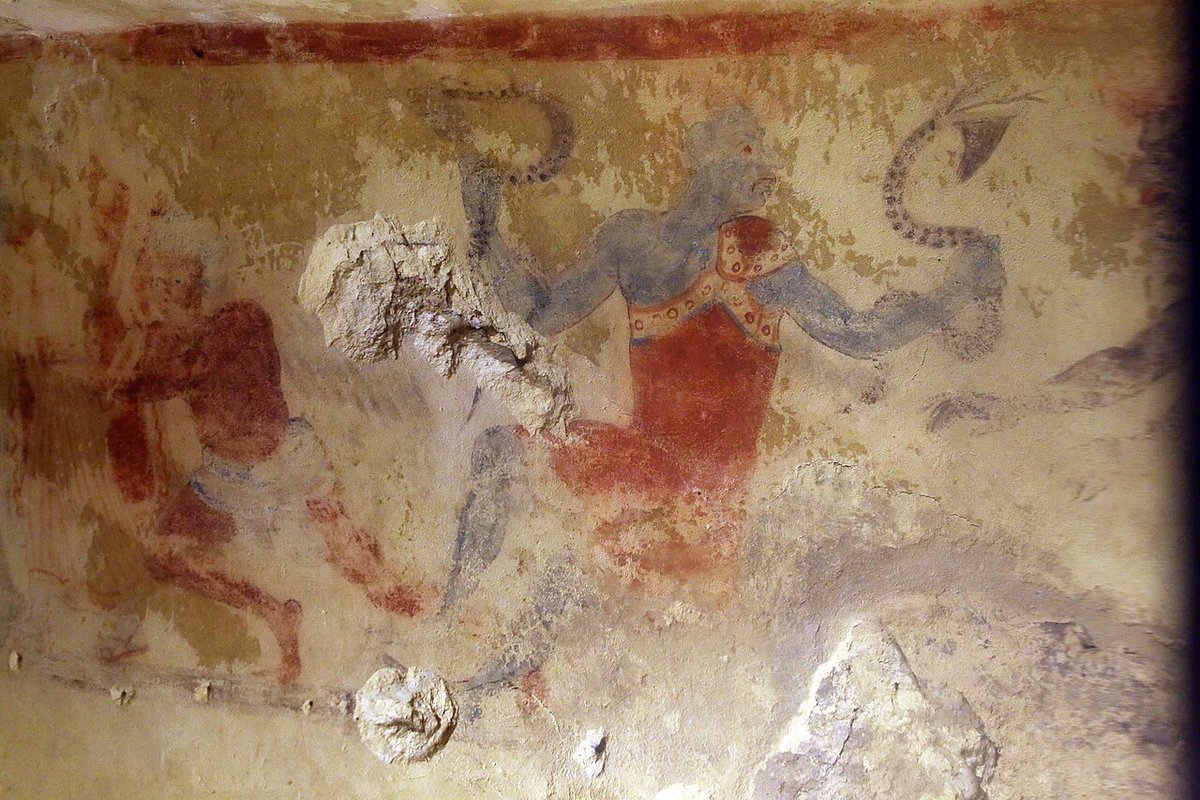
Researchers say two 5th-century BC Etruscan tombs were built as immersive sensory spaces, citing exceptionally long echoes in one of them. Their own account leaves open whether the sound was designed or simply came with the room.
The Scientist · Science desk
Drafted by a language model from the sources cited here and checked against its claim ledger before publication. How we use AISend a correction
What happened
- The researchers studied two chambers: the Tomb of the Blue Demons, known in Italian as Tomba dei Demoni Azzurri, and the Tomb of the Rooster, known as Tomba del Gallo.
- Their reconstructions support the view that some painted tombs were reused for family rituals and may have stayed open through the year.
- Findings appear in an account the researchers wrote themselves, published by Scientific American.
Compiled by The ScientistSomething wrong?How this is made
Why it matters
- constraint Sound is the reported effect in only one of the two tombs, so any wider claim that pre-Roman architects designed for acoustics needs many more chambers measured.
- constraint Present-day visits under LED light, including the authors' own, are weak evidence for what candle-lit ancient mourners saw and heard inside these rooms.
- capability Applying the same acoustic and AI methods to other painted tombs would give the comparison set needed to tell designed acoustics from incidental echo.
The published acoustic evidence for the claim is a description. The authors report "exceptionally long reverberation and echoes inside the Blue Demon tomb" [5]. Their account does not give reverberation times or say what the AI models computed, so the size of the effect cannot be checked from it [14].
The long echoes also make the design argument hard. Any small underground room with hard surfaces tends to ring, whether or not its builders cared about sound. Showing intent needs a control: chambers of similar size and stone left unpainted, or features shaped in ways that digging and burial did not require. Without that comparison, the echo fits a designed room and an accidental one equally well.
The authors build their case for intent from the whole arrangement. In the Tomb of the Rooster, an entrance passage with narrowing walls and a descending axis leads to a chamber with trenches, benches and niches carved into the floor and walls [10]. Visitors would have found their way by beeswax and tallow candles, incense burners and torches [9]. The researchers compare the effect to a modern 3D film [8]. They call their study the first to treat Etruria's underground funerary spaces as "transitional spaces" between life and death [16].
The two tombs make different arguments. By the authors' account, the Blue Demon tomb induces perceptual disorientation, while the Rooster "privileges visual attention and the architectural discipline of gaze" [6]. In my view the evidence supports something narrower than a general rule about pre-Roman architects. These builders cared how a room felt to stand in, and the acoustic effect they report comes from one of the two chambers [1].
There is a strong prior case. Etruscans kept ritual calendars dedicated to recognising natural noises such as thunder, and were early makers of musical instruments in the southern Mediterranean [12]. Painted tombs at Tarquinia, Chiusi and Orvieto are known for scenes of music, feasting and the afterlife [15].
One of the researchers, identified in the article only as Jacqueline, wrote that on her first visit to the Blue Demon tomb the paintings "seemed to confront me wherever I turned" [13]. She also named the limit of that impression. "My experience was, though, shaped by modern LED lighting," she wrote [17].
I think the question is a good one. Rebuilding a room's sound and light as its users met them is the right way to ask what the room did to people. I'd expect the case for deliberate acoustic design to depend on running the same measurements across many more tombs. The Oxford-led Sounds of Silence project has already used new acoustic techniques on the soundscapes around these tombs [3]. Duke's Neuroartifact project adds neuroscience and AI to the question of how artifacts affect cognition [4]. Between them, the comparison is within the team's reach.
What to watch
- A peer-reviewed paper with reverberation times and a description of what the AI models computed, so the size of the Blue Demon effect can be checked.
- Acoustic measurements of comparable unpainted or differently shaped Etruscan chambers, which would act as a control for the deliberate-design claim.
- Whether the Sounds of Silence work extends the analysis to other painted tombs at Tarquinia, Chiusi and Orvieto.