ProductNot yet confirmed elsewhere1 publisher2 min readPublished
Optional disclosure would leave data centre diesel fleets unaccounted, as Northern Virginia shows
Making minor-source disclosure voluntary hands the call to states and hides the permit-splitting that turned Northern Virginia into a 27-gigawatt diesel fleet.
The Product Desk
What happened
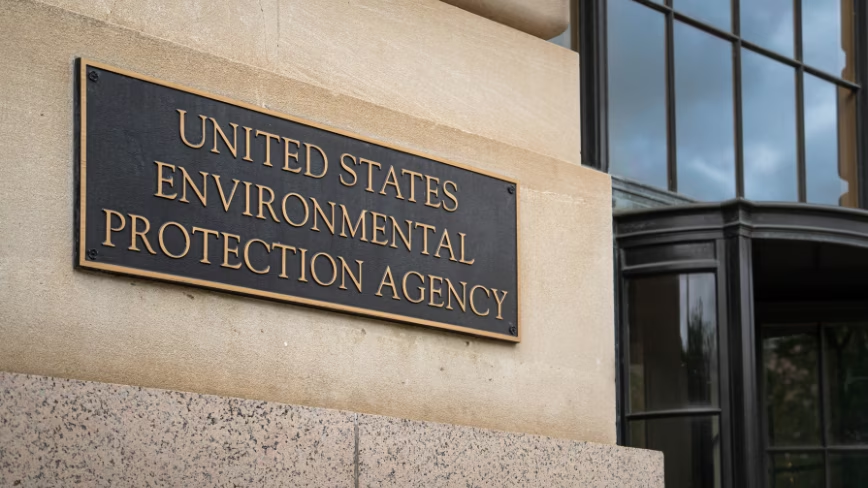
- The EPA has proposed making public disclosure of air pollution from minor sources voluntary, covering the diesel generators around data centres.
- Operators split permits across individual generators so no single unit crosses the threshold that triggers stricter federal review.
- Northern Virginia holds roughly 10,500 diesel generators at data centres, with combined capacity approaching 27 gigawatts.
- Amazon's minor-source permits there allow backup generators to emit up to 4,200 tons of nitrogen oxides a year, per Sierra Club analysis.
- The actions were posted on 8 July, a hearing was held on 22 July, and the comment period closed on 21 August.
Why it matters
- exposure Backup generation is what lets these campuses outrun the grid, and voluntary disclosure removes the main way anyone downwind learns a diesel fleet has arrived.
- constraint Because each small permit is rarely contested when issued, the after-the-fact record is the only tool for totalling a cluster; making it optional forecloses that accounting.
- precedent The rollback extends exemptions the administration already granted data centres this year, so further carve-outs become the expected direction.
Voluntary is the operative word, and it bites for a structural reason. The Clean Air Act currently requires facilities classed as minor polluters to disclose their emissions through state agencies, and the proposal would hand that decision to state and local officials instead [2]. Do the arithmetic on the Northern Virginia fleet and the average generator comes out around 2.6 megawatts [16], small enough on its own that no single permit invites the scrutiny the aggregate would.
Nitrogen oxides are the headline worry because they form ground-level ozone, but the same sites also emit carbon monoxide and heavy metals, and between them produce all six criteria pollutants the EPA ties to asthma, heart disease, and cancer [6]. Without a disclosure duty, a resident cannot establish what is actually in the air, and that record is the first thing any legal challenge or neighbourhood campaign needs [8].
Jeremy Fisher, a senior adviser at the Sierra Club, said the plan "opens the door to silence communities concerned about pollution" [7]. Joe Goffman, a former EPA assistant administrator, framed it as a message to those communities: "you all may have thought this was an ironclad promise, but it no longer is" [9].
The proposal does not arrive alone. It sits with a Clean Air Act resource page the agency has published for data centre developers under administrator Lee Zeldin, whose stated aim is to make the United States the AI capital of the world [11].
Europe restricts data centres on different terms: Brussels has told Big Tech to align with climate goals or stay away, Denmark has paused grid connections, and Spain is drafting rules tying grid access to hourly renewable matching [14]. Its binding constraint has been electricity and water; the American one is local air quality, largely because US sites lean far harder on on-site diesel to cover gaps in the grid [17]. That difference is why the change reaches past the states it names.
What to watch
- Whether the EPA finalises the rule as proposed now that the comment period has closed, or narrows it.
- Whether any state or local agency chooses to keep disclosure mandatory once the federal floor is removed.
- Whether the Sierra Club or others mount a legal challenge using the existing Northern Virginia permit record before it thins out.
Clarity's read
What the record supports and how the coverage leans. The claims behind it follow.
Reality
- Evidence61
- Adoption58
- Hype gap+12
- Incentives66
- Confidence49
Claim ledger
Ranked by verification strength, evidence, and original report placement.
- [1]
The US Environmental Protection Agency has proposed making public disclosure of air pollution from minor sources voluntary rather than mandatory, a change that would cover the diesel generators clustered around data centres.
- [2]
Under the Clean Air Act, facilities classified as minor polluters currently have to disclose their emissions to the public through state agencies, and the proposal would leave that decision to state and local officials instead.
- [3]
Operators frequently split permits across individual generators or turbines so that no single permitted unit crosses the threshold that would trigger stricter federal review, even where hundreds of them sit on one campus.
- [4]
Northern Virginia holds roughly 10,500 diesel generators at data centres with a combined capacity approaching 27 gigawatts.
- [5]
Amazon's minor source permits in Northern Virginia alone allow backup generators to emit up to 4,200 tons of nitrogen oxides a year, according to Sierra Club analysis, a figure it compares to a mid-sized coal plant; those permits are legal precisely because each unit is assessed on its own.
- [6]
Nitrogen oxides are the primary concern because they form ground-level ozone, though emissions also include carbon monoxide and heavy metals, and between them the facilities produce all six criteria pollutants the EPA associates with asthma, heart disease, and cancer.
- [7]
Jeremy Fisher, a senior adviser at the Sierra Club, said the EPA's plan opens the door to silence communities concerned about pollution.
- [8]
Without disclosure, residents cannot establish what they are breathing, which makes both legal challenges and local campaigns considerably harder to mount.
- [9]
Joe Goffman, a former EPA assistant administrator, said the message to communities is that they may have thought this was an ironclad promise, but it no longer is.
- [10]
Minor-source permits are rarely challenged at the point of issue because they are individually small, so the public record created afterwards is often the only way anyone assembles the cumulative picture across a cluster of sites.
- [11]
The agency has published a dedicated Clean Air Act resource page for data centre developers under administrator Lee Zeldin, whose stated aim is to make the United States the AI capital of the world.
- [12]
The regulatory actions were posted on 8 July, a public hearing was held on 22 July, and the comment period closed on 21 August; what happens next is a decision rather than a consultation.
- [13]
The administration has already excused data centres and rockets from parts of environmental law earlier this year.
- [14]
Brussels has told Big Tech to align data centres with climate goals or stay away, Denmark has paused grid connections outright, and Spain is drafting rules that would make grid access conditional on hourly renewable matching.
- [15]
Backup generation is what allows a data centre to be built faster than the grid serving it, and a disclosure regime that becomes optional removes the main mechanism by which anyone downwind finds out.
- [16]
Across the Northern Virginia fleet, 27 gigawatts spread over roughly 10,500 generators averages about 2.6 megawatts per unit.
- [17]
Europe's constraint has been electricity and, increasingly, water, whereas the American constraint is local air quality, largely because US facilities lean far harder on on-site diesel generation to cover grid gaps.
Sources
1 independent publisher whose own reporting we read for this story.
- thenextweb.comThe EPA wants to make data centre pollution disclosure optional
1 article · August 26, 2026
Topics and entities
Follow any of these and your For You feed starts watching them — no settings page required.
Topics
Entities
- US Environmental Protection AgencyFollow
- Clean Air ActFollow
- Sierra ClubFollow
- AmazonFollow
- Lee ZeldinFollow
- Jeremy FisherFollow
- Joe GoffmanFollow
- Northern VirginiaFollow
- Acid Rain ProgramFollow