ProductNot yet confirmed elsewhere1 publisher2 min readPublished
Tesla reportedly built several hundred Optimus robots a week in August, up from a few dozen
Tesla raised Optimus output at Fremont from a few dozen robots a week to several hundred by August, The Information reported. Tesla has not confirmed those figures or a release date, so a late-2027 purchase plan rests on a target.
The Product Desk
Targets: more than 1,000 robots a week from an automated line by end of 2026; about 20,000 units a week longer term; eventual capacity of one million robots a year. More than 100 screws and small parts in V3 hands and forearms needed manual assembly as of September reporting.
- 1,000 robots a week Automated line target by end of 2026, more than, claim 1
- 20,000 units a week Long-term goal, about, claim 2
- 1,000,000 robots a year Eventual capacity goal, claim 3
- 100 screws and parts V3 hand and forearm parts assembled manually, more than, claim 9 As of The Information's September report
| Figure | Value | Note | Claim |
|---|---|---|---|
| Automated line target by end of 2026, more than | 1,000 robots a week | 1 | |
| Long-term goal, about | 20,000 units a week | 2 | |
| Eventual capacity goal | 1,000,000 robots a year | 3 | |
| V3 hand and forearm parts assembled manually, more than | 100 screws and parts | As of The Information's September report | 9 |
What happened
- Tesla's January 2026 investor update planned production before the end of 2026 and an eventual capacity of one million robots a year, which the source treats as a long-term goal.
- On the January earnings call, Musk said Fremont's Model S and Model X space would be converted for Optimus and cautioned that volume would take time because the robot needs a new supply chain.
- The Information reported that the V3 hands and forearms contain more than 100 screws and small parts that still needed manual assembly as of its September reporting.
Why it matters
- decision A buyer setting a 2027 pilot date has to carry Musk's condition into the schedule, because his late-2027 sale date depends on reliability, safety and functionality expectations being met.
- constraint The August count measures V3 units, and the source says they are not necessarily the version customers will get. The commercial design is still being refined against stricter durability and reliability requirements.
- exposure The year-end line depends on automating work still done by hand and on suppliers who reportedly struggled to hold quality at higher volume, so the schedule risk sits in the hands and the supply base.
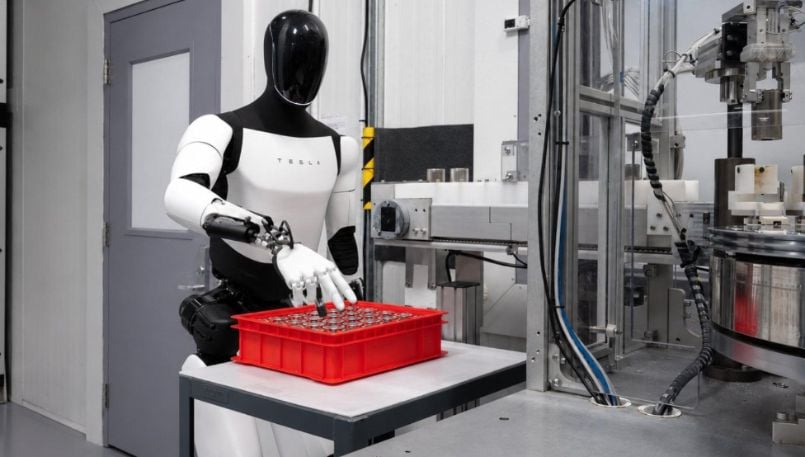
Inside Tesla's own buildings, an Optimus robot is generally restricted to a closely supervised environment and programmed for a specific task [13]. The Information reported that most robots built in the period it covered were used for internal testing, training and data collection [12]. Optimus also reportedly struggled to perform unfamiliar tasks without extensive training [11].
The robots in the report are narrower than the general-purpose machine in Tesla's roadmap language: supervised, and running a fixed task.
The long-run figures are easy to misread as output. In its January 2026 investor update, Tesla gave an eventual capacity of one million robots a year [3]. Electrek, citing The Information, reported a longer-term ambition of about 20,000 units a week [2]. Twenty thousand a week over 52 weeks is 1,040,000 a year [6], so the two numbers describe the same scale. The weekly figure is also 20 times the 1,000-a-week line reportedly targeted for the end of 2026 [5]. The source calls the 20,000 a goal and says it is not an established manufacturing capability [2].
The on-record statements from Tesla in this account date from January. Musk said then that Fremont's Model S and Model X space would be converted, and he cautioned that significant volume would take time [4]. The reported hurdles fit that caution. Tesla reportedly had trouble aligning precision components during automated manufacturing, and some suppliers struggled to keep quality consistent at higher volumes [10].
Musk's own conditions set the date. He said Tesla could begin selling to the public by late 2027, provided the robots meet expectations for reliability, safety and functionality, according to Axios [15]. A purchase schedule can carry those same three conditions, each with a test the buyer writes down in advance.
For the work itself, a buyer can sort candidate jobs on two axes: whether the task is fixed or varied, and whether a person will watch the robot while it runs. Tesla's robots, as described, occupy one cell, fixed task and close supervision [13]. The report does not describe a robot doing varied or unsupervised work. We'd expect a 2027 pilot to match jobs in that one cell and to treat the other three as research. The trade-off is that a supervised, fixed-task pilot tells a buyer little about the general-purpose robot the roadmap describes.
What to watch
- Whether Tesla itself publishes a release date or updated Optimus production figures, since it has confirmed neither so far.
- Whether the 100-plus screws and small parts in the V3 hands and forearms move from manual to automated assembly.
- Whether Tesla finalizes the commercial Optimus design and says how it differs from the V3 units built in August.
Clarity's read
What the record supports and how the coverage leans. The claims behind it follow.
Reality
- Evidence35
- Adoption
- Insufficient
- Hype gap+40
- Incentives
- Insufficient
- Confidence50
Claim ledger
Ranked by verification strength, evidence, and original report placement.
- [1]
Tesla managers are targeting an automated production line capable of producing more than 1,000 robots per week by the end of 2026.
- [2]
The longer-term ambition is reportedly to reach approximately 20,000 Optimus units weekly, a figure that remains a goal rather than an established manufacturing capability.
- [3]
In its January 2026 investor update, Tesla outlined preparations for its first Optimus production line, with production planned before the end of 2026 and an eventual annual manufacturing capacity of one million robots, a long-term goal and not current output.
- [4]
On the January earnings call, Musk described plans to convert the Model S and Model X production space at Fremont into an Optimus manufacturing facility, and cautioned that significant production volume would take time because Optimus requires an entirely new supply chain.
- [5]
The reported 20,000-per-week ambition is 20 times the reported 1,000-per-week end-of-2026 line target.
- [6]
20,000 robots a week over 52 weeks is 1,040,000 robots a year, about the same scale as Tesla's one-million-a-year eventual capacity goal.
- [7]
According to The Information, Tesla increased Optimus production at its Fremont, California, factory from a few dozen robots weekly during the second quarter of 2026 to several hundred in August.
ReportedContestedSource: The Information, via TechRepublic2 sources— create a free account to open themView cited source - [8]
Tesla has not confirmed a release date or provided updated production figures.
- [9]
According to The Information, the Optimus V3 design includes more than 100 screws and other small components in its hands and forearms that, as of the September reporting, required manual assembly.
- [10]
Tesla reportedly encountered difficulties aligning precision components during automated manufacturing, and some suppliers struggled to maintain consistent quality at higher production volumes.
- [11]
Optimus reportedly struggled to perform unfamiliar tasks without extensive training, limiting its usefulness as a general-purpose robot.
- [12]
Most Optimus robots produced during the period covered by the report were reportedly used for internal testing, training, and data collection rather than regular commercial work.
- [13]
Optimus robots operating inside Tesla facilities were generally restricted to closely supervised environments and programmed for specific tasks.
- [14]
The Optimus V3 robots reportedly being produced in August were not necessarily identical to the version Tesla intends to offer customers; the company was still refining the commercial design, which would need to meet stricter durability and reliability requirements before reaching the market.
- [15]
Musk previously said Tesla could begin selling Optimus robots to the public by late 2027, provided they meet expectations for reliability, safety, and functionality.
Sources
1 independent publisher whose own reporting we read for this story.
- techrepublic.comElon Musk’s Tesla Optimus Timeline: Robots Targeted for 2027 Launch
1 article · October 12, 2026
Topics and entities
Follow any of these and your For You feed starts watching them — no settings page required.
Topics
- Humanoid RobotsFollow
- Robotics manufacturingFollow