Science1 publisher3 min readPublished
Satellite records link African restoration projects to tree-loss changes up to 10 kilometers away
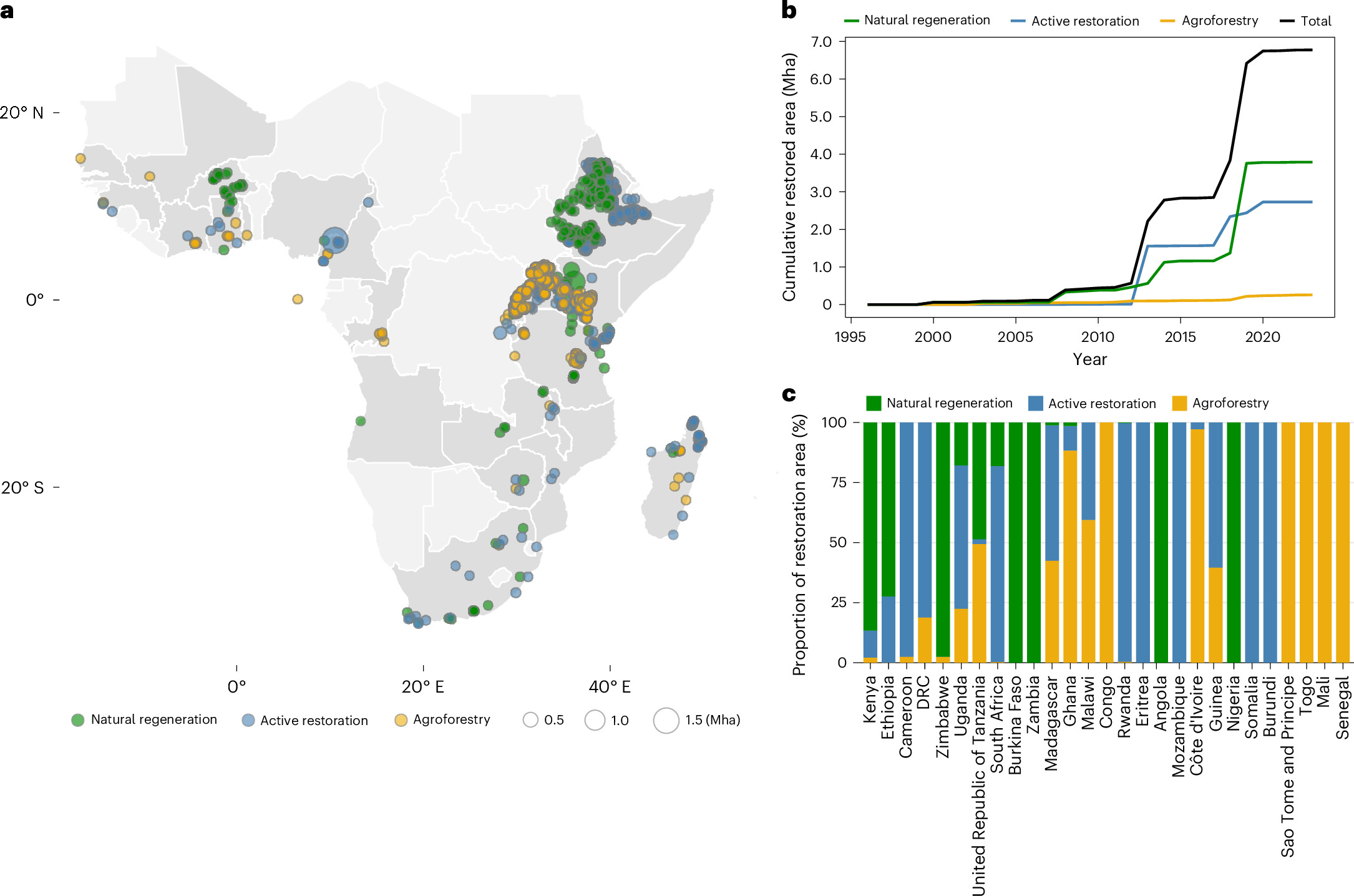
Cambridge and Sheffield researchers linked restoration at nearly 130,000 African sites to changes in tree loss up to 10 kilometers outside project boundaries. Accounting that stops at a project's edge can miss an effect almost as large as the one it measures, in either direction.
The Scientist · Science desk
Drafted by a language model from the sources cited here and checked against its claim ledger before publication. How we use AISend a correction
What happened
- Natural regeneration and active restoration were associated with tree-loss reductions of up to 9.1 percentage points inside sites and 8.9 points in the surrounding landscape after a decade.
- Agroforestry projects, where trees are added to cropland, saw tree loss rise by an average of 7.9 points inside the projects and 7.5 points in the land around them.
- The researchers suggest farm trees compete with crops for light and other resources, so farmers clear nearby forest or fallow land to make up the lost production.
- Kenya and Tanzania showed positive outcomes across restoration types, while Ethiopia and South Africa recorded instances of negative leakage.
Compiled by The ScientistSomething wrong?How this is made
Why it matters
- exposure Buyers of credits from agroforestry projects carry the risk of added tree loss outside the project boundary that nearly matches the added loss inside it.
- decision Certification standards that leave off-site impacts out now have to choose whether to start measuring a spillover this study puts close to the on-site effect in size.
- constraint A restoration method's record in Kenya or Tanzania cannot be assumed to carry over to countries such as Ethiopia or South Africa, where land-use pressure and institutions differ.
Put the outside figures next to the inside ones. For natural regeneration and active restoration, the spillover is about 98 percent of the on-site effect. For agroforestry it is about 95 percent [1][2]. The two pairs are not quite the same statistic. The restoration figures are reductions of "up to" their values after 10 years, while the agroforestry figures are averages [6][8].
The surrounding zone is also much larger than a typical project. The dataset covers about 6.8 million hectares across nearly 130,000 sites, or roughly 52 hectares per site [4][3]. A simple circle 10 kilometers in radius covers about 31,400 hectares, some 600 times that [6][4]. Zones around neighbouring sites overlap, and percentage points convert to hectares only through how much forest each zone holds. Even so, a near-equal change in points spread over that much land could make the off-site effect the larger one in absolute terms.
The design is observational. The team, led by Cambridge PhD student Xinran Miao, assembled a geospatial dataset of the sites and analyzed decades of satellite data [4][5]. Sheffield researchers helped build the models that estimate impacts inside and outside the projects [14]. The release calls the paper, published in Nature Sustainability, the most comprehensive study to date of restoration's effect on tree loss beyond project boundaries in sub-Saharan Africa [1][3]. Its results are reported as associations. The authors' explanation for the beneficial spillover is that projects involving communities, securing land tenure or supplying fuelwood and jobs ease pressure on nearby forest [7]. The release presents that as what the pattern "may reflect" [7]. It does not give baseline loss rates, describe how comparison areas were chosen, or report direct measures of either explanation.
"These findings provide the first large-scale empirical evidence that different restoration strategies can generate heavily contrasting positive and negative effects on deforestation rates in the wider landscape," said Dr. Oscar Morton, a Leverhulme early career research fellow at the University of Sheffield [10]. I think "evidence" holds for the pattern across 27 countries [4]. Reading it as cause depends on how well the comparison landscapes stand in for what would have happened without the projects.
The authors argue that outcomes depend on where and how restoration is done as well as on what is planted [16]. "These results illustrate how factors such as land tenure security, incentive structures and community participation can influence whether restoration strengthens or places additional pressure on surrounding landscapes," said Dr. Chris Bousfield of the University of Sheffield [12].
Global policy aims to restore more than 350 million hectares by 2030 [2]. The area in this study is about 2 percent of that [5]. According to the release, carbon market and certification frameworks often leave off-site impacts out [13]. On this study's numbers, the native-regeneration benefit those frameworks omit and the agroforestry risk they overlook are each close, in percentage points, to the on-site changes they do count [13][1][2].
What to watch
- Whether carbon market and certification bodies add off-site leakage accounting for restoration and agroforestry credits.
- The paper's choice of comparison landscapes and its baseline loss rates, which decide how far the associations can be read as effects.
- Field studies in Ethiopia or South Africa that test the crop-competition explanation for agroforestry's negative leakage.