Science1 publisher2 min readPublished
3D magnetic images suggest an unknown sea creature could read Earth's field 97 million years ago
Cambridge and Berlin researchers mapped 97-million-year-old magnetofossils in 3D, finding structures suited to sensing Earth's field direction and strength. The maker is unidentified, so the navigation claim rests on inferring behavior from magnetic structure.
The Scientist · Science desk
Drafted by a language model from the sources cited here and checked against its claim ledger before publication. How we use AISend a correction
What happened
- The fossils were retrieved from one North Atlantic location and are roughly 10 to 20 times larger than the magnetic particles bacteria use as compasses.
- Researchers had earlier proposed that these giant particles were protective spines, until computer simulations hinted at more sophisticated magnetic properties.
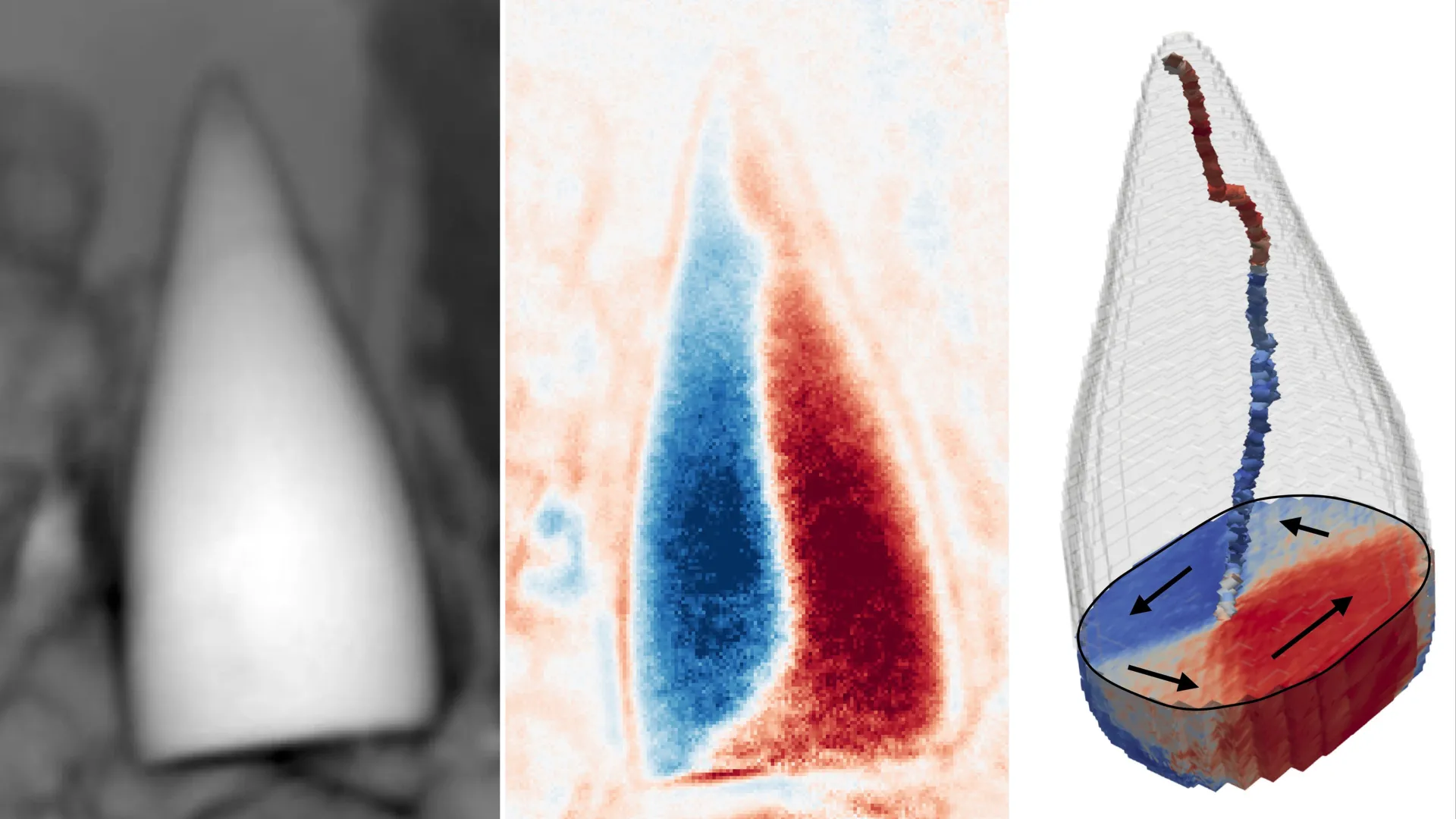
- Conventional X-rays could not penetrate particles this large, so the team used a new method to map how magnetic moments are arranged inside them.
- The University of Cambridge release calls the result the first direct evidence of animals navigating by Earth's field at least 97 million years ago, published in Communications Earth & Environment.
Compiled by The ScientistSomething wrong?How this is made
Why it matters
- constraint With the maker unidentified, the result cannot yet be tied to the ancestry of birds, fish or any other living navigator; for now it dates a sensor design only.
- capability Particles too thick for conventional X-rays can now be mapped magnetically in 3D, so other giant magnetofossils can be checked for the same map-like structure.
- precedent If structure can be read as function, fossil magnetite becomes datable evidence for the magnetite theory of magnetoreception, a sense still poorly explained in living animals.
Field strength turns a compass into something closer to a map [3]. Direction tells an organism which way it faces. According to the Cambridge release, direction and strength together could have told the animal where it was and where it was going [3]. "Whatever creature made these magnetofossils, we now know it was most likely capable of accurate navigation," said Rich Harrison of Cambridge's Department of Earth Sciences, who co-led the work [4].
The particles first drew attention because of their size. Bacteria in lakes and other waters carry chains of magnetic particles that let them swim toward the depth they prefer [8]. "At just 50-100 nanometers wide, these particles are the perfect compass needles," Harrison said. "If you want to create the most efficient magnetic sense, smaller is better." [9] At the stated ratio, the fossil particles come out at roughly half a micrometer to two micrometers across [1]. That fits the release's note that none is larger than a bacterial cell [2].
An organism that grew crystals that large, in shapes resembling spearheads, spindles, bullets and needles [2], was departing from the efficient size Harrison describes. "It looks like this creature was carefully controlling the shape and structure of these fossils, and we wanted to know why," he said [12]. The imaging technique that let the team look inside came from co-author Claire Donnelly at the Max Planck Institute in Germany [14].
The release says the organism's identity remains unknown [1], yet its central claim is about animals [5]. A structure suited to reading field strength shows the creature could sense it, not that it navigated. The summary's suggestion that the creature could travel thousands of kilometers with surprising precision [15] sits a step further out. The release does not say how many particles were imaged, or what the previous oldest evidence of magnetic navigation was.
In my view the imaging is the strong result here, and the navigation claim is a reasonable inference that a body fossil or a living relative would need to confirm. It is still useful to biologists. Magnetoreception remains poorly understood in birds, fish and insects [6], and one leading explanation is magnetite crystals working as compass needles inside the body [7]. A dated fossil structure that looks tuned for position as well as heading gives that explanation something physical to test against. The researchers say the findings could help explain how the sense evolved [16].
What to watch
- Identification of the organism that made the giant magnetofossils, which would test both the 'animal' label and the navigation reading.
- Use of the Donnelly 3D magnetic imaging method on giant magnetofossils from other sites or older sediments, which could move the date or show the structure is rare.
- Whether the Communications Earth & Environment paper reports how many particles were imaged and whether all shared the same magnetic arrangement.