Science2 publishers3 min readPublished
Six pages in Brighton fill the gap in a Yale manuscript signed by Henry VIII's dissolution enforcer
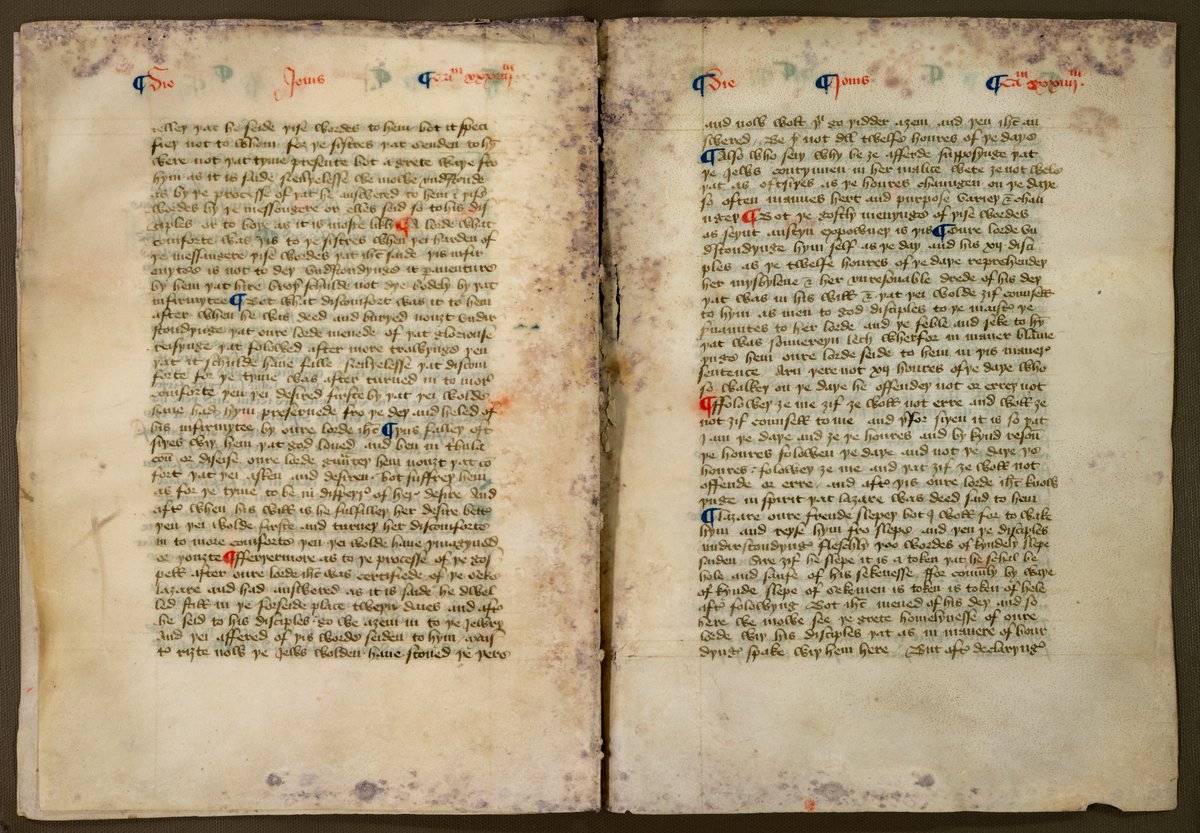
The hand, the page size and the annotation colour all match, which is how six loose leaves in a Brighton archive were fitted to Takamiya MS 20 at Yale. Sir John Gage's motives are the softer part of the case.
The Scientist · Science desk
What happened
- Katie Walter of Sussex and James Wade of Cambridge have matched six loose pages held at The Keep archive in Brighton to a Yale-held copy of Nicholas Love's Mirror of the Blessed Life of Jesus Christ.
- The signature of Sir John Gage sits on the final page of the Yale manuscript, in a list of likely owners that also includes the names of two religious women.
- The book stayed in Gage family hands until 1976, when a distant descendant sold it at auction to the Japanese professor and rare book collector Toshiyuki Takamiya.
- The six leaves travelled separately into a collection of Gage family estate records, passing through several sets of hands before they reached the Brighton archive.
Compiled by The ScientistSomething wrong?How this is made
Why it matters
- capability Because the Yale book had been digitized, the join could be tested from Britain by scrolling to the gap. Any orphan leaf whose parent volume has a digital surrogate can be checked the same way.
- constraint The signature establishes ownership. The claim that Gage defied his own commission rests on his office and his religion, and the study's word is suggests.
- decision Two institutions now hold halves of one object, and Wade expects them to stay apart, so the reunion happens in the catalogue.
A join like this is easier to assert than to demonstrate, and the two halves sat about 3,500 miles apart [24]. The case rests on unglamorous measurement. Walter and Wade compared the dimensions of the leaves and of the book, along with the style and colour of the annotations and headers, and found them identical [5]. In the Yale volume the gap falls just before a contested passage on the importance of oral confession to a priest, and the scribe's handwriting and the content of the missing passage both fit [3]. The six pages themselves cover Jesus raising Lazarus from the dead [4].
The match was made on a screen. The two scrolled through the digitized manuscript and found the space where the Brighton pages belonged [27]. It was digitized after Toshiyuki Takamiya gave his collection to Yale's Beinecke Rare Book and Manuscript Library [18].
Walter said the names above the signature point somewhere specific: "The fact that two possible owners before Gage were religious women suggests the manuscript might have been in a monastic house before it came into his possession" [8]. How it reached Gage is open. "One possibility is that Gage went to a monastic library and brought it home. Another is that someone else smuggled it out, and it briefly circulated from hand to hand until Gage acquired it," Wade said, adding that Gage "kept it safe when he was meant to destroy books precisely like this one" [7]. Gage's duties for Henry VIII included taking stock of monasteries and either turning their possessions over to the Crown or destroying them. Scientific American describes him as a devout Catholic who came across a copy of the Mirror and did not destroy it [9][28]. Neither account cites a document ordering the destruction of this particular copy; the study's own wording is that Gage saved the book from likely destruction [11].
The risk attached to owning the book changed under Love. He finished his English adaptation of an earlier Latin text around 1409, and it circulated as the safe option. "In the early 15th century, having Bible translations in English could get you killed," Walter said. Love's version, she said, "was considered orthodox and circulated with the seal of approval of Archbishop Arundel, the outspoken opponent of the Lollards" [12][14]. A 1401 act had condemned heretics including the Lollards to punishments that could include death by burning [13]. Love also appended a treatise arguing for the real presence of the blood and body of Jesus in the sacrament [15]. That kind of passage, as Wade puts it, made the work "a lightning rod for judging whether someone is a heretic or not" [26].
Wade gives the survival count as "65 copies of Love's text survive today. That's a lot for a 15th-century manuscript, but many could have been destroyed in the Reformation" [16]. How many were copied in the 15th century is not known, so 65 measures popularity among the things that lasted and not the scale of what was burned [29].
The stitches came loose at some point and the pages were left out when the book was mended [19]. "It was known that these pages existed, but they weren't cataloged accurately," Wade said [21]. The filing error had stood for nearly a century [22]. "All those decisions are above my pay grade," he said of putting the object back together, "but I'm pretty sure that, no, they won't be reconnected." He added: "Yes, this book is incomplete, but now you know where to find what's missing" [23].
What to watch
- Whether the Beinecke and The Keep amend their catalogue records to cross-reference each other. That cross-reference is the practical result of the identification.
- Whether other leaves from the same book turn up in the remaining Gage family estate papers held in Brighton.
- Whether other Middle English scholars accept the Notes and Queries identification, or challenge the handwriting and dimension evidence.