Science1 publisherNot yet confirmed elsewhere2 min readPublished
Stretching the kagome metal CsV3Sb5 by 0.9% separates two superconducting states
Okayama University physicists stretched the kagome metal CsV3Sb5 by 0.90% and found two separate superconducting transitions, one nodal and one nodeless. The team argues both states overlap in unstrained crystals, so earlier experiments may each have caught a different one.
The Scientist · Science desk
What happened
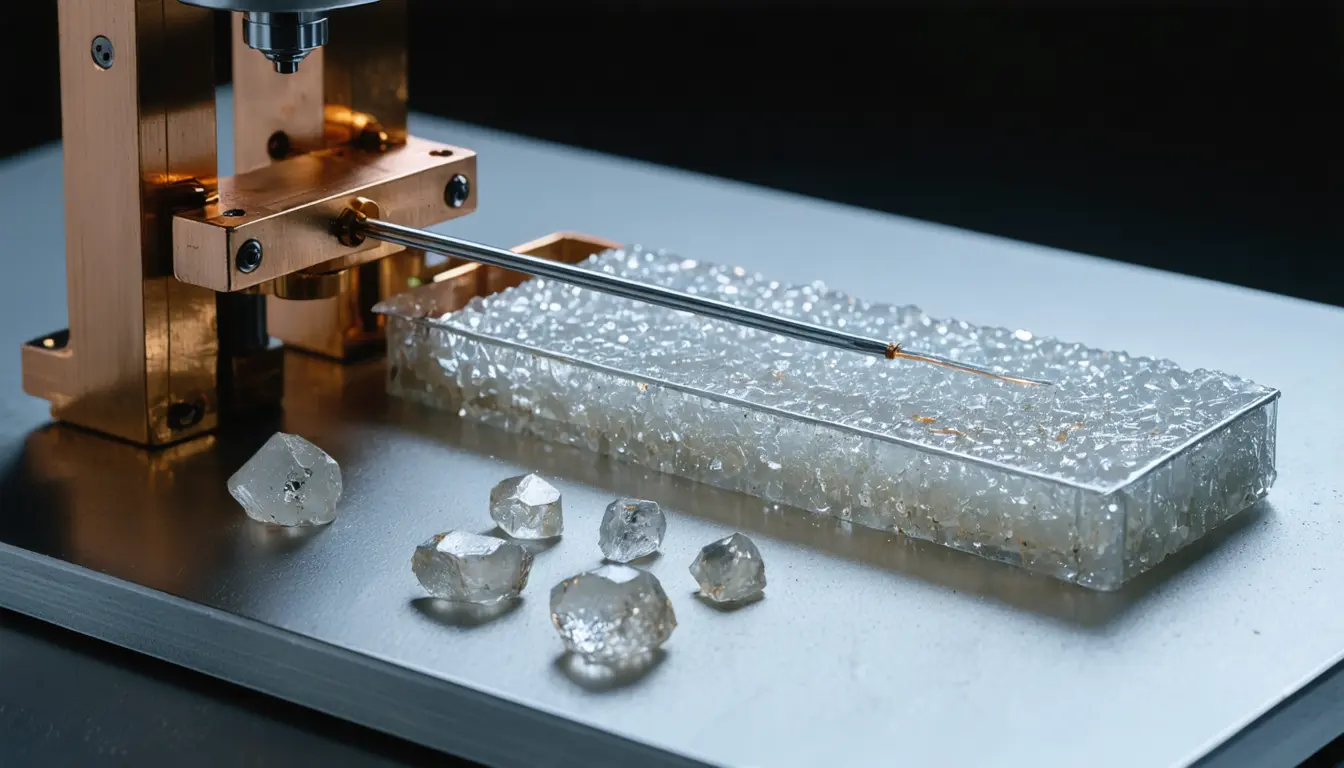
- Stretching the crystals raised the superconducting onset from about 3.0 K to 3.6 K at +0.90% tensile strain, a gain that compressing them did not deliver.
- The nodal component's share of the superconductivity rose from 10% with no strain to about 26% at +0.90% strain.
- Shinji Kawasaki's group combined a piezoelectric strain cell with nuclear quadrupole resonance and reported the work in Physical Review Letters on Aug. 28, 2026.
Compiled by The ScientistSomething wrong?How this is made
Why it matters
- constraint A single gap measurement on unstrained CsV3Sb5 samples a mixture of states, so its nodal-or-nodeless verdict can depend on which component the probe is most sensitive to.
- capability Experimenters can now change the pairing in CsV3Sb5 while its charge order holds still; hydrostatic pressure could not separate the two because it acts largely through that order.
- precedent If the strain method transfers, iron-based and heavy-fermion superconductors become candidates for the same separation of superconductivity from competing density waves, as the team proposes.
The strain is applied in situ, during the resonance measurement, so a crystal can be compared with itself at different strains [5]. The other control is the charge order. CsV3Sb5 forms a charge density wave at about 94 K, long before it superconducts [2]. According to the report, hydrostatic pressure tunes this material's superconductivity largely by acting on that charge order [13]. A pressure-driven rise in transition temperature is therefore hard to credit to the pairing alone.
I'd rate the stable charge order as the most useful result in the study. It lets the shift in transition temperature be pinned on the superconductivity itself. Kawasaki said strain "enhances superconductivity without changing the bulk charge density wave" [12].
The 0.6 K rise in onset is about 20% [15]. Those are onset temperatures. The report gives the material's usual transition as about 2.5 K [2].
At the largest strain the nodal state appeared first, at 3.6 K, and the nodeless one followed at 3.0 K [8]. The lower figure matches the unstrained onset [17]. One reading is that strain lifts the nodal state and leaves the nodeless one roughly where it was. Over the same strain range the nodal share grew by a factor of 2.6 [16].
The team interprets the two states as nearly degenerate, meaning close in energy, in an unstrained crystal, with strain pulling them apart [9]. If that holds, the long argument over whether the gap has nodes [3] has a plain cause. An unstrained sample already carries a nodal minority of about 10% [11]. A probe that weights one component could then reach a different verdict from a probe that weights the other. "For years, different measurements of CsV3Sb5 have pointed toward seemingly different superconducting states," Kawasaki said. "Our results show that these states can coexist and that uniaxial strain can separate them, giving us a direct way to study each state." [10]
The report does not say how many crystals were measured, how the 10% and 26% weights were extracted from the resonance data, or whether the nodeless transition moved with strain. The result comes from one group, straining along one crystallographic direction [4][5]. The team proposes the same approach for iron-based and heavy-fermion superconductors, where charge or spin density waves also compete with superconductivity [18]. CsV3Sb5 itself superconducts at temperatures too low for practical use [14].
What to watch
- Whether other groups straining CsV3Sb5 reproduce the split into a 3.6 K nodal transition and a 3.0 K nodeless one.
- Whether the strain approach pulls superconductivity apart from density-wave order in an iron-based or heavy-fermion material, as the team proposes.
- Whether the nodeless transition temperature is shown to stay fixed or shift as strain increases, which would test the reading that only the nodal state is lifted.
Clarity's read
What the record supports and how the coverage leans. The claims behind it follow.
Reality
- Evidence55
- Adoption
- Insufficient
- Hype gap+15
- Incentives
- Insufficient
- Confidence50
Claim ledger
Ranked by verification strength, evidence, and original report placement.
- [1]
Stretching the crystal, rather than compressing it, substantially increased the superconducting transition temperature: at zero strain the transition began at about 3.0 K, while tensile strain of +0.90% raised it to 3.6 K.
- [2]
CsV3Sb5 develops charge density wave order at about 94 K before becoming superconducting at about 2.5 K.
- [3]
Experiments have offered conflicting views of whether the superconducting gap of CsV3Sb5 is conventional or contains nodes.
- [4]
A team led by associate professor Shinji Kawasaki, working with professor Guo-qing Zheng, both of the Department of Physics at Okayama University, investigated CsV3Sb5 using in situ uniaxial strain and nuclear quadrupole resonance measurements.
- [5]
High-quality single crystals were strained along one crystallographic direction using a custom piezoelectrically driven strain cell while the researchers monitored the superconducting transition and local electronic properties.
- [6]
The study, Yusuke Takeuchi et al., 'Strain-Tuned Nodal Superconductivity in the Charge-Ordered Kagome Metal CsV3Sb5', from the Okayama University group of Shinji Kawasaki and Guo-qing Zheng, was published in Physical Review Letters on Aug. 28, 2026.
- [7]
The charge density wave remained essentially unchanged under strain, so superconductivity could be tuned independently of the charge order.
- [8]
Under the largest tensile strain the material underwent two superconducting transitions: the first at 3.6 K, associated with a nodal state, and a second at 3.0 K showing a nodeless state.
- [9]
According to the researchers, two distinct superconducting states that are nearly degenerate under ambient conditions separate when strain is applied, helping explain why previous experiments reached different conclusions.
- [10]
"For years, different measurements of CsV3Sb5 have pointed toward seemingly different superconducting states. Our results show that these states can coexist and that uniaxial strain can separate them, giving us a direct way to study each state."
- [11]
The nodal component's contribution increased from 10% at zero strain to about 26% at +0.90% strain.
- [12]
Kawasaki said strain "enhances superconductivity without changing the bulk charge density wave".
- [13]
Hydrostatic pressure changes superconductivity in CsV3Sb5 largely through its effect on charge order.
- [14]
CsV3Sb5 has a transition temperature too low for practical applications.
- [15]
Tensile strain of +0.90% raised the superconducting onset by 0.6 K, about a 20% increase.
- [16]
The nodal share grew by a factor of 2.6 between zero strain and +0.90% strain.
- [17]
At maximum strain the nodeless transition sits at the same temperature, 3.0 K, as the unstrained onset.
- [18]
The approach could provide a strategy for separating superconductivity from competing orders such as charge or spin density waves in other unconventional superconductors, including iron-based and heavy-fermion systems.
Sources
1 independent publisher whose own reporting we read for this story.
- phys.orgOne quantum material, two superconducting states: Stretching helps explain conflicting experiments
1 article · October 7, 2026
Topics and entities
Follow any of these and your For You feed starts watching them — no settings page required.