Science1 publisher2 min readPublished
Cavity-accelerated biexciton decay lifts quantum-dot photon indistinguishability to 90 percent
Physicists in Basel and Paderborn used an optical cavity to make quantum-dot cascade photons 90% indistinguishable, up from 60%. The fix targets the timing correlations that have limited these on-demand sources, and brightness and entanglement performance have yet to be reported.
The Scientist · Science desk
What happened
- According to the release, earlier quantum-dot photon sources emitted temporally correlated photons, and that correlation lowered their indistinguishability.
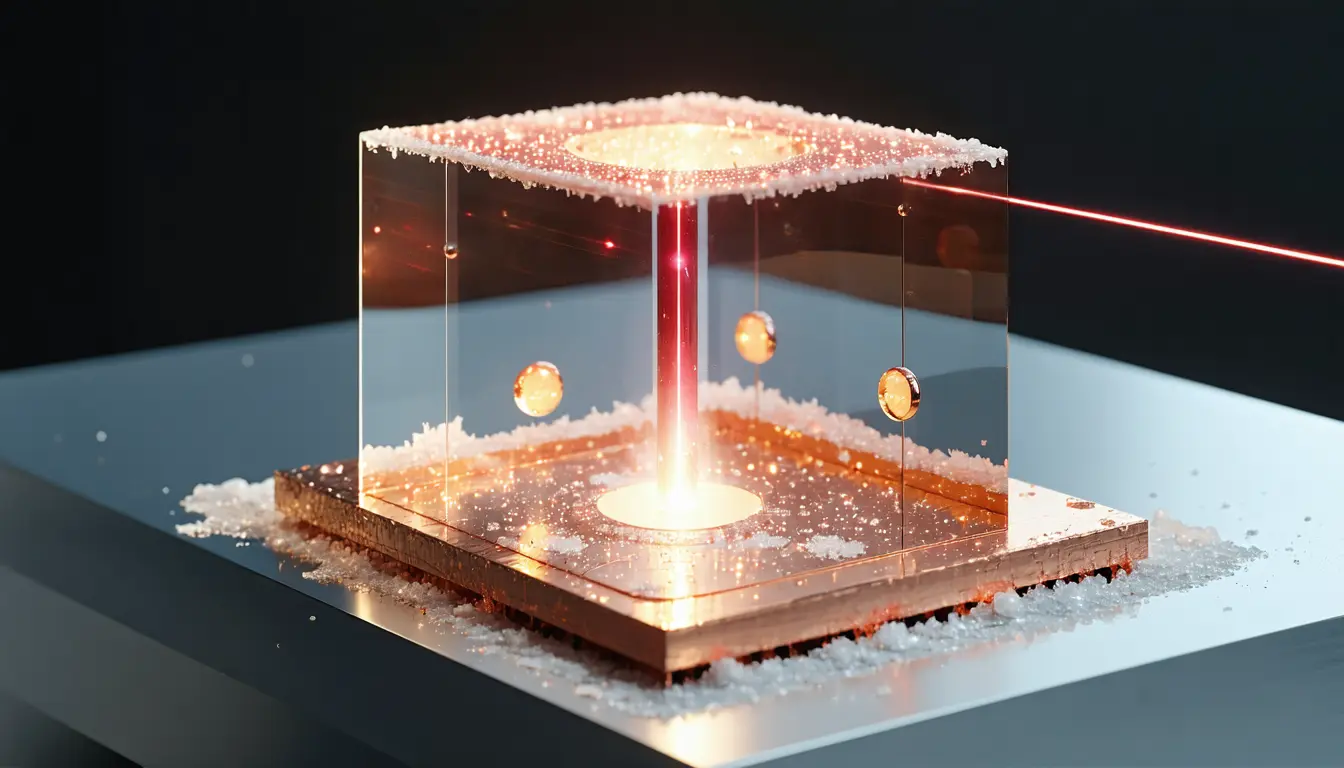
- The team placed the dots in an optical cavity that sped up the biexciton's decay in a controlled way, drawing on years of cavity work in Richard Warburton's group at Basel.
- Photon purity can also be tuned with the cavity and is limited only by vibrations of the crystal lattice, the phonon effect the team calls cavity feeding.
- A companion paper by Nils Heinisch and colleagues in Physical Review Applied, named an Editors' Suggestion, covers the single-photon source application.
Compiled by The ScientistSomething wrong?How this is made
Why it matters
- capability On-demand cascade sources can now be built to a higher photon quality, on Warburton's stated condition that a cavity controls the decay.
- constraint Phonons now cap purity, so the next cavity designs have to account for cavity feeding before purity can rise further.
- decision Groups weighing quantum dots for mass-produced photon sources now have to establish whether cavity-controlled decay can be reproduced dot after dot.
A biexciton is two bound excitons in one quantum dot. When it decays, it leaves a single exciton and a photon behind [3]. Lead author Timon Baltisberger of the University of Basel described the cascade as emitting photons "at the push of a button" [15]. "This is a process in which a quantum dot is doubly excited and the excitation then decays. This generates two photons, one after the other," he said [4].
The release credits doctoral candidates from Basel and Paderborn with the work [16], done with Ruhr University Bochum [1]. Their change was to put the dot inside an optical cavity, which Stefan Schumacher, head of a theory group at Paderborn University, likened to the cavity in a laser [5]. He said "the light emission process was specifically accelerated and controlled in this study" [5].
With the cavity effect, the photons were 90% indistinguishable. Without it, the figure was 60% [7]. That is a gain of 30 percentage points [1]. Counted the other way, the distinguishable remainder fell from 40% to 10%, a fourfold cut [2]. I would give the most weight to how well the data matched theory, because a model that predicted this result is one designers can point at the remaining gap. Warburton said "The results show excellent agreement with the theoretical prediction and point the way toward generating photons with even higher indistinguishability" [8].
Ninety percent is a large step for a cascade source. It still falls short of the release's description of photons that are "almost perfectly identical" [1]. Warburton's own condition is more exact: biexciton decay gives very high-quality photons, he said, "provided the system is properly controlled using a cavity" [17]. The release ties each gain in indistinguishability and purity to a lower error rate in data processing [12].
The thing this doesn't tell you is how the source performs inside a communication link. The release does not say whether the 60% baseline was measured on the same dot, how many dots were tested, how bright the source is, or what entanglement fidelity the photon pairs reach. For entanglement-based communication, I'd want the pair fidelity and the rate before calling the limit cleared. The paper's title, "Indistinguishable Photons from a Two-Photon Cascade," matches the scope of what was shown [14].
What to watch
- A measured entanglement fidelity for the cavity-accelerated photon pairs, which would test the result in the setting quantum communication actually uses.
- Indistinguishability above 90% from designs that suppress cavity feeding, the path Warburton and Jöns describe.
- Results across many dots, or interference between photons from two separate dots, which would speak to the mass-production case.