Science5 publishers3 min readPublished
Human organoids filled more than 90 percent of the cortex in mice bred without one
A Stanford team emptied the mouse neocortex genetically and grew human cortical organoids into the gap, where the grafts took in 25 of 29 animals, expanded nearly fivefold over three months and wired into the host nervous system.
The Scientist · Science desk
What happened
- A Stanford-led team bred immunodeficient mice whose neocortex and hippocampus are genetically depleted, then engrafted the empty cortical cavity in newborn animals with human stem-cell-derived cortical organoids.
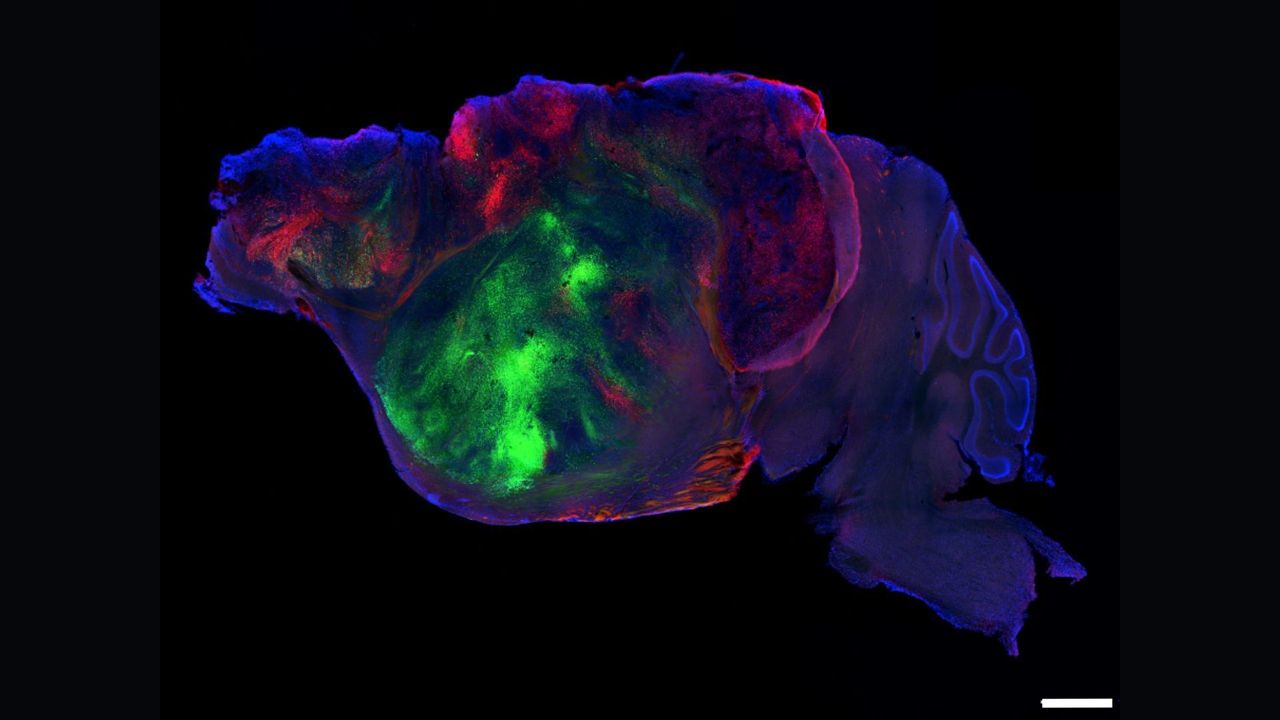
- The grafts expanded nearly fivefold in volume over three months and ended up filling more than 90 percent of the mouse cortex, against a third of one hemisphere in the group's earlier rat model.
- Oxygen deprivation left cellular signs of injury in the human tissue and gave the mice gait and limb coordination problems that also mark cerebral palsy in people.
Compiled by The ScientistSomething wrong?How this is made
Why it matters
- capability Organoids grown from patients with genetic autism or frontotemporal dementia can now be given circuit- and behaviour-level readouts in a living animal, and Pasca said those are the conditions he plans to study next.
- contradiction New Scientist has the memory deficit almost completely reversed; the Nature abstract calls the same rescue partial. Which reading is right decides how much lost function the graft can be said to restore.
- constraint Because the graft has no cortical layering, questions that depend on laminar organisation stay out of reach here, and the model is useful for cell types and circuit activity.
- precedent Hyun's panel judged the experiment on the cognitive capacity of the animal, not on the fraction of human tissue it carries.
The reason to empty a mouse cortex is timing. Human neurons mature slowly, and they go on doing so inside a rodent. "Even when they're put in an animal, in a mouse or in a rat, they will still develop about 20 times slower than the mouse or the rat," Sergiu Pasca told Live Science [13]. The host's own neurons wire up first and outcompete the graft, and they myelinate first, which Pasca said leaves a fatty physical barrier the human cells struggle to penetrate [14]. In the group's 2022 rat work, transplanted organoids reached at most about a third of one cortical hemisphere [15].
The new strategy leaves the maturation rate alone and gives the human cells room instead. Pasca's group genetically depleted glutamatergic neurons from the mouse neocortex and hippocampus, then engrafted the cortical cavity in newborn animals, work reported on 16 September in Nature [1][2]. Each mouse received four human cortical organoids, grown by bathing human stem cells in chemicals for about 40 days [8]. Those two structures account for roughly half the brain's volume [3]. Grafts took in 25 of 29 attempts, about 86 percent [5][6], and expanded nearly fivefold over three months to fill more than 90 percent of the cortex [7].
Inside that space the graft made cell types that dishes yield poorly, including layer 5 extratelencephalic projection neurons, and graft-wide calcium imaging and electrophysiology found organized activity resembling developing circuits [9]. New Scientist reports the grafts were also the first to contain von Economo neurons and neurons extending from cortex to spinal cord [10].
The three accounts do not describe the behavioural result the same way. New Scientist reported that the apallial mice's maze memory deficit was almost completely reversed in the grafted animals [17]. The Nature abstract describes the apallial deficits in fine motor coordination and working memory as only partially observed in xenocortical mice [16], and Science News reported grafted performance falling between intact mice and mice lacking a cortex [18]. Pasca told New Scientist that the apallial mice have only some memory and movement deficits because their brains adapt to compensate for the missing cortex [19]. The improvement is therefore being measured against a baseline that is itself adapting.
The clearest application in the paper is injury. Oxygen deprivation left cellular signs of injury in the human tissue and gave the mice problems with gait and limb coordination, features of cerebral palsy in people [21]. Gabriel Balmus of the University of Cambridge said mice are highly resilient to low oxygen, so the response is hard to reproduce in an ordinary animal [22]. "This could be used down the line to test many therapeutics that are being considered for cerebral palsy," Pasca said [23].
H. Isaac Chen of the University of Pennsylvania called the technique "certainly bold" and said the extent of humanization raises questions about ethical boundaries [24]. Pasca consulted an outside panel led by Insoo Hyun, a bioethicist at the National University of Singapore, who says there is little evidence these mice have crossed a line. "From a secular ethical point of view," Hyun said, "it boils down to cognitive capacity" [25]. Jurgen Knoblich of the Institute of Molecular Biotechnology in Vienna said the data so far do not show that a graft "makes the mouse smarter or more conscious than a normal mouse" [28].
The graft lacks the layering of a mature cortex [11]. Knoblich told New Scientist it is "a bit of a mishmash of neurons" and that "Most of the cell types are there but they're not separated into regions like in a normal cortex" [12]. The Nature abstract does not report the group sizes behind the behavioural tests [34].
What to watch
- Whether organoids derived from patients with genetic autism or frontotemporal dementia reproduce disease phenotypes in this model.
- Whether an independent lab reproduces the 25-of-29 engraftment rate and the behavioural results with its own apallial mouse line.
- Whether funders or regulators write a cognitive-capacity threshold, of the kind Hyun's panel used, into rules for chimeric neural grafts.