Science1 publisherNot yet confirmed elsewhere3 min readPublished
Solar panels between Swiss rails survive 11,000 trains in their first year
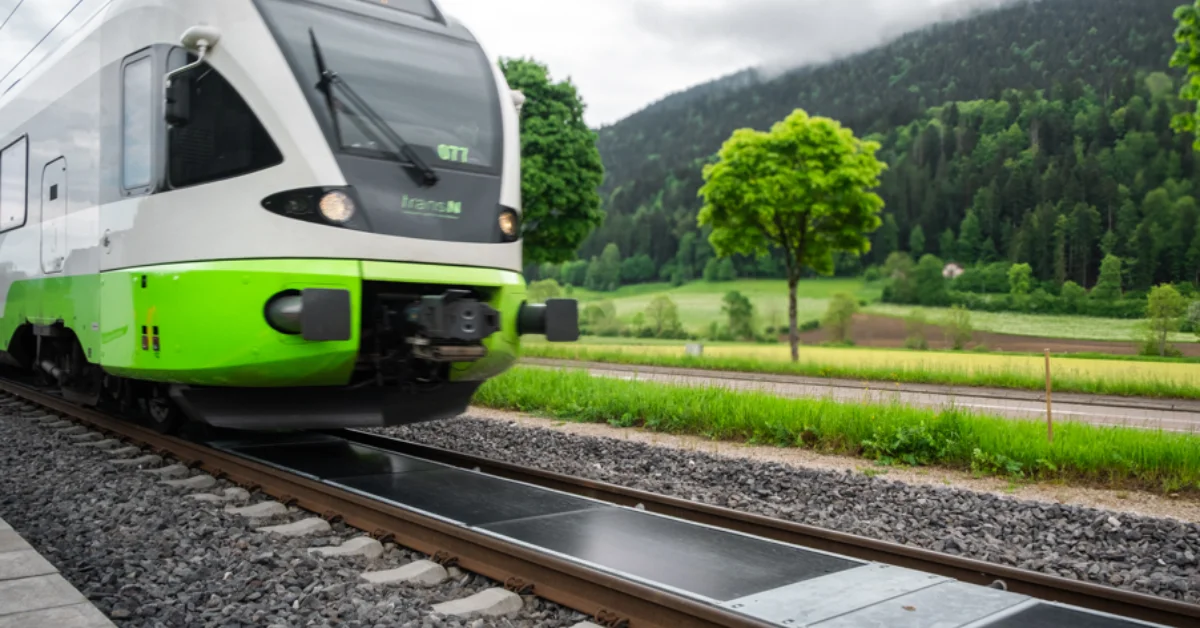
Sun-Ways' 48 solar panels between the rails at Buttes, Switzerland, made over 16,000 kWh in a year while 11,000 trains rolled over them. That makes slow regional track a credible site, but scaled up, the yield falls short of Sun-Ways' national forecast.
The Scientist · Science desk
Drafted by a language model from the sources cited here and checked against its claim ledger before publication. How we use AISend a correction
What happened
- Trains crossed the panels at speeds up to 55 mph, and the installation stayed stable, safe and productive through the first year, according to the published account.
- The plant went in during April 2025 as a three-year pilot that is officially scheduled to run through 2028.
- Sun-Ways projects that Switzerland's roughly 3,300-mile rail network could supply up to 2% of national electricity, enough for about 300,000 households.
- France's national railway company SNCF signed a deal with Sun-Ways in February.
Compiled by The ScientistSomething wrong?How this is made
Why it matters
- contradiction Sun-Ways' national forecast needs more power per mile than Buttes delivered, so anyone planning around the 2% figure is relying on assumptions the pilot has not tested.
- constraint The safety result covers regional speeds only, so the high-speed operators in Japan and South Korea that have shown interest would need trials of their own.
- decision By Scuderi's account, Swiss final approval is what partners abroad are waiting for, so the regulator's timing will set the pace of any expansion.
The practical problem in Buttes was access. Track needs regular maintenance, and anything fixed between the rails gets in the crews' way. Sun-Ways' patented panels fill that gap and lift out when work is due [10]. Over the first year roughly 30 trains a day ran across them [19]. "We have achieved our objectives, both in terms of railway safety and electricity production," Joseph Scuderi, the company's founder, told Swissinfo [2].
On average each panel produced about 333 kWh [20]. The stretch reached its total despite a month-long stop for snow and planned technical work [11]. Across all 330 feet, the output equals the annual use of three to four Swiss households [12].
Those figures are enough to check the company's national projection. Scaled to every one of the network's 3,300 miles, the 330-foot pilot stretch repeats 52,800 times [16]. At the Buttes yield, that comes to roughly 845 million kWh a year [18], or power for 158,000 to 211,000 households [17]. The 300,000-household figure Sun-Ways gives [22] sits above that range before a single tunnel or poorly lit stretch is taken out. Reaching it requires more usable track per mile of network than the pilot implies, or more output per foot.
The speed result has a ceiling too. Scuderi has told PV Magazine of interest from Japan and South Korea, where trains run at more than 186 mph [3]. That is about 3.4 times the fastest train in the Buttes test [21]. The evidence so far comes from one 330-foot stretch, one year into a pilot [8][9]. The report does not include an installation price or a cost per kilowatt-hour. Without one, goodgoodgood.co's point that rail solar needs no land purchase [14] cannot be weighed against what a conventional solar site costs.
In my view the Buttes data support a narrow conclusion. On a regional line at up to 55 mph, removable panels between the rails survived a year of traffic and kept generating, according to the account published by goodgoodgood.co [1]. That makes rail track a credible site for engineering trials. The case for national-scale generation rests on Sun-Ways' own projection, and the pilot's yield, scaled up, falls short of it [17][22].
Railway companies abroad are paying attention. "Last week there was a company from the Indonesian railway sector that came to see the pilot project to convince themselves it was real and not a fake video," Scuderi told PV Magazine in July 2025 [4]. He said he is talking with an Italian rail infrastructure firm about setting up a pilot in Italy before the year is out [5]. Scuderi hopes the early results will speed up approval [15]. "We have demonstrated that the solar plant between the rails is safe," he said [6]. "The sooner we obtain final approval, the sooner our partners abroad will also be able to move forwards." [7]
What to watch
- Whether Swiss authorities grant final approval before the Buttes pilot's scheduled end in 2028.
- Second-year output from Buttes with no month-long shutdown, and whether the panels hold up through a further 10,000-plus train passes.
- Whether the SNCF deal or the planned Italian pilot publishes installation costs and output per kilometre.