Science1 publisher3 min readPublished
Stalled low-pressure system dumps 300 mm on Bangkok drains built for brief downpours
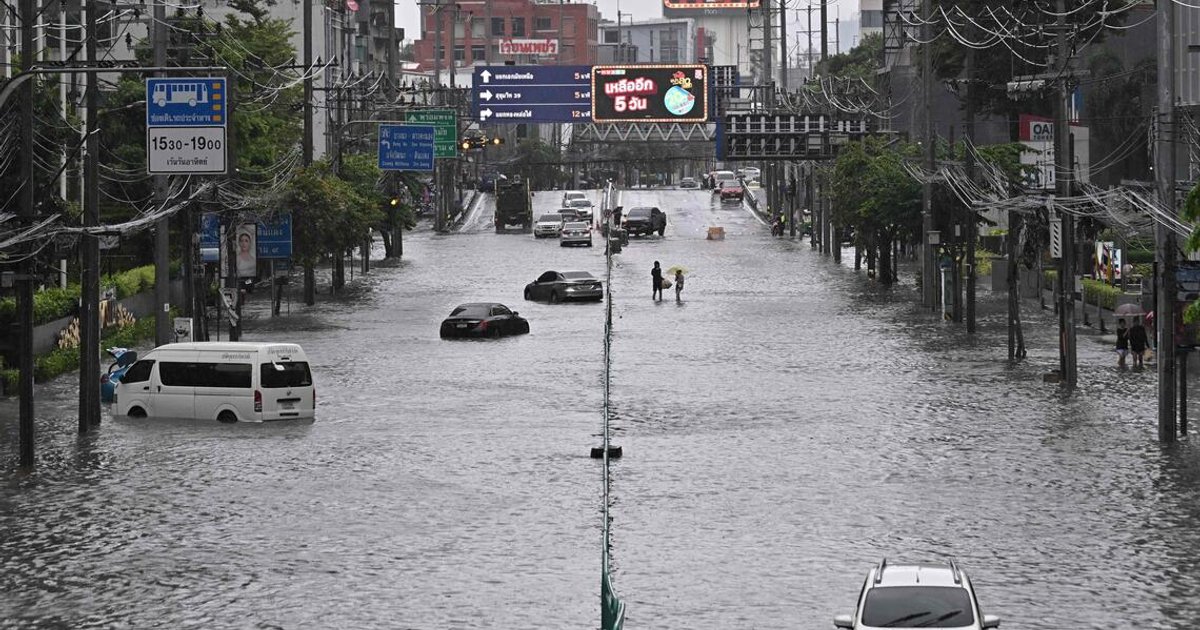
Bangkok got roughly 300 mm of rain in 48 hours from a stalled low-pressure system, swamping drains designed for short tropical downpours. Warmer air is expected to put more water into storms like this one, but nobody yet knows whether warming makes them stall more often.
The Scientist · Science desk
Drafted by a language model from the sources cited here and checked against its claim ledger before publication. How we use AISend a correction
What happened
- The two-day total came to about 87% of the 344 mm that September, Bangkok's wettest month, normally spreads across 18 rainy days.
- Authorities declared a citywide disaster zone, and at least 31 people have died while thousands have been forced to evacuate.
- Sea surface temperatures in the nearby Gulf of Thailand are close to 30 degrees C, several degrees above the local average, supplying the storm with moisture and energy.
- Thirty years of urbanization have raised Bangkok's surface runoff during extreme rainfall by 25% as concrete replaced absorbent soil.
Compiled by The ScientistSomething wrong?How this is made
Why it matters
- constraint Drainage sized for afternoon bursts leaves Bangkok short whenever a system stalls, because the volume to clear keeps growing for as long as the rain keeps falling.
- decision If the wettest-day trend holds, drains built now with a 30-year life must plan for 18 to 36 mm more rain on the wettest day by the end of that life.
- exposure As the ground sinks and the sea rises, floodwater drains more slowly into the Gulf, so future stalled storms will leave water standing in the city longer.
Averaged across the two days, the storm dropped about 150 mm of rain a day [22]. A typical September rainy day in Bangkok brings about 19 mm [21]. So each day of this event delivered close to eight ordinary rainy days' worth of water [22].
The cause was a low-pressure system that sat over the Bangkok region for about three days [6]. Air rises inside a system like this, and its moisture condenses into cloud and rain. When the system stops moving, the rain keeps falling on the same streets for days [6].
Bangkok's drains were built for a different kind of storm. In the humid tropics of Southeast Asia, daytime heat builds cumulonimbus clouds that release heavy rain in afternoon thunderstorms almost every day [1]. Urban drainage in cities such as Bangkok is designed for those short, heavy downpours [1]. A three-day stall keeps the water coming long after an afternoon storm would have ended [6].
The ground makes things worse. Bangkok is a largely flat floodplain near the mouth of the Chao Phraya, with no natural high ground to slow or redirect large volumes of water [10]. Groundwater pumping in the mid-20th century made the city sink, by more than 10 cm in 1988 alone [11]. Groundwater pricing and monitoring have slowed that to 2 to 3 cm a year [12]. At that pace the ground still drops 20 to 30 cm every decade [24].
The climate evidence needs careful reading. According to the phys.org account, it is too early to know how climate change affected this particular event, although its fingerprint shows up in global extreme-rainfall trends [14]. In Bangkok, rainfall on the wettest day of each year is rising by 6 to 12 mm a decade [15]. The thing this doesn't tell you is how stalls behave. A wettest-day trend measures single-day peaks. This flood built up over a stall lasting several days. The authors write that nobody yet knows whether climate change will affect stalling low-pressure systems, but that when such systems form, more rain should be expected [17]. A warmer atmosphere holds more water, and atmospheric water vapour reached a record high in August [16].
Bangkok's deadliest recent flood was a different kind of event. In 2011, high rainfall, several tropical storms, high sea levels and an early monsoon combined to cause flooding that lasted months and killed more than 800 people [8]. World Bank figures put the damage at an estimated US$46.5 billion, with manufacturing hit hardest [9].
I think the warming argument holds in part. Warming points toward more water in each stalled system [16][17]. But the evidence does not yet say whether stalls will come more often or last longer, and the length of this stall set the volume these drains failed to clear [6][17]. The source also does not estimate future deaths. Subsidence and the spread of concrete are the parts of the problem the city controls directly [12][13]. The authors expect extreme floods to hit Bangkok again because of its climate, geography and urbanization [19].
What to watch
- Whether the further rain forecast for Bangkok over the next week lands while residents are still cleaning up.
- An attribution study estimating how much warming added to this event's rainfall.
- Research on whether warming changes how often, or for how long, low-pressure systems stall over Southeast Asia.