Science1 publisherNot yet confirmed elsewhere2 min readPublished
Megatron simulations assemble a Milky Way-like galaxy from thousands of small ones
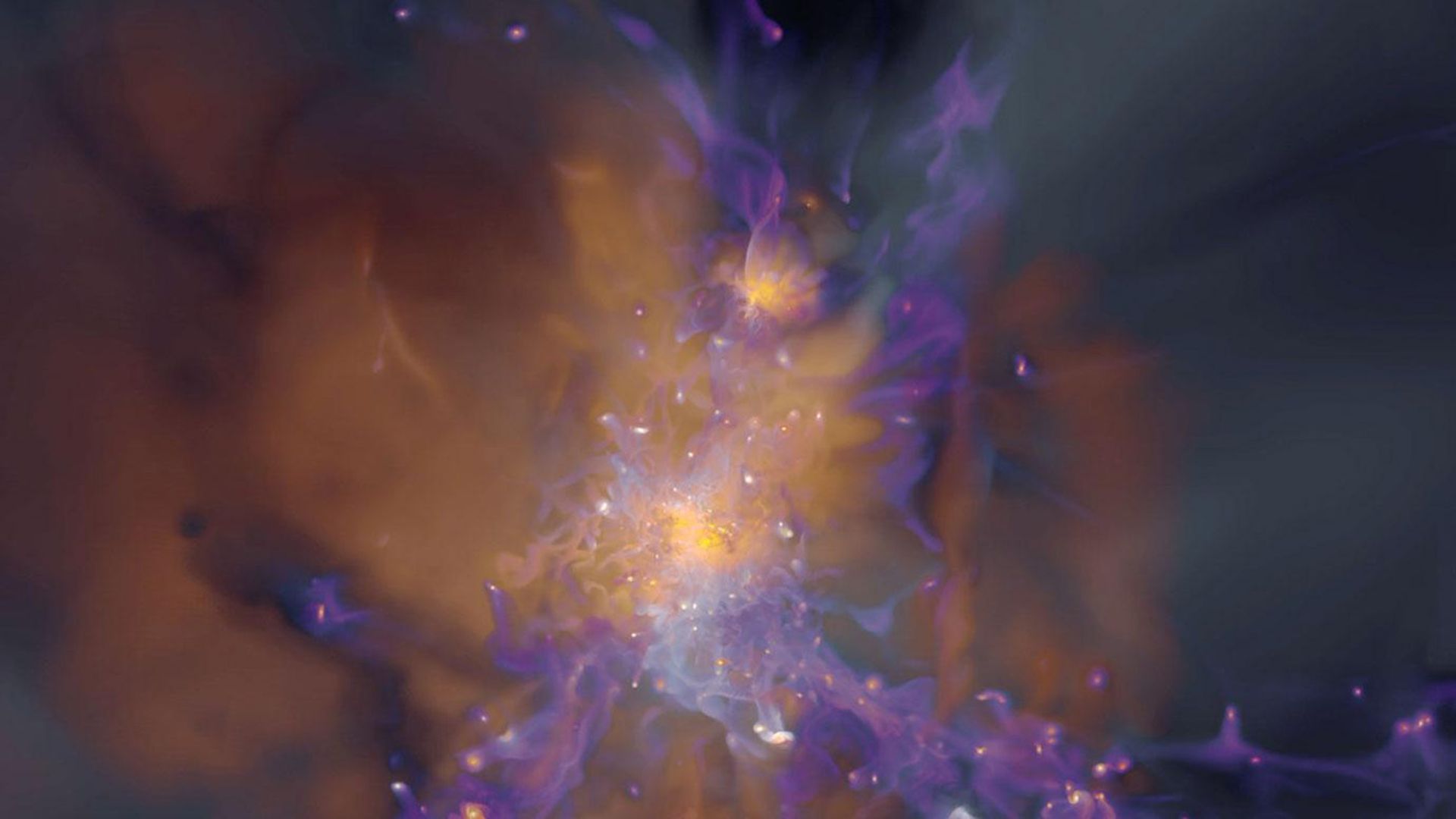
Megatron simulations suggest the region that became a Milky Way-like galaxy held thousands of small merging galaxies in the universe's first 2 billion years. Its galaxies come with predicted spectra that can be checked directly against James Webb Space Telescope data.
The Scientist · Science desk
What happened
- The result comes from three years of supercomputer runs, which Live Science calls the most detailed tracing yet of how a galaxy like ours came to be.
- The simulation starts 180 million years after the Big Bang with only pristine gas, then follows the first stars until their deaths spread carbon, oxygen and iron into the gas around them.
- The James Webb Space Telescope's surprisingly bright early galaxies and compact Little Red Dots show that current models need an update, the researchers said.
- The Milky Way result is one of six papers the Megatron collaboration published on Sept. 30 in The Open Journal of Astrophysics.
Compiled by The ScientistSomething wrong?How this is made
Why it matters
- decision When a JWST galaxy and Megatron disagree, astronomers have to judge whether the galaxy is unusual or the simulation is missing physics, because its own authors say parts of it are still wrong.
- constraint Only part of the path from thousands of galaxies to one is simulated: later merging, including the Sagittarius event begun over 6 billion years ago, has to be pieced together from traces astronomers are still finding.
- precedent Because the suite outputs what JWST measures, the next-generation simulations being built by UK team members can be judged on whether they close those gaps in the telescope's own data.
The count describes a model galaxy. Megatron traces how a galaxy like ours comes together [19]. The thousands of small galaxies, of many sizes and shapes, are what its Milky Way region holds in the universe's first 2 billion years, before they collide and merge [1]. The coverage does not say how many Milky Way-like regions the team simulated. It also does not say whether the new galaxies reproduce the bright early objects and Little Red Dots that the researchers cited as reasons to update the models [4].
I think the more useful result is the output format. Megatron follows gas, starlight and chemistry from 180 million to 2 billion years after the Big Bang, and it predicts the light signatures its virtual galaxies would give off [2]. JWST collects the same type of spectral data over a similar span of cosmic time. According to the team, that lets the simulation be checked directly against real observations to pinpoint what older models miss [3].
The authors do not claim a full match [16]. "But there are also things we're not getting right, which is interesting too," said Harley Katz, an assistant professor of astronomy and astrophysics at the University of Chicago [11] [14]. He followed with a question, "what are the parts we're still missing?" [12], and added: "That can lead you into new directions and new questions." [13]
The chemistry is a second check. The runs track how the first stars formed, died and forged new elements. Those predictions can then be compared both with JWST observations of early galaxies and with the chemical traces left in ancient stars [5]. "Together, these complementary observations allow us to test competing models of the first stars in ways that weren't previously possible," said Martin Rey, a theoretical astrophysicist at the University of Bath [6] [15].
Katz also tied the early physics to the present. "Looking at these results, it's very clear that the physics happening right after the Big Bang has direct impact on what we see today in the local universe," he said [10]. The simulation covers 1.82 billion years of that history, from 180 million to 2 billion years after the Big Bang [18].
What to watch
- Whether any of the six Megatron papers shows the simulated galaxies producing JWST's surprisingly bright early galaxies or Little Red Dots.
- Whether more Milky Way-like regions, simulated the same way, give a similar count of small progenitor galaxies.
Clarity's read
What the record supports and how the coverage leans. The claims behind it follow.
Reality
- Evidence55
- Adoption
- Insufficient
- Hype gap+20
- Incentives
- Insufficient
- Confidence50
Claim ledger
Ranked by verification strength, evidence, and original report placement.
- [1]
The findings suggest that in the first 2 billion years after the Big Bang, the region of the universe that would become our galaxy was littered with thousands of smaller galaxies of many sizes and shapes, which over time collided and merged into a single galaxy.
ReportedSupportedSource: Live Science, reporting the Megatron collaboration's findingsView cited source - [2]
The Megatron simulation suite traces ancient gas, starlight and chemistry from 180 million years to 2 billion years after the Big Bang and predicts the distinct light signatures of its virtual galaxies.
- [3]
Because JWST collects the same type of spectral data across a similar span of cosmic time, scientists can directly cross-reference the simulation against real observations to pinpoint what older models are missing, the team said.
- [4]
JWST found surprisingly bright early galaxies and a class of compact galaxies dubbed Little Red Dots that defied computer models; the researchers said these anomalies demonstrate that current models need an update.
- [5]
The simulation tracks how the first stars formed, died and forged elements; comparing it with JWST observations of early galaxies and with chemical traces left in ancient stars helps scientists understand how those first stars enriched their surroundings.
- [6]
"Together, these complementary observations allow us to test competing models of the first stars in ways that weren't previously possible."
- [7]
The findings are detailed in one of six papers the Megatron collaboration published Sept. 30 in The Open Journal of Astrophysics.
- [8]
The simulation begins 180 million years after the Big Bang, when the universe holds only pristine gas, and follows the first stars until their deaths spread heavy elements such as carbon, oxygen and iron into the surrounding gas.
- [9]
The simulation ends 2 billion years after the Big Bang, but the Milky Way's mergers continued long after; scientists are still discovering traces of small galaxies that joined it, and the merger with the Sagittarius dwarf galaxy began more than 6 billion years ago and is still unfolding.
- [10]
"Looking at these results, it's very clear that the physics happening right after the Big Bang has direct impact on what we see today in the local universe."
- [11]
"But there are also things we're not getting right, which is interesting too"
- [12]
"what are the parts we're still missing?"
- [13]
"That can lead you into new directions and new questions."
- [14]
Harley Katz is an assistant professor of astronomy and astrophysics at the University of Chicago and a co-author of the study.
- [15]
Martin Rey is a theoretical astrophysicist at the University of Bath in the U.K. and a co-author of the study.
- [16]
The simulation results help scientists understand how certain physics parameters affect the early universe and better match JWST observations with models, but also highlight areas that need further study.
- [17]
Megatron team members in the U.K. are developing the next generation of simulations, backed by dedicated time on national computing resources.
- [18]
The Megatron simulation window spans 1.82 billion years of cosmic history.
- [19]
The work is the result of three years of supercomputer simulations and is the most detailed tracing yet of how a galaxy like ours came to be, according to Live Science.
Sources
1 independent publisher whose own reporting we read for this story.
- livescience.comThe Milky Way is one galaxy — but it used to be thousands, new simulations reveal
1 article · October 8, 2026
Topics and entities
Follow any of these and your For You feed starts watching them — no settings page required.
Topics
- Cosmological simulationsFollow
- Early universeFollow
- Galaxy formationFollow
Entities
- MEGATRONFollow
- James Webb Space TelescopeFollow
- Harley KatzFollow
- Martin ReyFollow
- University of ChicagoFollow
- University of BathFollow
- Open Journal of AstrophysicsFollow
- Milky WayFollow
- Sagittarius dwarf galaxyFollow
- Little Red DotsFollow