Science1 publisher3 min readPublished
A magnetar may have done what no lab can: bend light in apparently empty space
Observations of magnetar 1E 1547.0-5408 point to vacuum birefringence, the effect Heisenberg predicted in the 1930s. The team calls it a possible first detection, not a confirmed one.
The Scientist · Science desk
Drafted by a language model from the sources cited here and checked against its claim ledger before publication. How we use AISend a correction
What happened
- Researchers including Dr Marcus Lower of Swinburne University of Technology report observations that may represent the first detection of vacuum birefringence occurring within a magnetar's magnetic field; the findings were published recently in Nature. The result is described as requiring confirmation.
- Vacuum birefringence was predicted nearly 90 years ago, in the 1930s, by Werner Heisenberg, whose work suggested a perfect vacuum is not truly empty but contains virtual particles that briefly appear and disappear.
- According to the theory, an exceptionally strong magnetic field affects the sea of virtual particles associated with the vacuum; those particles then influence how light travels, refracting it in a specific way and producing vacuum birefringence.
- The team studied the magnetar 1E 1547.0-5408 (1E1547) with NASA's Imaging X-ray Polarimetry Explorer (IXPE).
- The IXPE observations were supported by the NICER X-ray telescope aboard the International Space Station and by Murriyang, CSIRO's Parkes radio telescope, owned and operated by Australia's national science agency.
Compiled by The ScientistSomething wrong?How this is made
Why it matters
An international team including Marcus Lower of Swinburne University of Technology says it may have caught vacuum birefringence, the 1930s prediction by Werner Heisenberg that a sufficiently strong magnetic field makes apparently empty space change how light travels; the work was published in Nature [1][2]. What matters for anyone tracking fundamental physics is the instrument list: this was done with an X-ray polarimeter and a radio dish, not a laser hall [4][5].
The theory is old and specific. Heisenberg's work implied that a perfect vacuum is not empty but populated by virtual particles that briefly appear and disappear [2]. A strong enough field acts on that sea of particles, aligning them with the field direction and refracting light in a particular way [3][11]. The obstacle has always been the field. According to Lower, detecting the effect requires a magnetic field over 100 million times stronger than anything ever made on Earth, which leaves magnetars, the rare neutron stars with the strongest known fields in the universe, as the only available laboratory [7][14].
The target was 1E 1547.0-5408, observed with NASA's Imaging X-ray Polarimetry Explorer, with support from the NICER X-ray telescope on the International Space Station and Murriyang, CSIRO's Parkes radio telescope [4][5]. Lower's radio observations with Murriyang, analysed on Swinburne's Ngarrgu Tindebeek supercomputer, tracked how the polarization of the star's radio emission swung as it rotated [6][8]. That yielded the geometry: the magnetic and rotational axes are almost aligned, and the star is seen nearly pole-on, which the team describes as an unusually favourable viewing angle for this search [8][9].
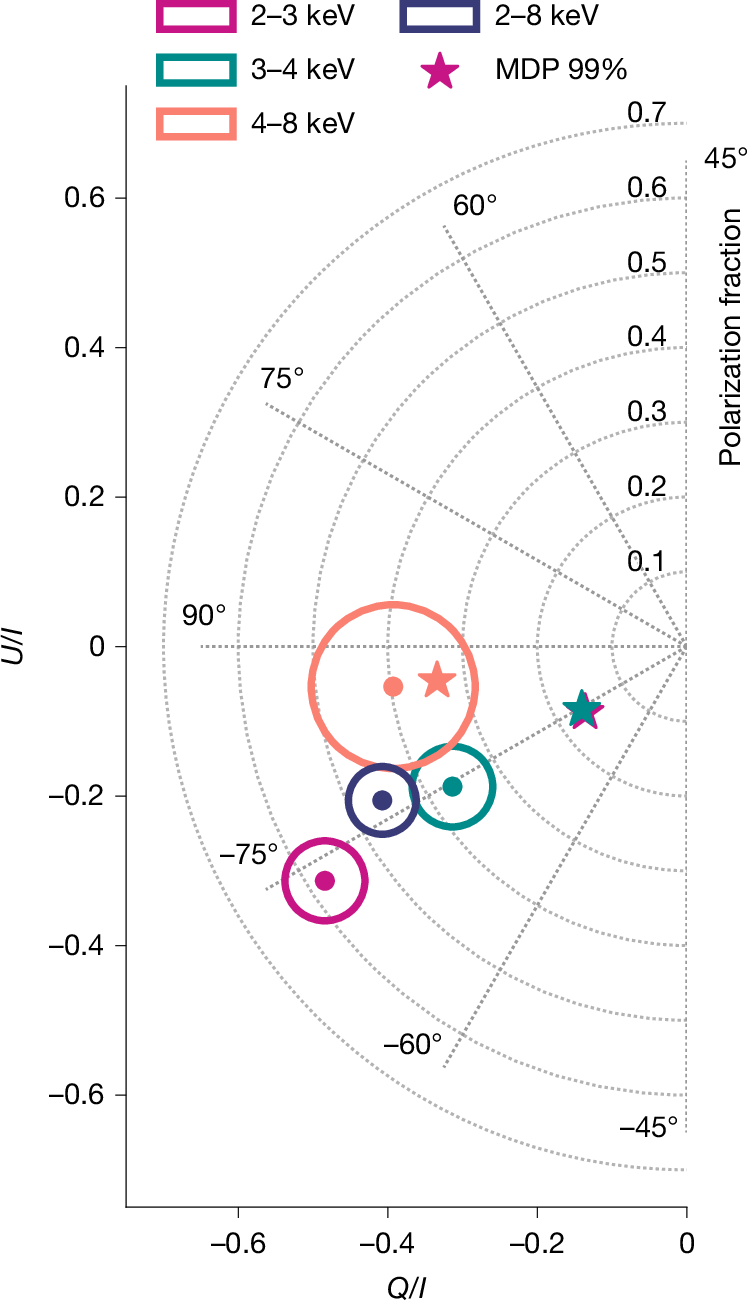
Two things then lined up. The X-rays measured by IXPE were extremely highly polarized, and the direction of that polarization stayed tied to the magnetar's magnetic field in the same way the radio data showed [10]. High polarization plus a field-locked position angle is what the birefringence picture predicts for this geometry [3][9].
The hedging in the announcement is load-bearing rather than decorative. Lower notes that no definitive detection of vacuum birefringence has yet been obtained, and the result is presented as a possible first, conditional on confirmation [12][1]. The Swinburne release also does not give the field strength in gauss, the measured polarization degree, or a statistical significance, so the strength of the case has to be read off the Nature paper rather than the summary [1]. If the interpretation holds, the payoff is a way to test established quantum theory under conditions no accelerator or magnet lab can reach [13].
What to watch: whether the same combination of very high X-ray polarization and a magnetic-field-locked polarization angle appears in other magnetars with comparable geometry, since a single well-aligned, pole-on source is a favourable case and not a population [9][10]. Watch also for competing explanations of highly polarized magnetar X-rays that do not require the vacuum to be doing anything, and for whether follow-up work quantifies how much of the signal only birefringence can produce [10][12].