BuildNot yet confirmed elsewhere1 publisher2 min readPublished
Sandisk prices its NAS 800 up to 65% above the WD Black SN8100 it is built from
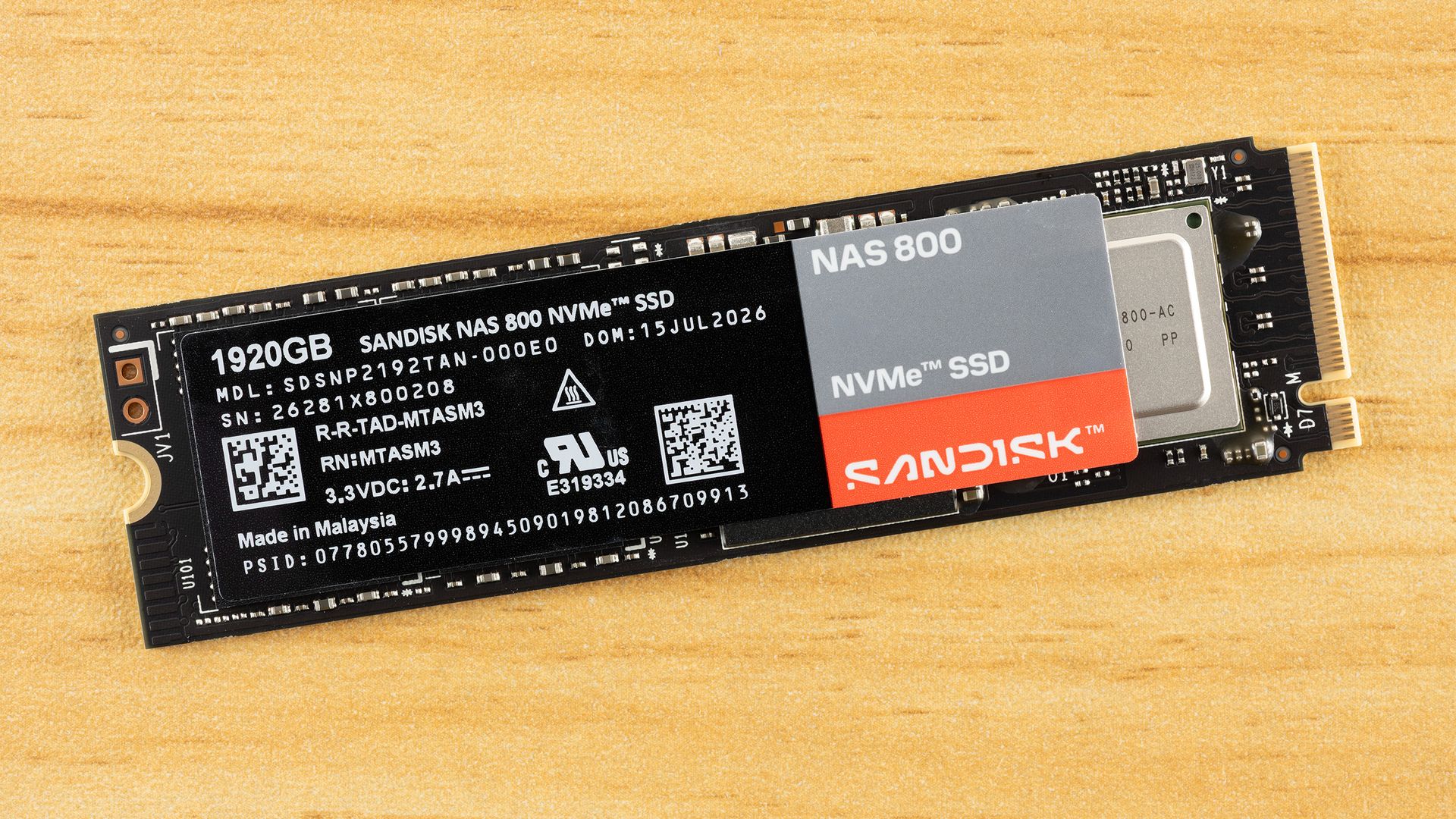
Sandisk's NAS 800, an endurance-tuned WD Black SN8100 rated for up to 14PB of writes, costs 45% to 65% more than that drive, Tom's Hardware found. The extra money buys about one full drive write a day for five years, so it pays off only in a NAS or workstation that writes that much.
The Engineer · Build desk
Bar chart of list price per terabyte by capacity: about $404 at 960GB, $365 at 1.92TB, and $358 at both 3.84TB and 7.68TB.
Approximate list price per terabyte, by capacity In $ per TB
| Item | Value | Claim |
|---|---|---|
| 960GB | 404 $ per TB | 19 |
| 1.92TB | 365 $ per TB | 19 |
| 3.84TB | 358 $ per TB | 19 |
| 7.68TB | 358 $ per TB | 19 |
What happened
- Compared with the same base drive sold under its new Optimus GX Pro 8100 name, the premium shrinks to between 27% and 29% at the time of review.
- Sandisk's store lists the 960GB, 1.92TB, 3.84TB and 7.68TB models at $387.99, $699.99, $1,374.99 and $2,749.99.
- The capacities look odd next to consumer drives because the NAS 800 holds back extra spare flash as overprovisioning to raise endurance.
- Rated speeds reach 14,900 MB/s sequential reads, 13,200 MB/s writes and 2,300K/2,100K random IOPS, and the 3.84TB model is expected to perform best.
Why it matters
- decision Buyers who can still find WD Black SN8100 stock at street prices face the widest gap, so the case for paying the NAS premium is weakest while that old-label stock lasts.
- capability Small-business NAS builders can now buy a 7.68TB NVMe drive without going to enterprise product lines, where the review says large drives have mostly been found.
- constraint Only the 7.68TB model is double-sided, so builders with tight M.2 slots or single-sided heatsinks have to check cooling before choosing the largest capacity.
Fourteen petabytes spread across a 7.68TB drive comes to about 1,823 full drive writes. Over a five-year warranty of 1,825 days, that is 1.0 drive writes per day [18]. Tom's Hardware gets the same figure and calls that level of endurance "all but required for a drive of this type" [10].
According to the review, the extra cost comes partly from the NAS tuning and mostly from the endurance rating [9]. Divide the list prices by capacity and you get about $404 per terabyte at 960GB, about $365 at 1.92TB, and about $358 at both 3.84TB and 7.68TB [19]. At the top capacity, a buyer pays roughly $196 per petabyte of rated writes [20]. The review text states a petabytes-written figure only for the largest model. For the range as a whole, it describes endurance as almost three times the consumer norm, scaled to capacity [4].
Tom's Hardware also recommends the drive for high-end desktops and enthusiast workstations [17]. We think the premium is worth paying in either role only if the machine regularly writes close to the drive's full capacity. Examples are a NAS write cache, a virtual machine store, or a workstation scratch volume. A mostly-read file share will reach the end of the warranty with most of the rating unused.
The base hardware is good. The review calls the SN8100 one of the best drives on the market, with "a stellar controller and excellent all-around flash with good power efficiency and low latency" [14]. The NAS version gives back some of that efficiency. Tom's Hardware lists below-average power efficiency as a reason to avoid it [11]. The 1.92TB model is rated at 3.3V and 2.7A, or about 9W. That sits between its 9.50W maximum power state and its 6.5W/6.4W average draw [12]. Its reported active draw is 7.52W. The review expects real-world draw to be lower, because the NAS tuning leaves the drive with only a small pSLC cache [13].
What to watch
- Published TBW ratings for the 960GB, 1.92TB and 3.84TB models, which would show whether the one-drive-write-per-day ratio holds below the top capacity.
- Whether the 27% to 29% gap over the Optimus GX Pro 8100 narrows once NAS 800 street prices fall below Sandisk's store list prices.
- Measured idle power in multi-drive NAS chassis, where below-average efficiency adds up across every bay and every hour.
Clarity's read
What the record supports and how the coverage leans. The claims behind it follow.
Reality
- Evidence55
- Adoption
- Insufficient
- Hype gap+15
- Incentives
- Insufficient
- Confidence55
Claim ledger
Ranked by verification strength, evidence, and original report placement.
- [1]
The Sandisk NAS 800 is a specialized, optimized Sandisk Optimus GX Pro 8100, the drive formerly sold as the WD Black SN8100.
- [2]
The NAS 800 comes in 960GB, 1.92TB, 3.84TB and 7.68TB capacities, which look strange next to consumer offerings because the drives reserve more spare flash as overprovisioning, improving endurance.
- [3]
Rated performance is up to 14,900 / 13,200 MB/s sequential reads and writes and up to 2,300K / 2,100K random read and write IOPS, with peak overall performance expected at 3.84TB.
- [4]
The NAS 800 is rated for up to 14PBW at its maximum capacity; proportional to size, this is almost three times the norm for consumer drives.
- [5]
The NAS 800 carries a standard five-year warranty.
- [6]
At the time of writing, Sandisk's store listed the four capacities at $387.99, $699.99, $1,374.99 and $2,749.99.
- [7]
The NAS 800's prices are roughly 45% to 65% more than the WD Black SN8100's current street prices.
- [8]
Against the same drive under its new Optimus GX Pro 8100 name, the NAS 800's premium is between 27% and 29% at the time of review.
- [9]
The extra cost comes partly from the drive's optimization but mostly from its TBW rating.
- [10]
Buyers get about one drive write per day over the five-year warranty, "which is all but required for a drive of this type, and worthy of the price tag if you're focused on endurance."
- [11]
Tom's Hardware lists high price and below-average power efficiency as reasons to avoid the NAS 800.
- [12]
The 1.92TB drive's rating of 3.3V / 2.7A puts it at around 9W, between its maximum power state of 9.50W and its 6.5W / 6.4W average draw for this capacity.
- [13]
The reported active draw of 7.52W is higher than the average, but because the drive is NAS-optimized with a small pseudo-SLC cache, it will likely be lower in practice.
- [14]
The SN8100 progenitor is one of the best drives on the market. It has "a stellar controller and excellent all-around flash with good power efficiency and low latency."
- [15]
The 960GB, 1.92TB and 3.84TB versions are single-sided; only the 7.68TB version is double-sided, which could make a difference for certain cooling arrangements.
- [16]
The 7.68TB capacity is the most welcome because it has been difficult to find larger drives outside of enterprise.
- [17]
The NAS 800 is designed for NAS appliances but could also be a good choice for high-end desktop and enthusiast workstations.
- [18]
14PB over 7.68TB is about 1,823 full drive writes; over 1,825 days of warranty that is about 1.0 drive writes per day.
- [19]
List price per terabyte is about $404 at 960GB, $365 at 1.92TB, and $358 at both 3.84TB and 7.68TB.
- [20]
At 7.68TB, the list price works out to about $196 per petabyte of rated writes.
Sources
1 independent publisher whose own reporting we read for this story.
- tomshardware.comSandisk NAS 800 1.92TB SSD Review: Endurance at a premium
1 article · October 11, 2026
Topics and entities
Follow any of these and your For You feed starts watching them — no settings page required.
Entities
- SanDiskFollow
- Western DigitalFollow
- Sandisk NAS 800Follow
- WD Black SN8100Follow
- Silicon Motion SM2508Follow
- Tom's HardwareFollow