Science1 publisherNot yet confirmed elsewhere3 min readPublished
Researchers question vertical farms' place in Canada's $750 million food security strategy
Canada's $750 million food security strategy backs vertical farms that mostly grow pricey greens and berries, researchers who reviewed developers' claims argue. If they are right, that spending buys year-round produce many low-income households cannot afford.
The Scientist · Science desk
What happened
- Canada's first National Food Security Strategy, launched in June 2026, targets more year-round domestic fruit and vegetable production, with vertical farms included.
- The authors tie the industry's need for high unit prices to its energy and infrastructure bills, and note several high-profile bankruptcies in recent years.
- The UN Food and Agriculture Organization leaves leafy greens out of its global hunger statistics, a point the authors cite against food security claims.
Compiled by The ScientistSomething wrong?How this is made
Why it matters
- decision Ottawa has to decide how much of the $750 million goes to buildings whose main crops, by the authors' account, are priced beyond the low-income buyers a food security plan is meant to reach.
- contradiction The strategy's production target counts LED-grown lettuce and berries as success, while the authors judge the same crops against food insecurity, so the two are grading different outcomes.
- constraint Because the review studied developers' claims and press coverage, its energy argument stays open until operators publish metered data; the crop-and-price argument does not wait on that.
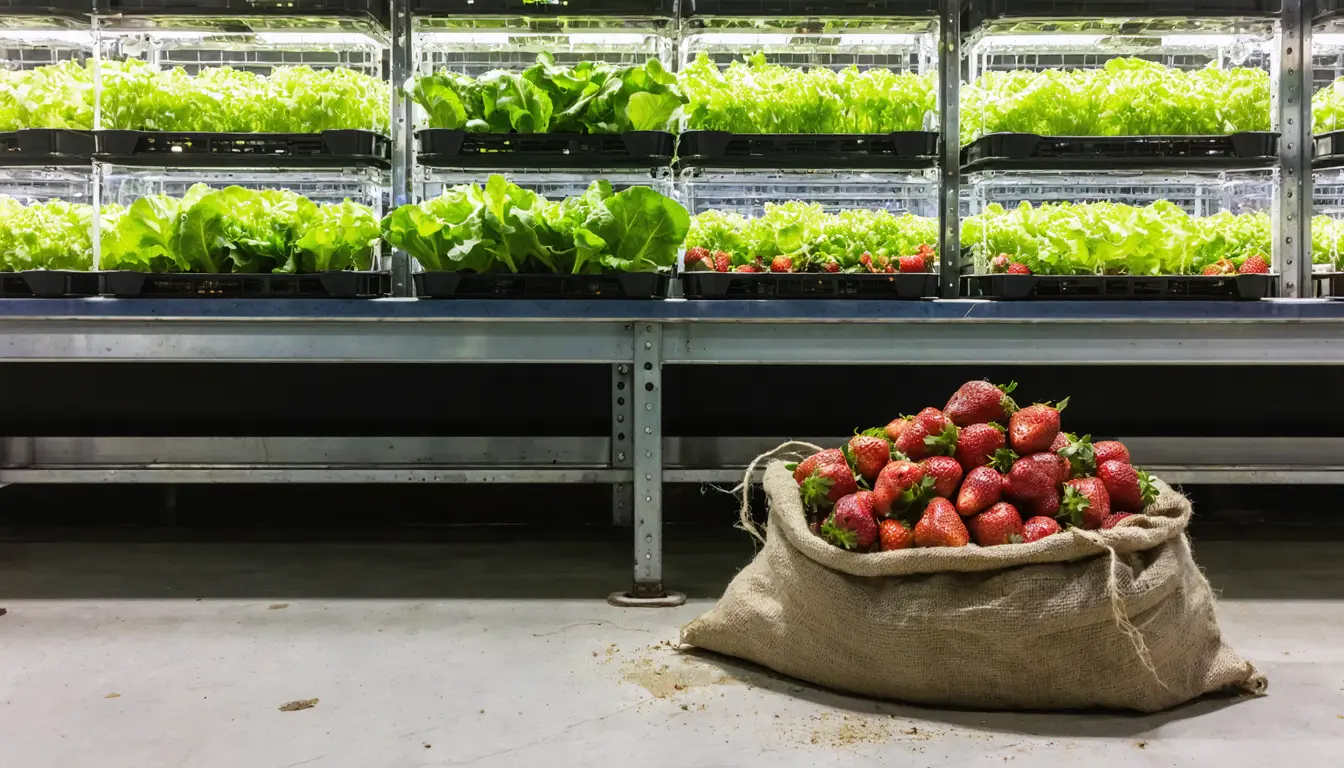
The authors define vertical plant factories as fully enclosed buildings where artificial light, plumbing, engineered substrates and climate control replace sun, soil and seasons [3]. Their argument starts with energy. A sealed building swaps free sunlight for high-powered LEDs, and its temperature and ventilation systems run around the clock [7]. Lighting, wiring, tubing and microchips break down or go out of date and have to be replaced often [8]. Those costs are recovered from each unit sold, so growers choose crops that fetch high prices per unit of volume, mainly lettuce, microgreens and berries [9][10]. Staple crops are out of reach, they write [9].
From there they move to who eats the output. The produce is often nutritionally limited and too expensive for low-income consumers, they write, so claims that vertical farms can help with food insecurity are misleading [11]. They point out that the Food and Agriculture Organization of the United Nations does not count leafy greens in its global hunger statistics [12]. The world already grows enough food for its population, the authors add, and the problem is distribution [13].
The study behind the article examined what leading Canadian vertical-farm developers claimed and how major Canadian news outlets reported those claims [4]. That design is good at one job: checking whether the public story matches the product. The claims under test were that the farms are climate-resilient and use less land and water [6]. A review of claims and coverage cannot weigh those against metered energy use per kilogram of lettuce. I think the crop-and-price argument is the sturdier half of the case, because it follows from a cost structure the industry has to price in however the press describes it.
Set against the strategy itself, the critique splits in two. The strategy's stated aim is more year-round Canadian production of fruits and vegetables [2]. Greens and berries grown under LEDs in a Canadian winter count toward that goal. The authors' objection lands on the food security label: the crops these buildings favour are the ones they say low-income households cannot afford [11]. The article does not say how much of the $750 million is meant for vertical farms, or give energy or cost figures for any of them.
Their broader conclusion is that the farms continue the contradictory logic of industrial agriculture instead of solving its problems [5]. They place the buildings inside what Sharon Stein and Evan Bowness call the "politics of continuity", a struggle over what societies try to preserve amid environmental instability, what they will do to preserve it, and who bears the costs [14]. Canadians expect supermarket shelves stocked with fresh produce all year, and vertical farms promise to keep them that way instead of adapting food systems and consumption to ecological limits, the authors write [16]. "Our point is that enormous technological and material investments are being mobilized to preserve the expectation that a particular version of the present can be sustained into an increasingly unstable future," they wrote [15].
What to watch
- A breakdown from Ottawa of how much of the $750 million goes to vertical farms compared with other fruit and vegetable growers.
- Metered energy and equipment-replacement data from Canadian vertical-farm operators, which would test the authors' energy argument directly.
- Whether any funded project grows staple crops or sets retail prices aimed at low-income buyers.
Clarity's read
What the record supports and how the coverage leans. The claims behind it follow.
Reality
- Evidence35
- Adoption
- Insufficient
- Hype gap
- Insufficient
- Incentives
- Insufficient
- Confidence40
Claim ledger
Ranked by verification strength, evidence, and original report placement.
- [1]
The Canadian government launched its first National Food Security Strategy in June 2026.
- [2]
The National Food Security Strategy aims to invest $750 million to increase year-round Canadian production of fruits and vegetables, including on so-called vertical farms.
- [3]
Vertical plant factories are fully enclosed buildings or warehouses where artificial lighting, wiring, plumbing, engineered substrates and climate control systems replace sun, soil and seasons; they are largely oriented toward producing leafy greens and berries.
- [4]
The authors examined the claims made by leading Canadian vertical farm developers and how those claims have been covered in major Canadian news outlets.
- [5]
The authors argue vertical plant factories are not a solution to the problems of industrial agriculture but a problematic continuation of its contradictory logic.
- [6]
Vertical plant factories are promoted as climate-resilient and land-saving, and touted for using less water and less land; they draw investment from governments and venture capital.
- [7]
Growing plants in a sealed building replaces sunlight with high-powered LEDs and temperature and ventilation systems that run around the clock; the systems often require enormous energy and extensive digital infrastructure.
- [8]
Equipment like lighting, wiring, tubing and microchips must be frequently replaced as it breaks down or becomes outdated.
- [9]
Vertical plant factories cannot grow staple crops; many focus on high-margin items like lettuce, microgreens and berries.
- [10]
High prices per unit of volume are required to pay the enormous energy and infrastructure costs of plant factories; several high-profile bankruptcies have plagued the industry in recent years.
- [11]
The fresh produce grown is often nutritionally limited and prohibitively expensive for low-income consumers, so claims that vertical plant factories can help address food insecurity are misleading, the authors argue.
- [12]
The Food and Agriculture Organization of the United Nations does not include leafy greens in global hunger statistics.
- [13]
Enough food is produced globally to feed the population, but prioritizing distribution remains a problem.
- [14]
Sharon Stein and Evan Bowness use the term 'politics of continuity' to describe the struggle over what contemporary societies seek to preserve amid deepening environmental instability, what they are willing to do to achieve these ends and who bears the costs.
- [15]
"Our point is that enormous technological and material investments are being mobilized to preserve the expectation that a particular version of the present can be sustained into an increasingly unstable future."
- [16]
Canadians have grown accustomed to supermarket shelves stocked year-round with fresh produce; vertical plant factories promise to sustain this expectation instead of adapting food systems and consumption patterns to ecological limits.
Sources
1 independent publisher whose own reporting we read for this story.
- phys.orgWhy 'vertical farming' is not a fix for our food system
1 article · October 8, 2026
Topics and entities
Follow any of these and your For You feed starts watching them — no settings page required.
Topics
- Agricultural policyFollow
- Food SecurityFollow
- Vertical farmingFollow
Entities
- National Food Security Strategy (Canada)Follow
- Government of CanadaFollow
- Food and Agriculture Organization of the United NationsFollow
- Sharon SteinFollow
- Evan BownessFollow