Science1 publisher3 min readPublished
Norway's first fully automated vegetable line reaches Coop stores with a 12-week shelf life
SINTEF's look at the Gardermoen facility run by Coop Norge and Avisomo finds the commercial case sitting in keeping quality, while the four other Norwegian growers it visited still run robots alongside hands.
The Scientist · Science desk
What happened
- Himmelgront AS, a partnership between the supermarket chain Coop Norge and the technology company Avisomo, runs the facility at Gardermoen near Oslo, which started up last fall and reached stores this spring.
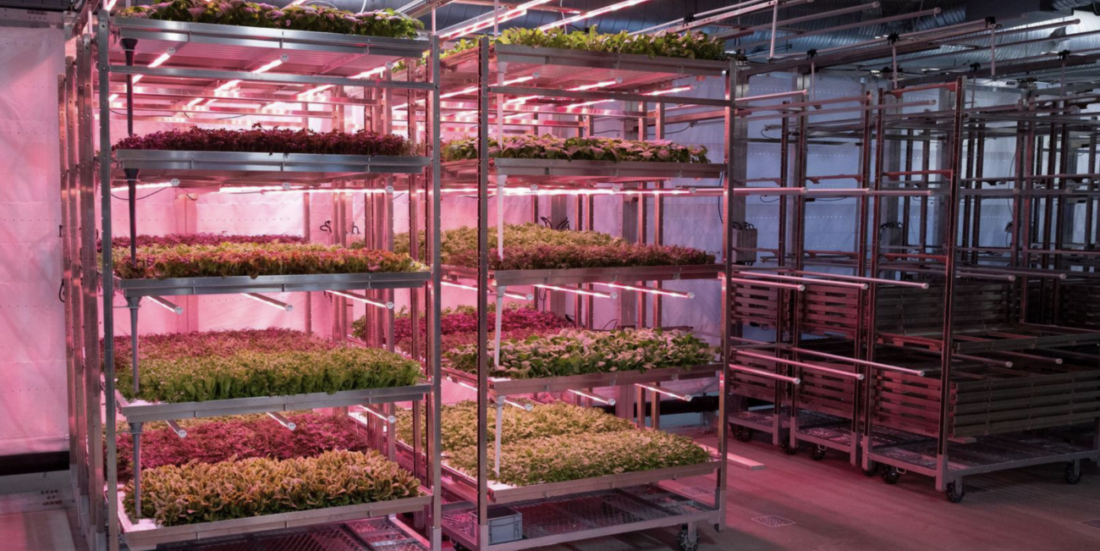
- Robots and automated systems carry out every task at the site, with light, air and water adjusted automatically to hold growing conditions.
- SINTEF reports that the growing model triples the lifespan of lettuce and herbs, taking shelf life to 12 weeks.
- Alongside Avisomo, the researchers visited four other Norwegian vegetable growers, none of them fully automated and all running a mix of automation and manual work.
Compiled by The ScientistSomething wrong?How this is made
Why it matters
- capability One site outside Oslo can supply every store in the chain, so a longer-keeping product can be listed nationally off a single build instead of a regional trial.
- decision For the four partly automated growers, the next move is a capital decision: SINTEF's own researcher puts the suitable level of automation down to investment, with the technology already available.
- exposure A grower blocked by hiring now has a production route that does not depend on the seasonal harvest workers Norway is short of.
- constraint Anyone pricing this against a conventional greenhouse has to generate their own energy, yield and capex numbers, because the published assessment leaves them out.
SINTEF describes the change in keeping quality as a tripling, and the baseline it gives for lettuce and herbs is 2 to 4 weeks [10]. Twelve weeks against four is three times; against two it is six [23]. Both figures describe how long a bag can sit before it has to be pulled, and neither measures what a store actually discards; Bakås's expectation that "much less has to be thrown away" [11] follows from the shelf-life number without being tested against sales data.
The project looked at vertical farming, indoor growing in a controlled environment with crops in stacked layers [18]. One seed goes into a unit on a multilevel shelf, the roots grow down into flowing water carrying nutrients, and the plant grows on top [8]. The fastest lettuces are ready in just over two weeks [9]. "In this facility, no one touches the lettuce from the time it is sown, grown and packaged until it ends up on the store shelf and is finally opened by the customer at home in their kitchen," said Ottar Bakås, a SINTEF researcher [4]. He and colleagues studied the status of automated indoor vegetable production in Norway and the scope for more of it [6]. Bakås said keeping the crop out of contact with human hands removes disease-risk sources that could reduce product quality [20]. Aleksander Lillienskiold, a former SINTEF researcher on the project [5], said the closed environment means "there are no pesticides or insects, so when the lettuce is ready for harvest, it can just be cut and bagged right away" [19].
The team also visited four other Norwegian growers, none fully automated, each mixing automation with manual work [15]. A grower deciding what to buy would want that part in detail. Which tasks those four still do by hand is missing from the published account, along with capital cost, energy use and yield figures [24]. Lillienskiold put the limit on capital: "The degree of automation that is suitable will vary. It is also a question of investment," he said [16]. On the technology itself he said it "is still common for many tasks to be done by people, but technology has evolved to the point where we can automate manual tasks" [17].
The health argument runs through two steps. "Research shows that the more you offer of a product line, the more customers buy. This can have a positive health effect on the population," Lillienskiold said [12]. The first step is an association between assortment and sales; the second assumes the extra purchases displace something less healthy. The article does not cite the studies behind either.
On labour, Lillienskiold said: "This will solve staffing challenges. Norway has a shortage of this type of labor" [13]. He also expects fewer heavy and dangerous tasks and more varied work in the sector [14].
The same shelf-and-water approach suits berries, tomatoes and cucumbers, and the researchers expect more growers to move toward it [21]. Bakås said the group hopes "to work on understanding how automation can contribute to this growing model being rolled out to a greater extent in Norway" [22].
What to watch
- Whether SINTEF publishes a task-level breakdown for the four partly automated growers, with the capital cost attached to each step.
- Whether Himmelgront extends the Gardermoen line beyond lettuce and herbs to tomatoes, cucumbers or berries.
- Whether Coop's own shelf data show the assortment-to-sales effect Lillienskiold expects from longer-keeping salad.