Invest1 publisher3 min readPublished
Japan buys back 210,000 tons of rice as private stocks swing from 1.5 million to 2.43 million
Japan is buying back 210,000 tons of rice to refill its reserves after private stocks swung from 1.5 million to 2.43 million tons in two years. The purchase covers about half the stock above the normal 2 million tons, so prices can keep falling from their 2025 peak.
The Investor · Invest desk
What happened
- Heat and drought damaged Japan's 2023 rice crop, and the shortage that followed in 2024 was severe enough to force a government minister to resign.
- Farmers chasing those prices raised output, and private stocks climbed from about 1.5 million tons to 2.43 million tons by mid-2026.
- This month the government moved to buy back 210,000 tons of rice to refill the emergency reserves it released in 2025.
Compiled by The InvestorSomething wrong?How this is made
Why it matters
- cost The state pays to take out about half the excess above normal stock, and the roughly 220,000 tons it leaves behind keeps pushing prices down.
- constraint A US purchase commitment agreed during the shortage keeps adding imported rice through 2026, working against the government's effort to shrink the glut.
- exposure Growers who expanded when a bag sold for 4,300 yen now face a ministry forecast of an even larger surplus heading into 2027.
- precedent Regulators who cannot trace rice from farm to consumer will struggle to time the next release or buyback any better than the late 2025 one.
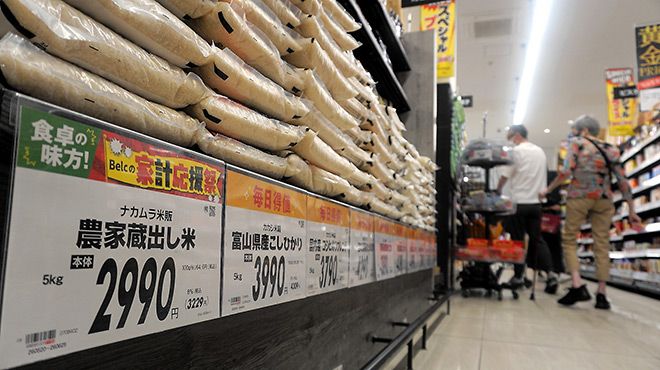
The shortfall that started this was about half a million tons. Private stocks fell from a normal level of about 2 million tons to roughly 1.5 million [6], a gap of 25% [7]. Heat and drought in 2023 had damaged rice during grain filling, while a tourism boom and panic buying after an earthquake warning lifted demand [5]. "The supply-demand gap was there, but it's not such a huge gap," said Ryosuke Inoue, a visiting fellow at the CSIS Japan Chair in Washington [19][4]. He added: "But in the U.S., the price fluctuation is not so high." [4] In Japan a five-kilogram bag went from about 2,000 yen in early 2024 to 4,300 yen by 2025, according to his data [7]. A 25% shortfall produced a 115% price rise [3].
"Every expert is actually surprised by this fluctuation," Inoue told Fortune [3]. Growers answered the price by planting hard, and private stocks climbed to 2.43 million tons by mid-2026 [10], about 430,000 tons above normal [1]. From trough to peak the stock moved roughly 930,000 tons, close to twice the hole it was filling [2]. The bag has fallen back toward 3,300 yen [11]. The fall so far is 23% from the peak, and the bag still costs about 65% more than when the shortage began [4]. Inoue estimates the price could keep sliding toward 2022 and 2023 levels or lower [11].
The 210,000-ton buyback is sized to the reserves the government drained in 2025 [12], its first emergency release since the reserve system was created in 1995 [8]. Against the 430,000 tons above normal, it takes out about 49% [5]. If the whole purchase comes out of the mid-2026 private stock, that stock still sits near 2.22 million tons, around 11% above normal, with about 220,000 tons of excess left [6]. The agriculture ministry forecasts the surplus growing into 2027 [10].
In the Fortune account, the overshoot came from farmers chasing price [10]. The state's part in the shortage was timing. "People said the government should have released the rice much more quickly," Inoue said [9]. Asked whether Japan's rice stock lacked a buffer, he said: "Your instinct is correct." [18] He also described a supply chain the regulator could not see: "Many distributors are trying to maximize their profit, and even the government doesn't know how the rice was distributed from the farmers to the final consumers." [13]
Trade is where policy still adds supply. Japan already bought US rice under a 770,000-ton duty-free WTO quota, about half of it historically American [14], and a 2025 deal pushed its US purchases up 75% [15]. "This trend will continue in 2026 and further," Inoue said [15].
The market has three plausible paths. Prices slide toward Inoue's lower range, growers cut planting and the next hot summer meets a thin buffer [11]. Alternatively, the buyback holds the bag near 3,300 yen while stocks stay heavy into 2027 [10][12]. The third is a bad harvest landing on 2.43 million tons of stock, where the surplus finally works as the buffer Japan lacked [10][18]. I think the first is the most likely. Price is the only signal coordinating output, in a chain the regulator cannot trace [13]. The average grower is 67.7 years old and 1.2% are under 30 [16], yet that workforce raised output enough to overshoot in about two years [10]. The view is wrong if stocks settle back near 2 million tons while the bag holds above the 2,000 yen where the shortage began [6][7].
What to watch
- The agriculture ministry's 2027 supply forecast, and whether planted area falls as the bag price slides from about 3,300 yen.
- Whether the government buys beyond the 210,000 tons needed to refill the reserves it drained in 2025.
- US rice volumes arriving under the 2025 trade deal as the 75% purchase increase keeps working through the system in 2026.