Science1 publisher3 min readPublished
Duke team uses 13 trapped ions to watch a simulated particle string break
Duke-led physicists used 13 trapped ions to reproduce string breaking, in which a stretched bond between particles snaps and new pairs form. Two other teams saw similar physics on other hardware, though at this size any payoff for particle physics is still a forecast.
The Scientist · Science desk
What happened
- A team led by the Duke Quantum Center used a 13-ion trapped-ion simulator to observe string breaking, the process tied to particle-antiparticle pairs forming.
- The paper appeared in Nature Physics on September 23, with collaborators at Maryland, Oxford, Caltech, Cornell and KU Leuven.
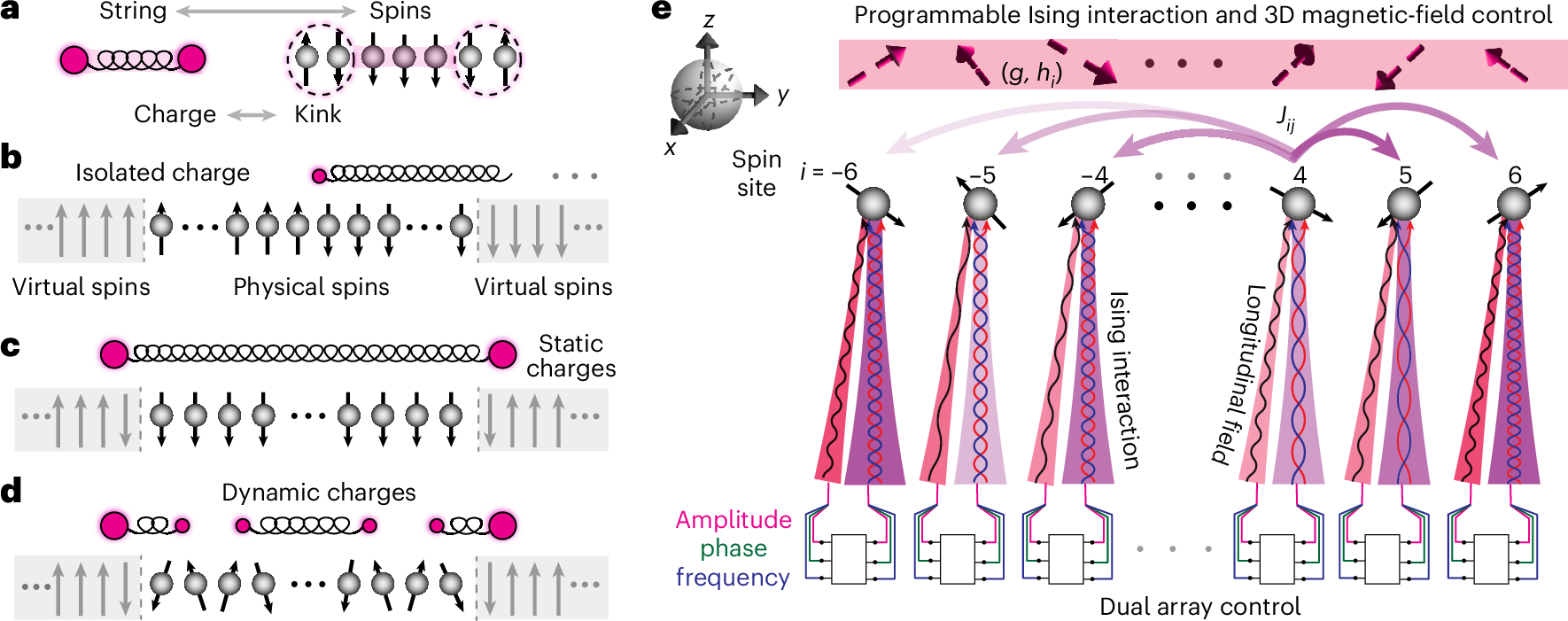
- The team encoded a string-breaking model into the chain of ions and used laser beams to adjust how the ions interacted with one another.
Compiled by The ScientistSomething wrong?How this is made
Why it matters
- constraint With a chain of only 13 ions, the result can show that the protocol works; any edge over classical computers on particle-physics problems still has to be demonstrated on larger runs.
- precedent With three teams using different hardware, string breaking is becoming a shared test problem, so future simulator results can be compared across platforms on the same physics.
- capability Physicists can now program and follow over time a process that in nature needs collider energies or conditions just after the Big Bang.
Quarks sit inside protons and neutrons, roughly a billion times smaller than an atom, and isolated quarks cannot currently be observed directly because they stay tightly bound [9]. Duke's release describes the effect with a stretched string between two charged particles. The farther apart they are pulled, the more energy the string stores, until there is enough to create new particles and the connection breaks into pairs [3]. In nature this needs enormous energy, the kind produced in the Large Hadron Collider or thought to have existed shortly after the Big Bang [10].
The experiment runs a model of this process in ions. Tuning the ion interactions let the team control the system's energy and stretch the simulated string until it broke. The release calls the result "analogous" string-breaking behavior [5]. Duke's case for using a simulator here is that it can be precisely controlled and programmed to imitate processes at atomic and subatomic scales [11].
The design choice I like best is the starting point. The researchers put the chain in an out-of-equilibrium state and then followed how it changed over time [6]. That means the experiment records the process as it unfolds. A snapshot of the end state would not show that.
Thirteen ions is a small machine [4]. Duke calls the result one of the earliest demonstrations of its kind [12], and its summary keeps the payoff conditional: quantum computers "could eventually" help researchers study how matter formed and evolved after the Big Bang [13]. The release does not report whether the 13-ion run was checked against a classical calculation, or whether a classical computer could have reproduced it. On this evidence, the work shows the protocol runs on real hardware. Showing that such machines can handle particle-physics problems that defeat classical computers will take larger runs than this one.
The stronger evidence comes from outside Duke's lab. A result that turns up on machines built in different ways is harder to blame on the quirks of one machine. Two other teams have published similar physics on different types of quantum hardware [7]. With Duke's, that makes at least three demonstrations [8].
Christopher Monroe, the Duke professor who led the research [16], made the larger claim. "Quantum computer simulations provide the best platform to investigate complex questions like matter formation, short of having witnessed the Big Bang itself," he said [14]. For a 13-ion chain, I think "best platform" describes where the field hopes to go more than what this result shows [4]. The first author, Arinjoy De, has since left Monroe's lab to become production machine lead at QuEra Computing [18]. "By simulating quark confinement and string-breaking phenomena in a controlled lab environment, we're opening up new pathways for experimental investigations into the behavior of matter at its most fundamental level," De said [17].
What to watch
- Longer ion chains, or a published classical comparison, that show a string-breaking result a classical computer cannot reproduce.
- A side-by-side reading of the two other string-breaking studies on different hardware, to see whether the three platforms agree on the details.