Science1 publisher2 min readPublished
CUNY physicists find vibrations settle into stable loops in an irregular hyperbolic cavity
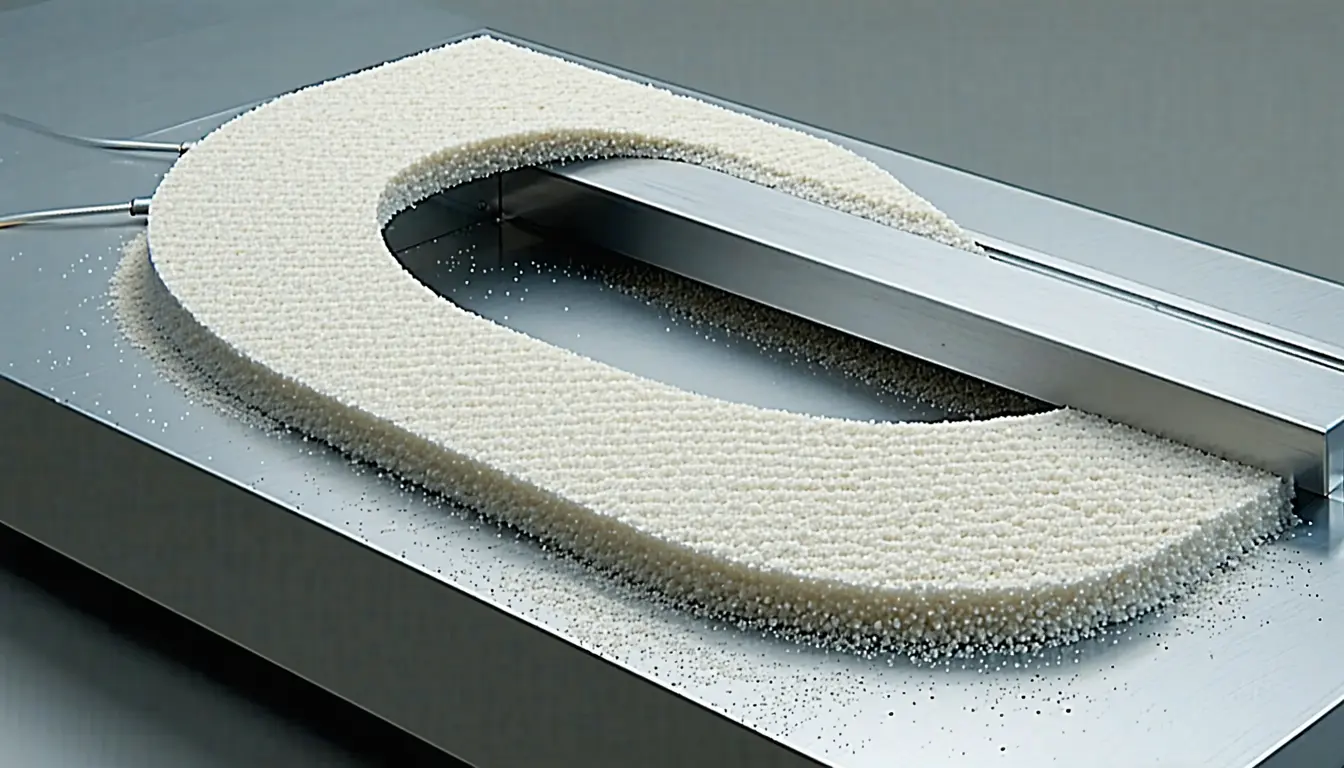
CUNY ASRC physicists report in Nature Physics that waves bouncing in an irregular hyperbolic cavity settle into stable closed loops. The test used mechanical vibrations, so steering light and radio this way is still a proposal.
The Scientist · Science desk
What happened
- The team traces the order to a break in mirror symmetry during reflection, with the wavelength shrinking on each successive bounce around the cavity.
- The closed paths are scale-invariant, keeping the same underlying geometric structure across different scales.
- Each attractor has a handedness, circulating clockwise or counterclockwise, and that property is tied to how waves propagate in the material.
- Oceanographers study similar internal wave attractors in water with density gradients, according to the researchers.
Compiled by The ScientistSomething wrong?How this is made
Why it matters
- constraint Optical and radio engineers have no measured result in their own media to build on yet, so every claim about steering light or radio signals rests on extrapolation from a mechanical test.
- capability If the rules carry over, a cavity's shape and material could be chosen to set where waves circulate and which way they turn, instead of accepting the chaotic pattern an irregular geometry usually produces.
- precedent The overlap with ocean internal wave attractors gives metamaterials researchers and fluid dynamicists a second physical system in which to test the same geometry.
A ball bouncing inside a curved or irregular container is a textbook model of chaos, known as a dynamical billiard [5]. The wave version behaves the same way. An ordinary wall sends a wave out at the angle it came in, and in an irregular room repeated reflections scatter it in many directions [5].
Hyperbolic materials take their name from the hyperbola, because of the shape they force light waves to take [14]. They change the reflection rule. They hold waves to narrow, sharply defined directions, so a wave meeting a tilted wall can leave at an angle an ordinary material would not produce [6].
Andrea Alu's group at the CUNY Advanced Science Research Center wanted to know what those rules would do inside an irregular cavity [15]. The expected answer was more chaos. "Normally, we expect a complicated cavity to produce complicated, chaotic wave patterns," said Simon Yves, a postdoctoral researcher in the lab and a first author of the study [7]. "Here, the opposite happens. The unusual propagation and reflection of waves create a strong geometric organization, producing well-defined paths that can persist across a broad range of wavelengths." [7]
The experiment ran on engineered vibrations in a mechanical metamaterial, a structure built to control how waves move through it [11]. I think that was a sensible place to start, because the team needed to see the organization form. Enrico Renzi, a doctoral student and the other first author, put it in those terms. "We can observe how the waves become organized, and we can connect that organization to properties such as stability and handedness," he said [12]. "This gives us a framework for designing wave behavior rather than simply observing it." [12]
The thing this doesn't tell you is how the effect holds up in the systems the proposed applications need. According to the release, the findings could eventually help engineers control light, radio waves and sound in complex environments [2]. The demonstration it describes is mechanical [11]. The release does not give operating frequencies, cavity sizes, or how much energy a wave keeps as it circles an attractor. Those are the figures an optical or radio designer would ask for first.
Alu, the study's principal investigator and director of the center's Photonics Initiative, described the next step as exploration. "By understanding how waves organize themselves in these hyperbolic media, we can begin to explore new approaches to controlling energy, information and communication signals in complex environments," he said [3].
What to watch
- A demonstration of the attractors in an optical or radio-frequency hyperbolic material, with operating frequencies and cavity dimensions reported.
- Measurements of how much energy a wave retains as it circles an attractor, given that its wavelength shrinks with each bounce.
- Whether theory from ocean internal-wave attractors predicts the loop positions and handedness seen in the metamaterial.