Science1 publisher2 min readPublished
Max Planck physicists outrun vortices to push superconductors toward their depairing current
Max Planck researchers drove type-II superconductors past their DC critical current by applying current for only a few picoseconds. Vortices barely move in that time, so the pulses probe an intrinsic depairing limit that steady currents struggle to reach.
The Scientist · Science desk
What happened
- MPSD researchers reported in Nature Physics that type-II superconductors exceed their conventional critical current when the current lasts only a few picoseconds.
- The higher ceiling they reached is the depairing current, the point at which the superconducting state becomes unstable and Cooper pairs begin to break apart.
- Few-picosecond electrical pulses came from photoconductive switches fired by 300-femtosecond, 515 nm laser pulses and were sent through micrometer-scale samples.
- The team tested NbN, with a fairly uniform s-wave gap, and YBCO, with a strongly direction-dependent d-wave gap, to see how pairing structure shapes breakdown.
Compiled by The ScientistSomething wrong?How this is made
Why it matters
- constraint The extra current capacity appears only while current lasts picoseconds, so magnets and other steady-current devices still run into the vortex-limited critical current.
- capability Materials groups can now read off the intrinsic ceiling directly and see how much room is left above the vortex-limited value they work to raise.
- precedent Running an s-wave and a d-wave material through the same pulses sets up a comparison that other superconductors can be put through to link gap structure to breakdown.
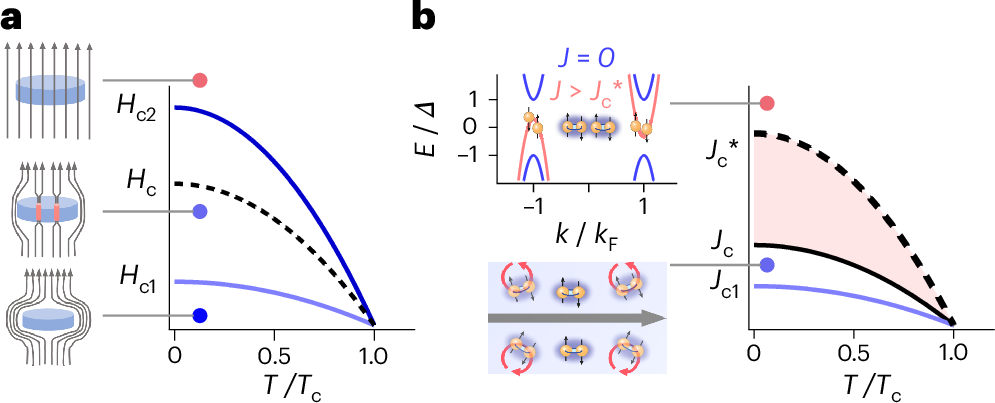
In a type-II superconductor, the everyday current limit is set by vortices, and vortices can move. Magnetic flux passes through the material in tiny regions. Once the current is high enough, those vortices start to travel, and their motion generates resistance and heat that can push the material out of the superconducting state [4]. This normally happens before the condensate itself is pushed too far, so conventional direct-current measurements have trouble reaching the intrinsic limit at all [7].
"Our strategy was to outrun the vortex dynamics," said Eryin Wang, the study's lead author [8]. According to the MPSD team, vortices typically move at tens of kilometers per second, or tens of nanometers per picosecond [9]. At 10 km/s a vortex covers 10 nm in one picosecond, about a hundredth of a micrometer [1]. The samples were micrometer-scale [12]. A pulse that short can reach very high current density before the vortices have time to move and heat the sample [10].
With the vortices barely moving, what fails is the condensate. "One way to picture it is that the current 'twists' the phase of the coherent quantum state of the superconductor, rather like winding a spring," Wang said [5]. Wind it too far and the pairs come apart. The current at that point is the depairing current [6][2].
Co-author Guido Meier credited a platform the institute has been building. "To apply current to superconductors for only a few picoseconds, we used the ultrafast electrical-transport platform that we have been developing at our institute," Meier said [11].
The two-material comparison is the part of the design I like best. NbN's gap is roughly uniform and YBCO's depends strongly on direction, so a difference in how they break down can be traced to the structure of the pairing [13]. In NbN, superconductivity held until a well-defined threshold much higher than the usual DC critical current, and past it the response changed abruptly [14]. The effect size is the first thing I would want from the paper: the ratio of pulsed threshold to DC critical current in each material, and whether YBCO fails as sharply.
The thing this doesn't tell you is whether anything that carries current for longer than a few picoseconds can use the headroom. The critical current is the figure of merit behind magnets, sensitive detectors and quantum circuits [3][15]. If the current lasts long enough for vortices to move, the vortices set that number [4][10]. In my view the immediate gain is a measurement. Materials scientists have long worked to raise the vortex-limited critical current [3]. Now they have a direct reading of the intrinsic ceiling above it [2].
What to watch
- The ratio of pulsed threshold to DC critical current for NbN and YBCO in the Nature Physics paper, which sets how much headroom there is.
- Whether YBCO's direction-dependent d-wave gap produces a breakdown as abrupt as NbN's.
- Measurements at longer pulse lengths that locate the duration at which vortex dissipation returns.