Science2 publishers2 min readPublished
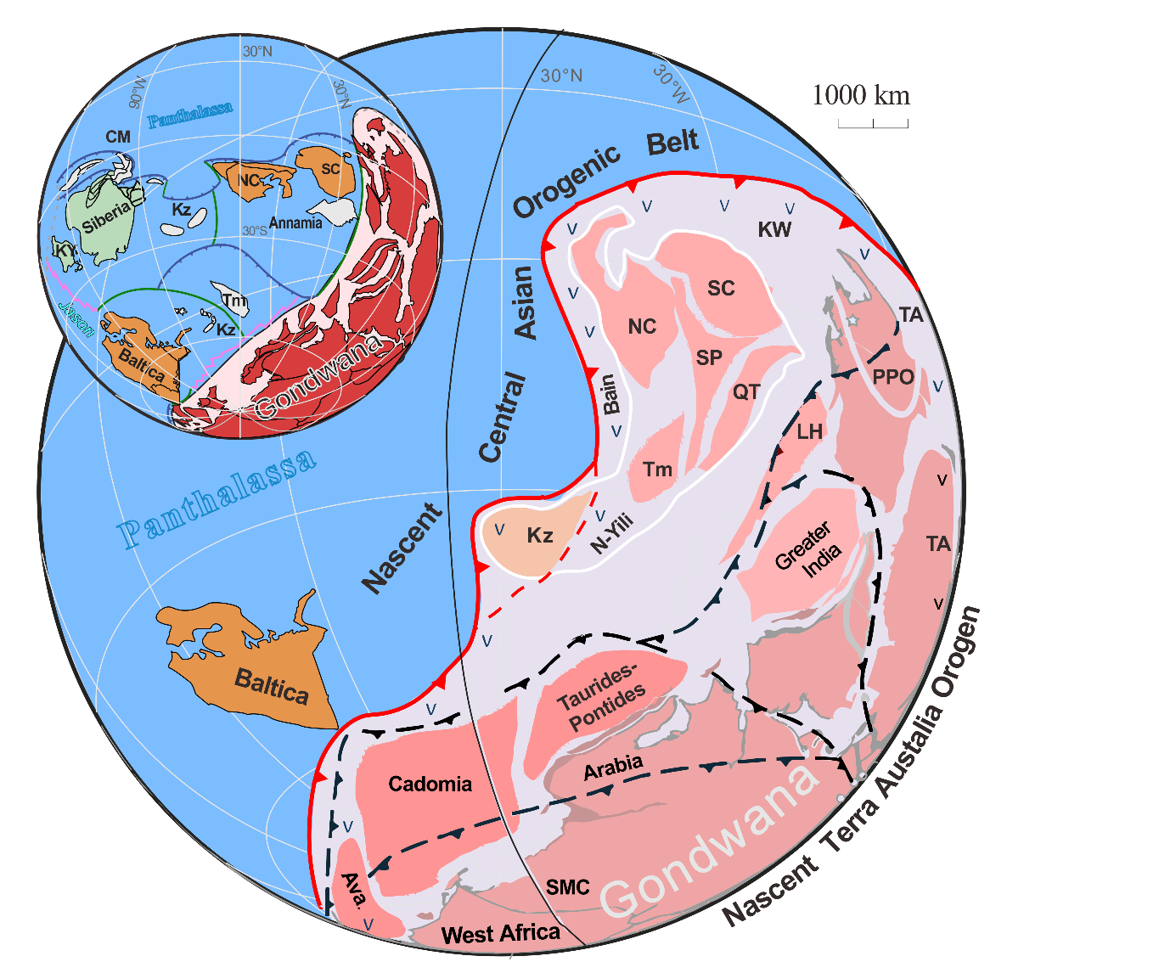
Crust traced under China and Kazakhstan raises Gondwana's share of ancient land to 80%
A global compilation of granite ages traces Gondwanan crust from India through most of China into Kazakhstan, and that buried land is what carries the supercontinent past a 75 percent cutoff one of the paper's coauthors calls arbitrary.
The Scientist · Science desk
What happened
- A study in Science Advances identifies crust buried deep beneath Asia, Europe and North America that was once part of Gondwana, against older estimates that put the supercontinent at around 64 percent of global land area.
- Earlier reconstructions counted five core fragments and later added land from the Appalachians through southern Europe to Turkey, Iran and Pakistan, and still fell short of supercontinent status.
- The discovery was serendipitous: the team was compiling a global granite dataset to relate deep crustal processes to mineral formation, and dating the older rocks those granites had melted from.
- Much of the belt running from India and Southeast Asia through most of China into Kazakhstan had been read as ancient ocean floor carrying volcanic island chains, and the age map assigns it to Gondwana.
- The authors write that other fragments may have been submerged or recycled back into Earth's crust, so even the enlarged figure could be an underestimate.
Compiled by The ScientistSomething wrong?How this is made
Why it matters
- contradiction The two published accounts of the same paper describe different material: a granite compilation in the coauthor's own write-up, more than 25,000 volcanic rocks in Scientific American's. The rock type decides which databases a reader can check the coverage against.
- capability Plotting granite source ages at continental scale gives reconstruction work a way to ask whether a buried mountain belt is recycled continental crust or accreted seafloor, using samples already sitting in geochemistry archives.
- decision Regional models that treat the Chinese and Kazakh belts as island-arc terranes now have to be checked against these source ages, or explain why granites there melted from 700-to-550-million-year-old continental rock.
- constraint The size estimate cannot carry the biological argument on its own. A crustal age map dates crust, so the Cambrian link remains a coincidence in timing plus a list of named candidate mechanisms.
Granites mostly form by melting older continental rock, so the isotopes in a granite date the crust it came from and not the range it now sits in [7]. The coauthor's example is the Himalayas. Granites there formed 20 million, 50 million and 120 million years ago, and all of them came from a single continental block that assembled roughly 700 to 550 million years ago [8]. Take the youngest end of that range and the melts still postdate their source by 430 to 530 million years [4].
The isotope measurement is decades old. Individual data points from rock samples are rarely plotted at continental scale, and this team did it globally to build an age map of the deep Earth [7]. The fragments it found sit under younger rocks and mountain ranges [1].
The debate turns on a share. Supercontinent status has been tied to a cutoff of 75 percent of continental landmass, a value the phys.org account by one of the paper's coauthors calls arbitrary, and Gondwana was first measured at 64 percent [4]. The concept itself came out of the mid-1980s, when geologists recognised cyclic global sea-level changes in the record going back at least two billion years [16]. Roughly 80 percent [10] adds 16 percentage points to the old figure [1], a quarter more land [2], and sits five points above the line that 64 percent missed by eleven [3].
That share also depends on its denominator, which is an estimate of total global land area around 500 million years ago [2]. Revise the estimate of how much land existed then and Gondwana's percentage moves without anyone finding a single new fragment.
Both accounts hedge the biological claim. Scientific American reports the authors writing that Gondwana's size "could have been instrumental" in the Cambrian explosion, which it dates to about 540 to 530 million years ago [13], and gives the candidate levers as sea level, atmospheric gas and volcanic eruptions [14]. The coauthor writing at phys.org is plainer about the difficulty. "Even then, linking global climate, biology and geology is daunting," the coauthor wrote [15]. The two accounts also place the event in different windows: 550 to 500 million years ago in the phys.org piece, 540 to 530 in Scientific American [5].
What to watch
- Whether the Science Advances supplement itemises sample counts and rock types by region, which would show how evenly Asia is covered.
- A published carbon or oxygen isotope record tying Gondwana's assembly to a measured environmental change in the 550-to-500-million-year window.
- Whether another group reproduces the roughly 80 percent figure from the same public geochemistry databases.