Science1 publisher2 min readPublished
Prototype shoe runs its onboard AI on electricity harvested from footsteps
Simiao Niu's team built a battery-free shoe that runs AI on footstep power, sorting four activities with 95.4 percent accuracy. Charge-free gait monitoring for conditions like Parkinson's is the goal, though so far the shoe only labels activity, counts steps and estimates calories.
The Scientist · Science desk
What happened
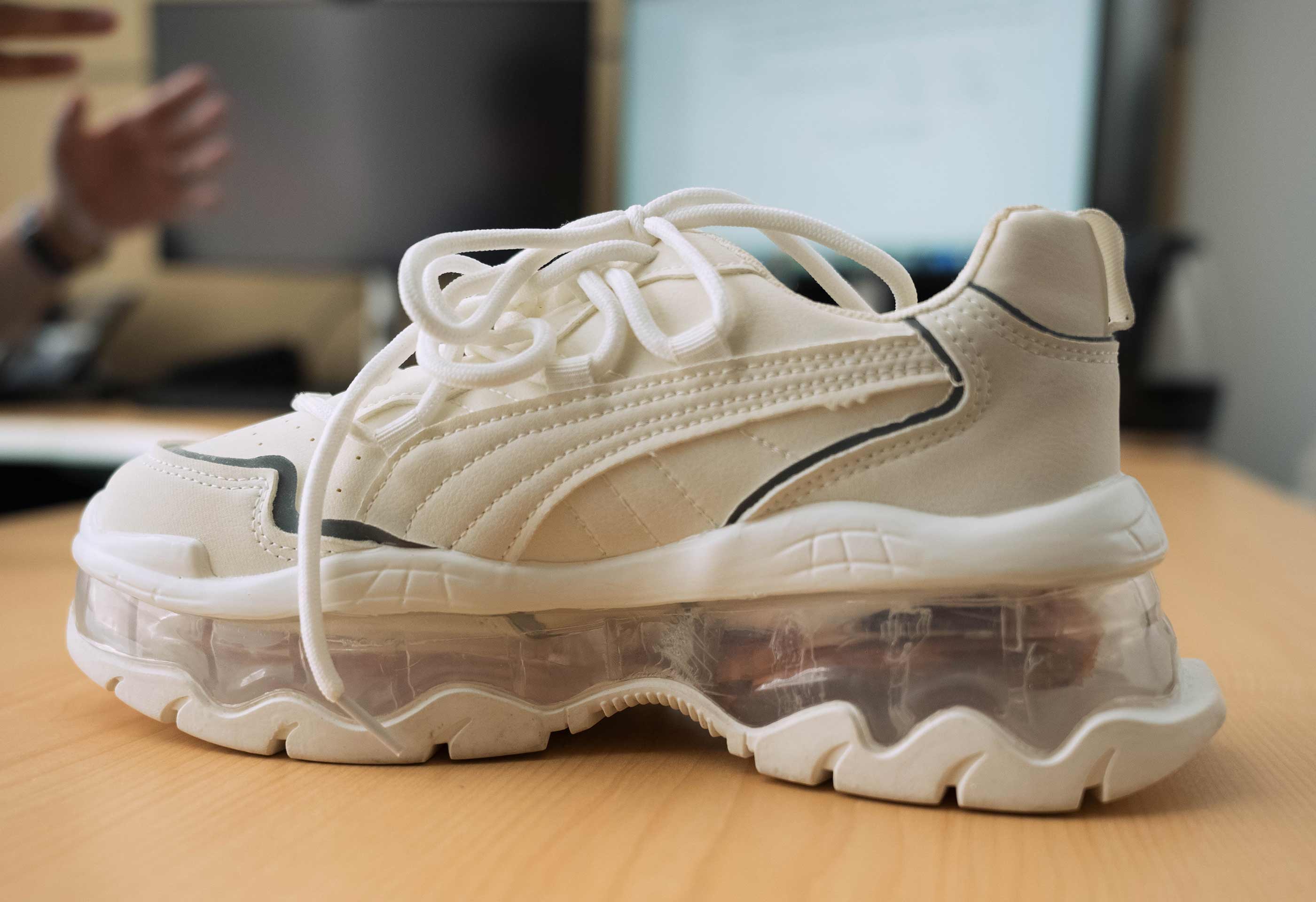
- A generator in the sole uses the triboelectric effect, the charge build-up behind static electricity, to make current from the pressure and friction of each step.
- A power-management circuit makes each step's irregular burst of charge usable, raising available energy by as much as 120 times over a conventional approach.
- A three-axis accelerometer feeds 15-second stretches of motion to a small processor, which labels each as slow walking, fast walking, running or stair climbing.
- The motion sensor and the AI algorithm together consume 86 microwatts, with all of the analysis done inside the shoe.
- In laboratory tests, even slow walking supplied enough electricity to keep the complete system working.
Compiled by The ScientistSomething wrong?How this is made
Why it matters
- capability A shoe that needs no charging could record gait across ordinary days between appointments, where a clinical assessment often sees one short walk in a controlled setting.
- constraint Any finer gait model the team adds has to run on what footsteps supply, so clinical-grade analysis must fit a power budget measured in microwatts.
- precedent The expected next step is clinical: showing the shoe's readings follow gait change in patients, the testing Discover says these applications still require.
At 86 microwatts, each 15-second classification costs about 1.3 millijoules [1]. The budget stays that small partly because inference happens on the shoe, so raw measurements need not be continually transmitted to a phone, computer or remote server [9]. Results appear on a screen mounted on the shoe [8].
Niu framed the work around charging. "We want to solve the fundamental bottleneck in current wearable devices. We are developing a smart wearable with integrated AI functionality that can harvest energy on its own, so you don't need to worry about charging," he said [11]. A shoe gave his team the movement data and the energy needed to analyze it in the same place [19]. "When you are walking or running, you automatically have biomechanical energy available, so you can harvest this energy," Niu said in a press release [3].
The paper, published in Science Advances [1], is titled "A biomimetic, ultralow-power edge-AI-empowered and self-sustaining gait analysis system" [18]. The reported accuracy of 95.4 percent across the four activity classes [8] leaves an error rate of 4.6 percent, roughly one window in 22 [2]. Gait in the clinical sense covers rhythm, speed, balance and stride. Changes in those can signal recovery from injury, disease progression or the likelihood of a fall [12]. I'd expect a gradual shortening of stride, or a drift in balance, to be much harder to catch than the difference between running and climbing stairs.
"Gait is one of the most significant biomarkers for a lot of diseases," Niu said [13]. "If you are able to use what I call the 'worry-free shoes' we've developed, patients can just wear them, and the shoes can automatically collect their gait pattern," he said [14]. Discover's report does not say how many people wore the prototype in testing, or whether any of them had a gait disorder.
I think the energy result is the finding to keep. Running a motion sensor and a classifier on what a slow walk supplies is, in Discover's words, "a demonstration that footsteps can power their own analysis" [17]. The clinical version needs one more thing on the power side. The people it is meant for may walk differently from anyone in the lab tests, and their steps have to keep the system running too [6].
What to watch
- A study of the shoe in people with Parkinson's disease or another gait disorder, scored against clinical gait measures instead of activity labels.
- Whether a model that tracks stride length or balance runs within a microwatt budget comparable to today's four-class classifier.
- Harvest figures for very slow or irregular walking, showing whether the system stays powered for the people it is meant to monitor.