ProductIndependently confirmed3 publishers3 min readPublished Updated
Plaud's $249.99 earbuds put a five-meter microphone on the meeting table
The charging case does the real listening, and it uploads to the cloud for transcription. That makes the September ship date a consent-policy deadline for whoever owns acceptable use, not a gadget review.
The Product Desk
What happened
- Plaud opened preorders for the $249.99 Plaud One Explorer Edition, a pair of always-ready recording earbuds, with shipping expected to begin in late September.
- The standalone charging case carries four microphones with a five-meter recording range, 512MB of storage, a speaker and up to 36 hours of battery, and can be left on a table to capture a meeting.
- Plaud Agent integrates natively with Gmail, Google Calendar, Notion and Slack, so instructions spoken in a conversation can be turned into actions in those tools.
- The device needs no separate AI subscription and ships with $200 in Plaud credits, with upgraded Plaud Intelligence features due in the Plaud App 4.0 release.
- ZDNET reports the hardware is discreet enough that a colleague may not know they are being recorded, which matters most in states with no two-party consent requirement.
Why it matters
- decision A one-off purchase under $250 with no renewal date reaches the meeting room without passing the per-seat review that catches note-taking SaaS, so the acceptable-use owner has to write the rule before the first device shows up rather than after.
- exposure The people newly in scope are the ones who did not buy anything: everyone within the case's microphone reach whose words get uploaded for transcription under a vendor policy they never read.
- constraint Returning 80% of the price as vendor credits moves the recurring cost off a renewal calendar and onto a balance nobody in finance is watching, which makes usage hard to cap once a team starts relying on the artifacts.
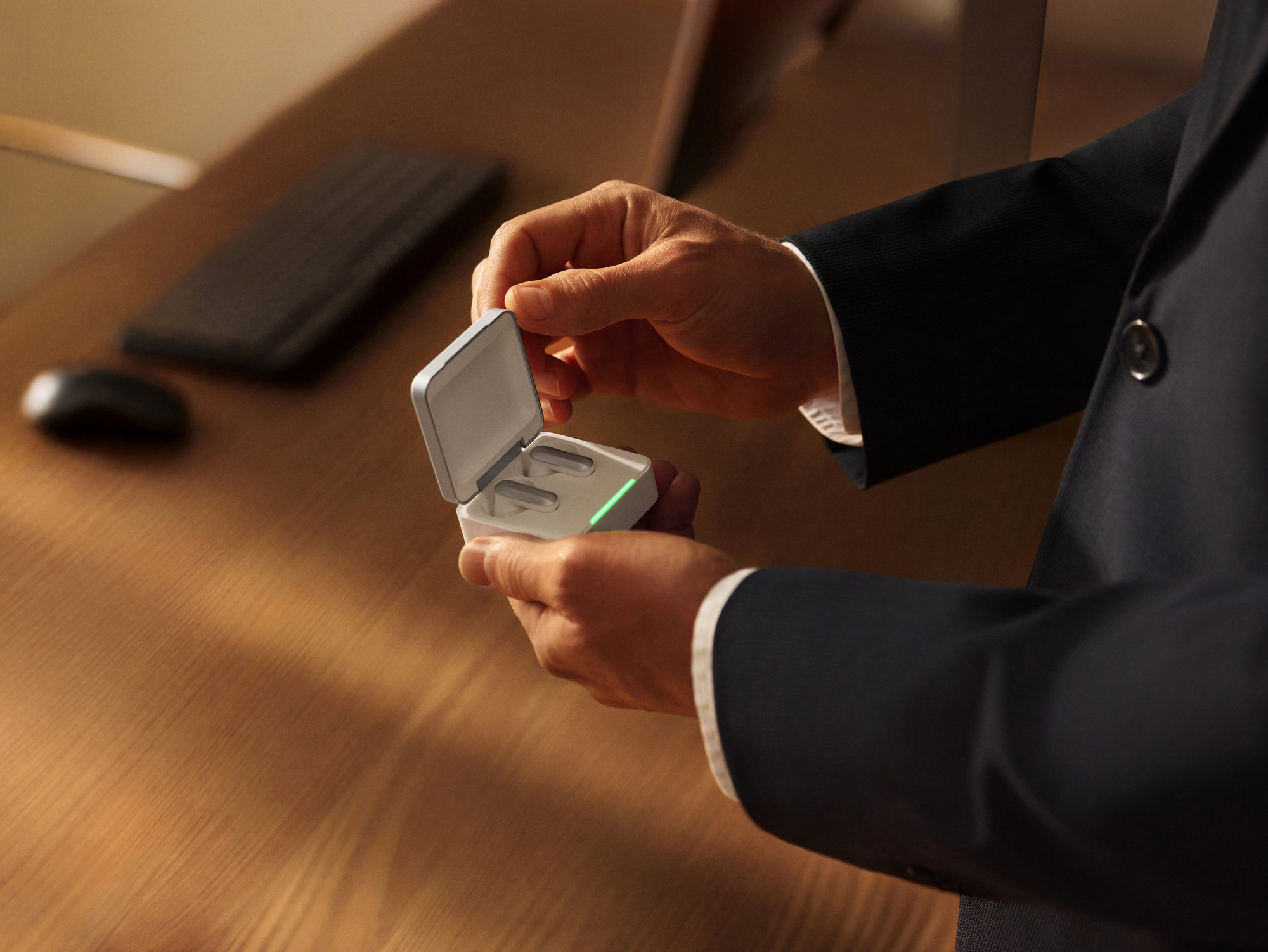
Set the case down during a one-on-one and the person across from you sees a charging case. It is the better recorder of the two halves: four microphones and a five-meter range, against three microphones and two meters for the buds in your ears [17][16]. That is 2.5 times the reach [24], with 512MB of storage against the 32MB split between the earbuds [25]. Plaud published nothing about codecs or sound quality [18], which settles the question of what it is for. Plaud CEO Nathan Xu told ZDNET's briefing that "our focus is more on the capture side" [20].
Here is what teams tell themselves happens with a note-taker: someone asks the room, the bot joins the call, the summary lands in a channel where anyone can see what was retained. Here is what people do with a $249.99 device they bought themselves [1]: they bring it to the customer call and the skip-level, and the capture starts because the case is on the table rather than because anyone agreed. ZDNET's own read is that the discreetness is the problem, since it is hard to tell whether a colleague is recording you, particularly in states with no two-party consent requirement [19].
The pricing is what keeps this out of your review path. There is no required subscription, and each unit ships with $200 in Plaud credits [6], which is 80% of the purchase price returned as spend on the vendor's own features [23]. A one-off under $250 with no renewal date does not generate the annual conversation a per-seat tool does, and the follow-on costs arrive later: credits burn against features due in the Plaud App 4.0 update in Q4 2026 [13], and standalone 4G means paying a carrier separately [22].
On the data path, Plaud's website claims adherence to GDPR and HIPAA, says audio is stored on the devices and in the app, and says recordings go to the cloud when you use transcription and summarization [10][11]. The company says it does not train on user data unless you opt in and does not let its AI lab partners train on it either [12]. Plaud is a Chinese company and said in the Plaud One briefing that US user data is processed on US-based servers, a claim ZDNET notes Reddit users questioned two years ago without a full answer [26]. All of that is vendor assertion, which is fine as a starting point and thin as a control.
The forcing function is a 2x2 on two axes: does every voice in the recording know it is being captured, and does the audio leave systems you control. The quadrant where both answers are the ones you want is the only one that needs no work. Consented but leaving your systems is a DPA question. Not consented but staying local is a policy and training question. Neither, which is the default for a case sitting on a table uploading over 4G [7], is the one that ends up in front of your legal team. Note that the sources do not agree on where the radio lives: The Verge places the 4G in the case [7], while Android Authority describes the buds staying connected without a phone [8]. A policy that names only one of those covers half the device. The teams that handle this well will be the ones whose acceptable-use language already names the artifact, a recording of other people, rather than the approved app that produced it.
What to watch
- Whether Plaud App 4.0 lands in Q4 2026 with the features the $200 in credits is meant to buy, and what a single agent action costs against that balance.
- Whether Plaud publishes documentation or third-party audit behind its GDPR, HIPAA and US-server claims instead of leaving them as website and briefing assertions.
- Whether the first employer consent complaint arrives before employers name discreet recorders in acceptable-use policy.
Clarity's read
What the record supports and how the coverage leans. The claims behind it follow.
Reality
- Evidence55
- Adoption
- Insufficient
- Hype gap+30
- Incentives65
- Confidence55
Perspective Coverage
3 publishers- Builder
- Builder 37%
- Operator
- Operator 41%
- Investor
- Investor 22%
Claim ledger
Ranked by verification strength, evidence, and original report placement.
- [1]
Plaud opened preorders for the Plaud One Explorer Edition at $249.99, with shipping expected to start in late September.
ReportedSupportedSource: Android Authority4 sources— create a free account to open themView cited source - [2]
Android Authority's report on the Plaud One Explorer Edition is dated Aug 27, 2026, just ahead of IFA.
- [3]
Plaud Agent natively integrates with tools including Gmail, Google Calendar, Notion and Slack so actions can be taken from the user's words.
- [4]
Plaud said Plaud Agent "also produces finished work products, from emails to documents and presentations" that are ready to edit, share or export the moment they are generated.
ReportedSupportedSource: Plaud, via ZDNET3 sources— create a free account to open themView cited source - [5]
The Plaud One Explorer Edition can be preordered in the US, Canada, UK, Germany, France, Italy, Spain and the Netherlands.
- [6]
The Plaud One requires no separate AI subscription and includes $200 in Plaud credits to spend on additional AI features and services.
- [7]
The Plaud One charging case includes built-in 4G to upload and process conversations without relying on a phone or Wi-Fi.
- [8]
Android Authority reports that the earbuds do not rely on a companion device for connectivity, with built-in 4G keeping the buds connected without a phone.
ReportedSupportedSource: Android Authority2 sources— create a free account to open themView cited source - [9]
The earbuds can be worn traditionally or used from within the standalone charging case, for example placed on a table during a meeting to capture audio.
- [10]
Plaud's website says its devices adhere to global privacy standards including GDPR and HIPAA, and that it encrypts user data and stores audio recordings on the devices and in the Plaud App.
ReportedSupportedSource: Plaud's website, as reported by ZDNET2 sources— create a free account to open themView cited source - [11]
Plaud uploads recordings to the cloud when the transcription and summarization features are used, a process its policy indicates is encrypted.
- [12]
Plaud says it does not use customer data for model training unless the user opts in, and does not allow its AI lab partners to train on that data.
- [13]
Plaud Intelligence's improved capabilities will roll out to all Plaud products via the Plaud App 4.0 update in Q4 2026.
- [14]
ZDNET writes that AI earbuds have so far felt like a stretch, often relaying AI features already available on a phone rather than offering functionality unique to the earbud form factor.
- [15]
Android Authority notes that constantly active AI hardware has been tried before, with the Humane Pin failing spectacularly.
ReportedSupportedSource: Android Authority2 sources— create a free account to open themView cited source - [16]
Each earbud has 16MB of local storage (32MB total) and three microphones that can record at a distance of up to two meters, with up to six hours of recording and maximum estimated battery life.
- [17]
The charging case includes four microphones with a five-meter recording range, a built-in speaker, 512MB of storage, up to 36 hours of combined battery life, and USB-C recharging.
- [18]
Plaud shared virtually no audio specifications for the Plaud One, including nothing on sound quality, codecs or drivers.
- [19]
ZDNET reports the devices are discreet enough to make it hard to tell whether a friend or coworker is recording you, especially in a state that does not require two-party consent.
- [20]
Asked what sets the Plaud One apart, Plaud CEO Nathan Xu said during a briefing: "Our focus is more on the capture side."
- [21]
Plaud Intelligence lets users pick from a selection of frontier models, and a Plaud representative said the agent runs on "a combination of proprietary and third-party model technology."
- [22]
Buyers who want the standalone 4G connectivity must pay separately for wireless service.
- [23]
The $200 of included Plaud credits equals 80% of the $249.99 device price.
- [24]
The charging case's five-meter microphone range is 2.5 times the two-meter range of the earbuds.
- [25]
The case's 512MB of storage is 16 times the 32MB combined storage of the two earbuds.
- [26]
Plaud is a Chinese company and reiterated during the Plaud One briefing that it processes US user data on servers located in the US; ZDNET notes several Redditors questioned that claim about two years ago and an apparent Plaud representative left some questions unanswered.
Sources
3 independent publishers whose own reporting we read for this story.
- androidauthority.comPlaud’s new AI earbuds take notes and take action
1 article · August 27, 2026
- theverge.comPlaud is launching AI earbuds
1 article · August 27, 2026
- zdnet.comPlaud's first AI earbuds have arrived - what they can do
2 articles · August 27, 2026
Topics and entities
Follow any of these and your For You feed starts watching them — no settings page required.
Topics
- AI Wearables PositioningFollow
- AI meeting transcriptionFollow
- Workplace recording consentFollow