Science1 publisherNot yet confirmed elsewhere2 min readPublished
Soft tube feet survived 450 million years, and only one other crinoid has managed it
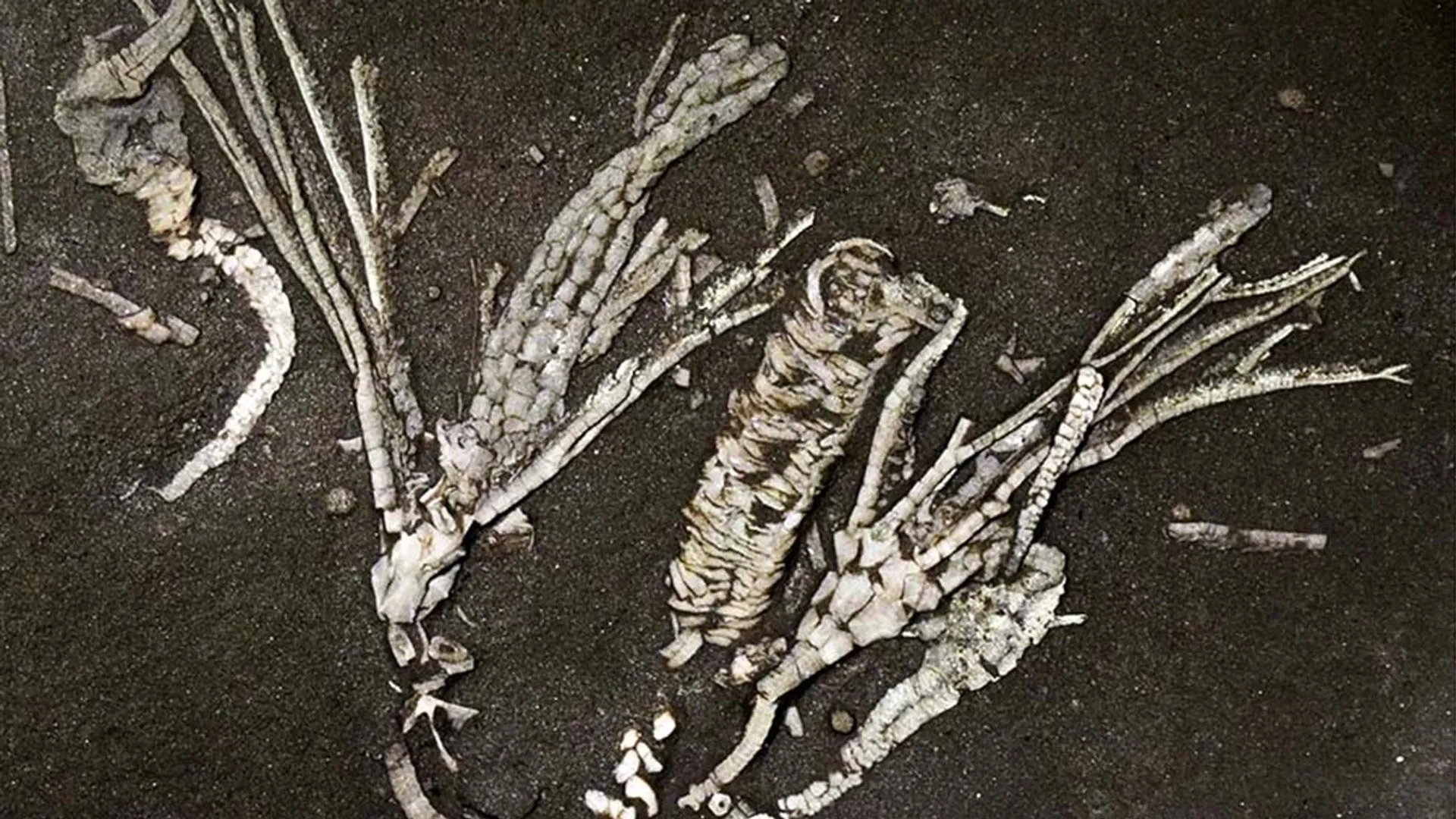
University of Oklahoma paleontologists report preserved feeding tissue in Dendrocrinus simcoensis. Two specimens against a fossil record of millions sets the limit on what it can prove.
The Scientist · Science desk
Drafted by a language model from the sources cited here and checked against its claim ledger before publication. How we use AISend a correction
What happened
- University of Oklahoma paleontologists report preserved tube feet in a crinoid fossil, Dendrocrinus simcoensis, structures that almost never survive fossilization.
- It is only the second crinoid fossil ever found with soft tissue, and the oldest such specimen known.
- The animal lived more than 450 million years ago, when crinoids were already thriving in some of Earth's earliest coral reefs.
- Co-author David Wright puts the tissue at more than 200 million years older than the oldest dinosaur.
Compiled by The ScientistSomething wrong?How this is made
Why it matters
- capability Feeding structures become an observation instead of an inference, which is precisely what shells and skeletal plates cannot deliver about how an early reef animal lived.
- constraint With two soft-tissue crinoids in existence, whatever this animal shows about early reef feeding stays a single point that cannot be generalised to its contemporaries.
- precedent Since tissue survives only where burial chemistry behaved like a refrigerator or a vacuum seal, the productive search is for those settings rather than for more crinoids.
Wright's framing is the load-bearing part of the announcement: crinoid tube feet work as evidence in roughly the way mammal teeth do, with structural differences reporting where an animal lived and how it fed [10]. The traits said to carry that signal are size, spacing and overall form, which vary with the animal's surroundings and feeding method [9]. The analogy therefore only cashes out in measurements, and the University of Oklahoma release supplies none. It gives the verdict, that the anatomy of this ancient species was very different from living crinoids [4], without the dimensions behind it, and it does not name the journal carrying the description [15]. What is defensible today is that a difference was found, not what the difference says about diet.
The rarity figure is worth doing properly rather than admiring. Cole calls the preservation one in a million, and notes that crinoid fossils number in the millions while this is only the second occurrence of soft tissue [3]. Two specimens against a record of at least two million is a recovery rate at or below one per million [13]. That is not decoration on a press release; it is the ceiling on the evidence base. Soft tissue is also exceptionally uncommon in fossils of early echinoderms as a whole [11], so the comparative dataset for feeding anatomy in the group will stay in single digits for a long time.
That bears directly on the larger claim attached to the fossil, that it can help reconstruct the ecology of early Paleozoic oceans, when crinoids were among many animal groups flourishing in reef ecosystems [16]. One animal's feeding structures constrain one animal's niche. A reef needs the range, and the arithmetic in the release itself explains why nobody has it. The sober reading is a calibration point: a fixed anatomical observation at 450 million years that any account of how crinoid feeding strategies changed [4] now has to accommodate, rather than a working picture of Ordovician reef life.
What to watch
- Whether the deposit that yielded the specimen produces further soft-tissue echinoderms, turning a sample of two into a series.
- Whether anyone can assign Dendrocrinus simcoensis a specific feeding mode or current regime from the preserved tube feet, rather than a general statement of difference.
- Whether the rarity rate holds once other institutions re-examine crinoid material with soft tissue in mind.