Science1 publisherNot yet confirmed elsewhere2 min readPublished
Knot theory yields a knit stitch that shrinks a dropped loop's damage until it stops
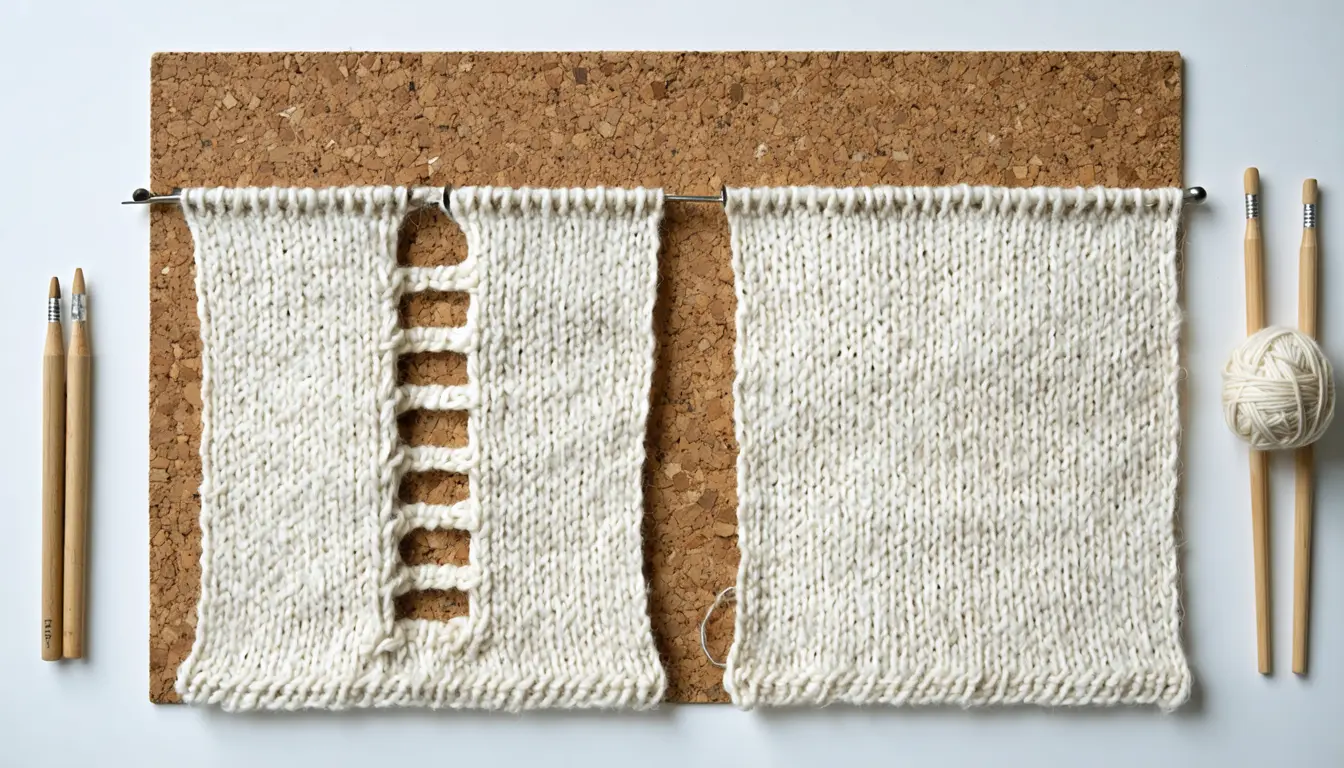
Ritsumeikan physicist Daisuke Shimamoto's team used knot theory to design a knit stitch that shrinks a single dropped-stitch defect row by row until it stops. The protection covers isolated slips only; once more than one stitch slips in a row, defects grow again.
The Scientist · Science desk
What happened
- The team wrapped a 3D model of a plain jersey stitch around a torus, keeping the pattern but removing its edges so the whole fabric became one closed knot.
- Jersey's common failure is laddering, in which one missed loop slips down its column of stitches and unravels the entire column.
- The new "robust knit" is a complex stitch whose sweeping loops cross through two stitches instead of one.
- Alexander Omelchenko of Constructor University, who devised the topological method, said earlier work had described stitch defects only as static objects.
Compiled by The ScientistSomething wrong?How this is made
Why it matters
- capability How far damage travels becomes a design choice: knot moves applied to a stitch model can turn an endless ladder into a defect that dies out.
- constraint Brute-force searching for more stitches like this is out of reach for now, because Omelchenko says fully evaluating candidates with torus diagrams would be impractically expensive to compute.
- decision Shimamoto pitches the robust knit as a proof of concept for manufacturing, so fabric makers now have to decide whether a more complex two-stitch crossing is worth knitting for the protection it buys.
A torus is the right shape for this problem. Knitting leaves both ends of the yarn outside the fabric, and the loops stay in place by passing through one another without ever being tied [2]. A flat swatch also has edges. Wrapping the stitch model around a doughnut keeps the repeating pattern and deletes the edges, so the fabric becomes one closed knot that knot theory can analyse [3]. With no border in the model, edge effects drop out of the comparison [3].
Stacking several rows on the torus let the team follow a defect from one row into the next until the whole fabric came apart [4]. The researchers call this defect propagation and regard it as a defining trait of knittable fabric [4]. "It's a very original approach," said Omelchenko, who was not involved in the study [6].
Plain jersey fails without limit. "If one unit cell is disentangled, the cell just below that cell is disentangled, and it is repeated, and it propagates endlessly," Shimamoto said [8].
He then used moves from basic knot theory to rework the stitch so that propagation can still begin but cannot continue forever [9]. In the resulting robust knit, described in Physical Review X, a defect that propagates gets smaller with each row until it stops [1] [11].
Both stitches went through the same torus analysis, and they differ in how the loops cross, so in this model the stitch's structure decides whether one mistake ends or runs the length of the fabric [15]. The thing this doesn't tell you is the effect size in real cloth. The account does not say how many rows a defect survives in the new stitch, what the more complex pattern costs in yarn or knitting time, whether knitted samples were tested, or what role yarn fibre plays.
Shimamoto learned to knit from his mother, and he gave her an author credit on the paper as thanks [14].
What to watch
- Knitted samples of the robust knit, with counts of how many rows a dropped stitch travels before it stops in real yarn.
- A cheaper way to evaluate torus diagrams, which would let researchers screen many candidate stitches instead of designing them one by one.
- Any manufacturer trial of the two-stitch crossing on knitting machines, where the cost of the more complex pattern would show up.
Clarity's read
What the record supports and how the coverage leans. The claims behind it follow.
Reality
- Evidence45
- Adoption
- Insufficient
- Hype gap+15
- Incentives20
- Confidence50
Claim ledger
Ranked by verification strength, evidence, and original report placement.
- [1]
In a paper in Physical Review X, a team of researchers mathematically investigated knitting to invent a new, more resilient stitch.
- [2]
In knitting the two ends of the yarn remain outside the fabric; loops from the middle of the yarn are slipped through one another so the yarn holds its position but is not knotted together.
- [3]
Daisuke S. Shimamoto, a physicist at Ritsumeikan University in Japan, and colleagues wrapped a three-dimensional model of a single jersey knit stitch around a torus, which preserves the pattern without edges at the top or bottom and converts the knit pattern into one giant knot that can be analyzed with knot theory.
- [4]
The scientists projected multiple knit rows on the torus to reveal how defects from one row of stitches spread until the entire fabric unravels; this is called defect propagation, which the researchers say is one of the defining characteristics of knittable fabrics.
- [5]
Applied mathematician Alexander Omelchenko of Constructor University in Germany says researchers have described stitch defects mathematically in the past, but only as static objects; this study shows how defects move dynamically across a textile.
- [6]
"It's a very original approach," said Omelchenko, who was not involved in the study but originated the topological analysis method used.
- [7]
A common type of defect propagation is laddering, in which a single missed loop slips down a column of stitches, unraveling the whole column.
- [8]
"If one unit cell is disentangled, the cell just below that cell is disentangled, and it is repeated, and it propagates endlessly," Shimamoto said.
- [9]
After the topological analysis of the jersey knit, Shimamoto used moves from basic knot theory to design a knittable stitch in which defect propagation can still happen but not endlessly.
- [10]
The robust knit is a complex stitch with sweeping loops that cross over through two stitches rather than one.
- [11]
The robust knit reduces propagated defects row by row until they stop.
- [12]
In the robust knit, defects expand only when there is more than one slipped stitch in a row.
- [13]
Omelchenko notes that fully evaluating the possibilities of new stitches using torus diagrams would be impractically expensive to compute.
- [14]
Shimamoto gave his mother an author credit as a thank you for teaching him how to knit.
- [15]
In the model, changing the stitch structure (how loops cross) turns a defect that runs the whole column into one that dies out, so structure decides whether a single mistake spreads.
- [16]
Shimamoto hopes the robust knit, as a proof of concept, can one day inspire stronger fabric design for manufacturing.
Sources
1 independent publisher whose own reporting we read for this story.
- scientificamerican.comMathematicians invented a knitting stitch that stops mistakes from spreading
1 article · October 8, 2026
Topics and entities
Follow any of these and your For You feed starts watching them — no settings page required.