A drag-forecasting neural network timed Cosmos-482's fall to within two minutes in a hindsight test
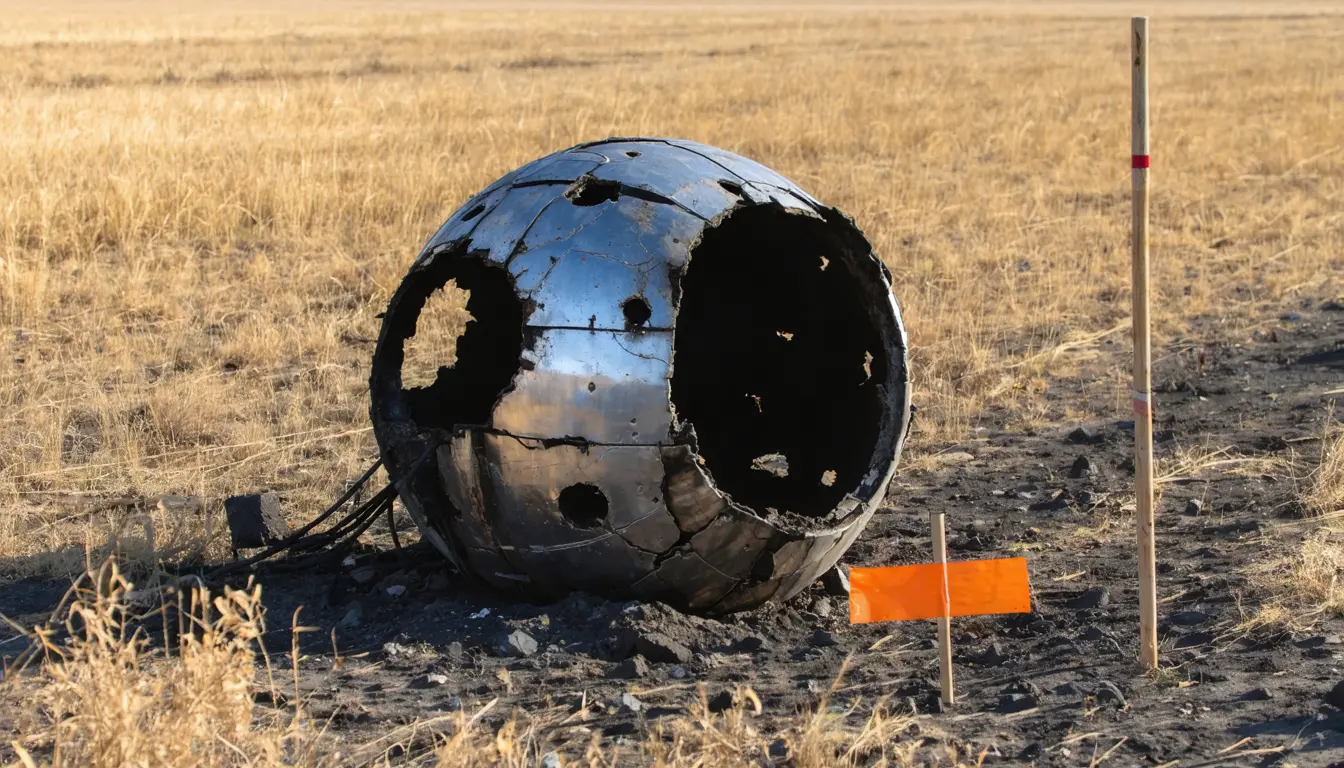
Indonesian researchers paired a neural network with orbital mechanics to predict Cosmos-482's 2025 reentry within two minutes. Low Earth orbit holds 25,060 cataloged objects, nearly double a decade ago, and the check covered only three falls, each tested after the fact.
The Scientist · Science desk
Key figures: the Cosmos-482 prediction carried an uncertainty window of give or take 11.4 minutes. That corresponds to roughly 5,200 km along the path on either side. Each minute of timing error shifts the fall point by about 460 km.
| Figure | Value | Note | Claim |
|---|---|---|---|
| Cosmos-482 prediction uncertainty window, give or take | 11.4 minutes | 13 | |
| Path either side, roughly | 5,200 km | 21 | |
| Shift per minute, about | 460 km | 5 |
What happened
- For NEOWISE, the model predicted 00:54 UTC on Nov. 2, 2024, give or take 7.8 minutes, against 00:49 on the mission's website.
- For a Long March 4B upper stage launched in 2006, it predicted 22:45 UTC on March 26, 2023, give or take 13.2 minutes; debris was seen over Murcia and Almeria in Spain.
- Physics computes the orbit from Earth's gravity, its flattening and a standard atmosphere model, while a neural network forecasts how the ballistic coefficient will change.
- Each network is trained for one object alone, on 11 years of public tracking data, one full solar cycle.
- Running the network 100 times with random parts switched off gives the spread that sets each uncertainty window.
Why it matters
- What it limits constraint A window of plus or minus 11.4 minutes is still roughly 5,200 km either side along the ground track at the authors' 460 km per minute.
- Who's exposed exposure Many of the 25,060 cataloged objects will fall without control, and the final days, when braking grows fastest, are when fresh tracking data thin out.
- What it limits constraint A network trained on one object's own decay history needs that history, so objects with shorter public records give it less to learn from.
The NEOWISE gap was five minutes [18]. Cosmos-482's was two [17]. Both sit inside the windows the model gave itself [19]. The numbers are the authors' own: M. Khawariz Andaristiyan of Indonesia's National Research and Innovation Agency (BRIN) led the study, published in Acta Astronautica, and the reference times come from Roscosmos and the NEOWISE mission website [4][13][14].
At the authors' rule of thumb of about 460 km of along-track shift per minute of error, the two gaps work out to roughly 920 km and 2,300 km [20]. An hour's error would cost about 28,000 km [5].
In use, the loop runs every three hours, the rhythm at which a standard geomagnetic index updates, and each pass feeds the network the new orbit and takes back a new coefficient [10]. The calculation stops at 80 km, the height the authors take as the threshold of reentry [10]. The ballistic coefficient is the quantity at issue because a tumbling stage, or a satellite with wide solar panels, shows the air a different face from one moment to the next [6][7].
All three falls came in the active solar years of 2023 to 2025, when a heated, swollen upper atmosphere makes low orbits decay faster [12][16]. They were tested after the fact, on objects launched in 1972, 2009 and 2006 [1][14][15]. A common simplification holds the coefficient fixed at a value estimated from past tracking [7]. Neither a head-to-head against that baseline nor the Long March sighting time appears in the account on Phys.org. Without them, two small misses cannot be assigned to the network or to the orbit calculation.
We think the split is sound. Newton's laws can be written down, and the coefficient of a tumbling stage cannot [8]. Using a network for the piece that cannot be written down is a sensible use of machine learning.
The condition is the record behind each network. An object with less tracking history than the 11 years used here gives it less to learn from, and we'd expect the forecast to degrade there [9].
What to watch
- The Long March 4B sighting time, to set against the 22:45 UTC prediction with its 13.2-minute window.
- A comparison against the fixed ballistic coefficient baseline, run on falls outside the 2023 to 2025 active solar years.
- Tests on objects with less than 11 years of public tracking history, and forecasts issued before a fall rather than after.
Clarity's read
What the record supports and how the coverage leans. The claims behind it follow.
Reality
- Evidence45
- Adoption
- Not scored
- Hype gap+5
- Incentives
- Not scored
- Confidence55
Claim ledger
Ranked by verification strength, evidence, and original report placement.
- [1]
Cosmos-482, launched in 1972, was stranded by a failed upper stage of its rocket and circled Earth for 53 years before coming down on May 10, 2025.
- [2]
Roscosmos later reported that Cosmos-482 came down in the Indian Ocean, west of Jakarta.
- [3]
By the end of 2025, low Earth orbit held 25,060 cataloged objects, nearly twice as many as a decade earlier, according to the European Space Agency; many old satellites and spent rocket stages will one day fall back without control.
- [4]
The study was published in Acta Astronautica and led by M. Khawariz Andaristiyan of the Research Center for Satellite Technology at Indonesia's National Research and Innovation Agency (BRIN), with Affiani Machmudah and Wahyudi Hasbi of the same center and Ridanto Eko Poetro of the Institut Teknologi Bandung.
- [5]
An object near the end of its life in orbit flies at about 7.8 km/s; an error of one minute in the time of its fall shifts the place where it falls by about 460 km along its path, and an error of one hour by about 28,000 km.
- [6]
The ballistic coefficient, which measures how strongly the air slows an object, is its drag coefficient times its cross-section, divided by its mass.
- [7]
A tumbling rocket stage or a satellite with wide solar panels shows the air a different face from one moment to the next, and in the last days fresh tracking data often become scarce; a common simplification holds the coefficient fixed at a value estimated from past tracking.
- [8]
The method computes the object's motion with Newton's laws, using Earth's gravity and flattening and the drag from a standard model of the upper atmosphere driven by solar and geomagnetic activity, and lets a neural network learn how the ballistic coefficient will change.
- [9]
For each object, the coefficient history is read from 11 years of public tracking data, one full solar cycle, by measuring how fast its orbit shrank; a sequence-type network then learns, for that object alone, to forecast the coefficient from the object's past and from forecasts of solar and geomagnetic activity.
- [10]
During prediction, every three hours, the rhythm at which a standard index of geomagnetic activity is updated, the network receives the new orbit and returns a new coefficient; the calculation stops at 80 km, the height taken as the threshold of reentry.
- [11]
To estimate how much the network's forecast varies, the authors run it 100 times with random parts switched off; the spread of the answers gives a window of uncertainty around the predicted time.
- [12]
The authors tested the method after the fact, on three objects that had already fallen, all in recent active solar years, from 2023 to 2025.
- [13]
For Cosmos-482, the authors' prediction is 06:22 UTC, give or take 11.4 minutes; Roscosmos reported 06:24.
- [14]
For NEOWISE, the NASA infrared telescope launched in 2009, the authors predict 00:54 UTC on Nov. 2, 2024, give or take 7.8 minutes; the mission's website reported 00:49.
- [15]
For the upper stage of a Chinese Long March 4B rocket, launched in 2006, the authors predict 22:45 UTC on March 26, 2023, give or take 13.2 minutes; its debris was seen over Murcia and Almeria, in southeastern Spain.
- [16]
When the sun is active, it heats the upper atmosphere, which swells, so that the air at a given height grows denser and low orbits decay faster.
- [17]
The Cosmos-482 prediction was 2 minutes from the reported time.
- [18]
The NEOWISE prediction was 5 minutes from the reported time.
- [19]
Both gaps fall inside the model's own stated uncertainty windows: 2 minutes is less than 11.4, and 5 minutes is less than 7.8.
- [20]
At about 460 km per minute of error, the Cosmos-482 gap is roughly 920 km along the path and the NEOWISE gap roughly 2,300 km.
- [21]
The Cosmos-482 uncertainty window of plus or minus 11.4 minutes corresponds to roughly 5,200 km along the path on either side of the predicted point.
Get this ledger inside ChatGPT. Ask about any of our stories and the answer brings its figure, each claim’s verdict and the sources. Free, no account.
Sources
1 independent publisher whose own reporting we read for this story.
Topics and entities
Follow any of these and your For You feed starts watching them — no settings page required.
Topics
- Space DebrisFollow
- Physics-Informed Machine LearningFollow
- Satellite reentry predictionFollow