Science1 publisher3 min readPublished
Letting tropical forests grow back can cost 96% less than planting them, cost mapping finds
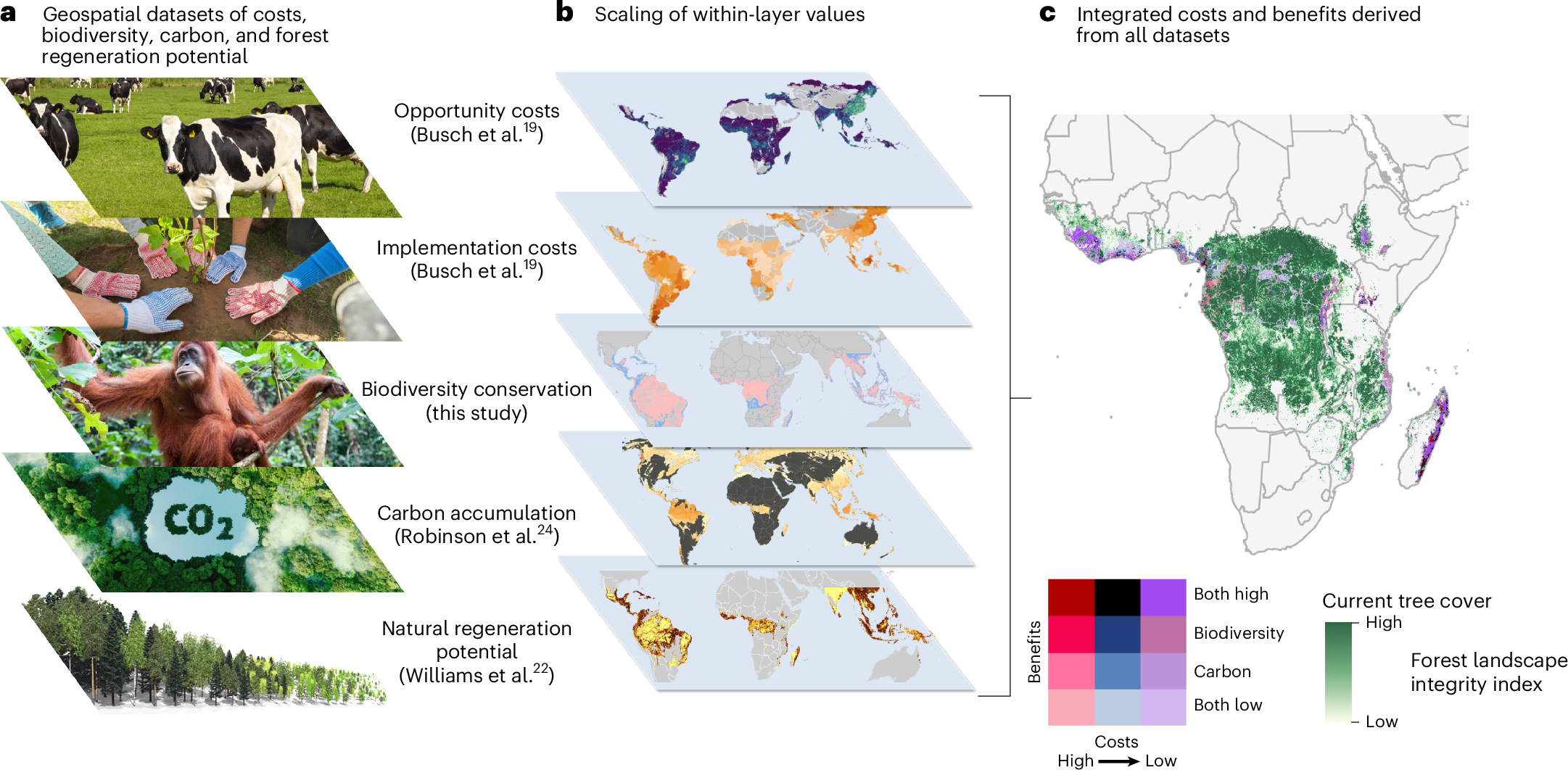
A Nature Ecology & Evolution study maps where assisted natural regeneration beats planting on carbon, biodiversity and price. The headline saving is a ceiling, not an average.
The Scientist · Science desk
Drafted by a language model from the sources cited here and checked against its claim ledger before publication. How we use AISend a correction
What happened
- A study from the University of Queensland and the University of Newcastle found that natural forest regeneration delivered substantial carbon and biodiversity benefits and could be up to 96% cheaper than traditional tree-planting programs; the work is published in Nature Ecology & Evolution.
- School of the Environment PhD candidate Jiaqi Li said the team mapped how the costs and benefits of natural regeneration varied across the tropics.
- A 96% cost reduction corresponds to roughly 25 times as much area treated per unit of budget.
- Li said that for tree planting, you need to purchase seeds and hire workers or recruit volunteers to plant and manage them, which is costly.
- Li said that for natural regeneration, people just need to check the land for invasive species and remove them, make sure there are adequate seed sources, provide protection from fire, grazing animals and humans, and then it is mostly self-sufficient.
Compiled by The ScientistSomething wrong?How this is made
Why it matters
Researchers at the University of Queensland and the University of Newcastle have mapped how the costs and ecological benefits of natural forest regeneration vary across the tropics, and report that regeneration can deliver substantial carbon and biodiversity gains at up to 96% less cost than conventional tree-planting programmes [1][2]. Restoration and offset budgets are fixed in a way that ambition is not, so a cost ratio of that size determines how much land actually gets treated.
Take the ceiling number literally and it implies roughly 25 times as much area per dollar at the favourable end of the range [3]. That is the favourable end. The account of the work published by phys.org does not give the average saving across the mapped area, a cost per hectare, or the spread between best and worst cases, so the 96% figure should be read as an upper bound on a distribution whose shape is the actual finding.
The mechanism is mundane, which is the point. Planting requires buying seeds and hiring workers or recruiting volunteers to plant and manage them, according to lead author and PhD candidate Jiaqi Li [4]. Regeneration, Li said, means checking land for invasive species and removing them, making sure seed sources are adequate, and providing protection from fire, grazing animals and people, after which it is mostly self-sufficient [5]. Li also said that studies show regenerated forest can end up storing more carbon and being more biodiverse than a planted forest [6]; that is a characterisation of prior work rather than an output of this cost map.
Geography does most of the allocation work here. The study identifies "holistic hotspots" combining high carbon benefit, high biodiversity benefit and low restoration cost, located mostly in Indonesia, Madagascar, the Philippines, Mexico and Malaysia [7]. Carbon benefits stand out most in Neotropical areas such as the Amazon basin and in the Indomalayan tropics including Borneo, Sumatra and Papua New Guinea, while biodiversity benefits are greater in the Afrotropics, including Madagascar [8][9]. A buyer optimising for tonnes and a fund optimising for species will therefore be pointed at different countries, and only the five hotspot nations satisfy both cheaply.
The baseline is grim enough to make the arithmetic matter. Between 2000 and 2012, tropical forests were reduced globally by 2.3 million square kilometres, releasing an estimated 0.86 gigatons of carbon annually and threatening the well-being of around 1.5 billion people who depend on forests [10]. Tropical forests cover 18% of land and host more than half of all land vertebrate species [11]. Against the 2022 Kunming-Montreal Global Biodiversity Framework pledge to restore 30% of the Earth's degraded land, senior author Brooke Williams of the University of Newcastle said restoration costs could mean some nations cannot meet their targets, and described the study as giving a broad idea of the benefits and costs that could occur [12][13]. Co-author Matthew Luskin of UQ said the work will help countries and communities prioritise where and how to invest depending on their goals and resources [14].
Two things to watch. First, whether the paper's own cost surfaces, published as Li et al in Nature Ecology & Evolution [15], put a median saving next to the 96% ceiling, since procurement runs on medians. Second, whether the preconditions Li lists, adequate seed sources and durable protection from fire and grazing, hold in the places the map calls cheap. Protection is a governance cost, and governance costs do not show up in a seedling invoice.