Science1 publisher3 min readPublished
University of Newcastle team grows silicone brushes whose friction shifts with the surrounding liquid
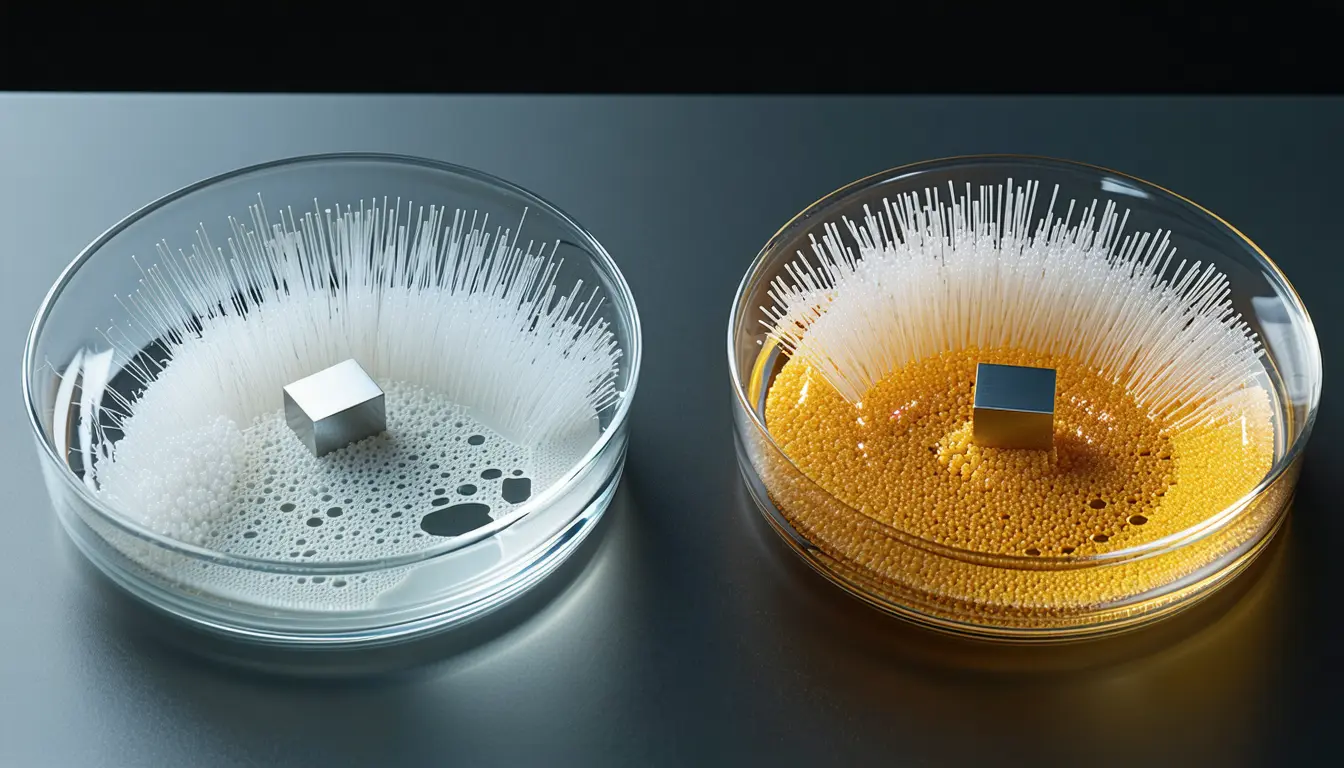
University of Newcastle researchers grew silicone brush layers, tunable to more than 70 nanometres thick, whose friction shifts with the surrounding liquid. The softer, swollen state forms in hydrocarbon liquids similar to lubricants, so lubricated parts look like a nearer use than medical devices.
The Scientist · Science desk
What happened
- The team grew the layers by surface-initiated controlled polymerization and describes the resulting brushes as exceptionally smooth and uniform.
- Neutron reflectometry on the Platypus instrument, ellipsometry and atomic force microscopy together tracked brush growth, structure in each liquid, and the effect on friction and adhesion.
- The group says the surfaces can be made on a larger scale as a platform for switchable silicone coatings.
Compiled by The ScientistSomething wrong?How this is made
Why it matters
- constraint Any coating used in water would sit in its collapsed state, so the medical-device case depends on friction and adhesion data for that state in particular.
- decision In lubricated parts the choice of lubricant becomes part of the coating's design, because hydrocarbon liquids are what swell the brushes into their softer form.
- capability Engineers could set a surface's friction and stickiness by changing the fluid over it, a control suited to the microfluidic devices on the group's list of uses.
Silicone brushes have been very hard to make, and their surface properties have been hard to control [2]. The goal sounds simple. Silicone is a polymer made of long molecules, and scientists have wanted those chains anchored to a surface and standing up like bristles [14]. At that scale silicone could cut surface friction [13]. The paper's title names the chemistry the Newcastle group used: silicone methacrylate brushes made by atom transfer radical polymerization [12]. The thickness shows how well the growth is controlled. It can be set from a few nanometres to more than 70 [4].
For me the structural measurement is the strongest part of the design. The team used the Platypus neutron reflectometer at the Australian Center for Neutron Scattering alongside ellipsometry and atomic force microscopy. Together the three tracked how the brushes grew, how their internal structure responded to each liquid, and how that changed friction and adhesion [7]. "Neutron scattering was essential to explain this behavior. Neutron reflectometry directly revealed how the polymer brush nanostructure changes in different environments, providing the missing structural insight needed to understand the unusual lubrication response," said principal investigator Dr. Edwin Johnson of the University of Newcastle [8]. So the team measured the shape of the chains in each liquid. They did not have to work it out backwards from the friction readings.
The structural result itself is clean. In water and simple alcohols the chains collapse tightly against the surface [5]. In toluene and other hydrocarbons they take up solvent and extend into a thicker, softer layer [6]. In the account, friction and stickiness are adjusted by changing the liquid [10]. The thickness range is a separate result about controlling the growth [3][4].
Medical technologies are on the group's list of possible uses. So are lubrication, industrial finishes, low-fouling surfaces and microfluidic devices [11]. The medical case has less behind it than the list implies. A coating used in water would sit in its collapsed state [5], so the claim depends on how that state behaves under load. The phys.org summary does not report friction coefficients or adhesion forces, does not compare the brushes with a conventional silicone coating, and does not describe any test in a biological fluid.
I think the nearer application is wherever the working liquid is already a hydrocarbon. The source describes toluene and hydrocarbons as similar to the liquids found in lubricants, and those are the liquids that swell the brushes [6]. The group also says the surfaces can be produced on a larger scale, as a platform for switchable silicone coatings [10]. That condition is the one to hold the claim to. A swollen brush that lowers friction in a lubricated contact is a testable product. A medical coating needs data from the collapsed state first.
First author Zachary Di Pietro, who holds an AINSE postgraduate research award, did the work with instrument time and staff expertise at the neutron centre [9]. The study is published in Chemistry of Materials [1].
What to watch
- Friction coefficients and adhesion forces in the full Chemistry of Materials paper, and whether they are benchmarked against a conventional silicone coating.
- Any test of the brushes in water-based or biological fluids, where the chains collapse against the surface.
- How large the larger-scale production actually runs, and whether the brushes hold up under repeated sliding wear.