Science1 publisher3 min readPublished
Falling water level drove about half the Dead Sea's deep-water warming in a GFZ-led model
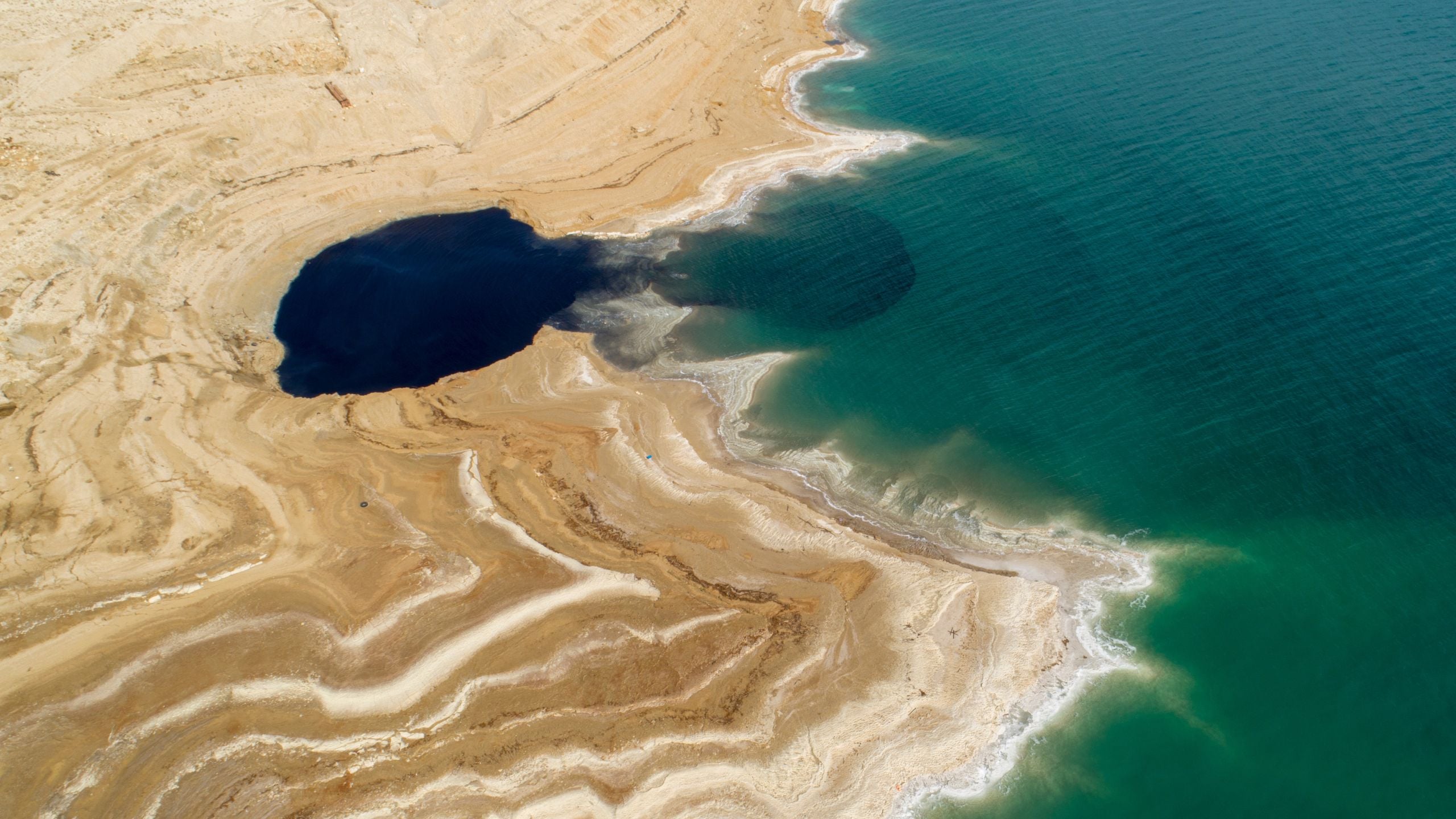
Emmanuel Guillerm's model attributes 1.5C of the Dead Sea's 2.8C deep-water warming from 1979 to 2019 to the lake's own falling level. Saltier brine cools itself less as it evaporates, so the same loop may help explain ancient salt beds that formed without an exceptionally hot climate.
The Scientist · Science desk
Drafted by a language model from the sources cited here and checked against its claim ledger before publication. How we use AISend a correction
What happened
- From 1979 to 2019 the lake's level fell about 34 metres while its upper layer warmed about 1.7C, less than the deep water did.
- Dissolved salt lowers water's tendency to evaporate, so as the brine concentrates, evaporative cooling weakens and the remaining water warms.
- Run forward with all inflows and industrial extraction stopped, the model projects about 85 metres more decline and 5 to 8C of warming by 2100.
- In longer runs, the rising brine concentration kept the water warming after the imposed air warming had stopped.
- A simulated eastern Mediterranean, fully cut off from the ocean, warmed about 20C as its surface fell 2.5 kilometres over roughly 8,000 years.
Compiled by The ScientistSomething wrong?How this is made
Why it matters
- decision Choices about how much of the lake's inflow to divert now carry a modelled warming cost for the deep water, separate from anything emissions policy does.
- constraint On this model's evidence, holding air temperature steady would not stop the deep water warming in a lake that keeps losing water.
- constraint Thick ancient salt beds become weaker evidence of an exceptionally hot, dry climate if a concentrating brine can heat itself.
Hotter air and a shrinking lake arrived over the same decades [2], and human diversion of incoming water contributed to the shrinking [3]. The temperature record alone cannot say which one warmed the water. Guillerm's group [1] separated them inside the model, running it once with air temperature held constant and once with lake level held constant [5]. By the 2010s, air warming accounted for about 1.3C of the deep-water rise in those runs [6]. Add the 1.5C from the falling level and the total is 2.8C, the whole observed deep warming, with the level supplying about 54% of it [22][23]. Single-factor runs need not sum to the full record when the factors interact. In this model they do.
I like the validation best. The model was calibrated on measurements from 2012 to 2015, four years of data, and then reproduced the warming trend across the four decades from 1979 to 2019, along with the seasonal temperature cycle [4][24]. Fitting a short window and matching a long record is a fair test. The thing it does not tell you is whether the split would survive a different model. The 1.5C is a counterfactual computed by this model, and no measurement of the real lake can check it directly.
Surface heat also reaches the depths. In summer, warmer and saltier water sits over cooler, slightly fresher water. Heat diffuses faster than salt, so sinking streams carry both downward in a process called salt fingering, and winter mixing gives air warming a second route [9]. "This part of water warming is thus due to water diversion, and adds on top of water warming due to anthropogenic air warming," Guillerm told ScienceAlert [8].
Projections to 2100 rest on simplifications that push in opposite directions. Leaving out inflow tends to overstate decline and warming. Leaving out industrial extraction tends to understate water loss [11]. Guillerm thinks the two balance, and points to the absence of any break in the simulated decline at the 2019 transition to projections [11]. Groundwater inflow remains uncertain [11]. Humidity, wind and sunlight repeat their historical seasonal patterns while air temperature is prescribed to rise [12]. The projected fall works out to about 1.05 metres a year, against roughly 0.85 metres a year from 1979 to 2019 [26][25].
This loop runs only while the lake keeps losing water. Restoring historical freshwater inflow would stop the decline, Guillerm said [14]. "Warming due to increasing salinity would stop," he said [15]. A dilute surface layer would then insulate the deeper water from atmospheric warming, though the surface itself would keep warming [16].
For the Mediterranean, the assumptions carry more weight. The run treats the eastern basin as completely disconnected from the ocean, and whether that happened during the Mediterranean's ancient loss of water is still debated [17]. It starts with the surface 400 metres below sea level and the brine already concentrated enough for rock salt to crystallise [18]. According to ScienceAlert's account, the same loop could explain how ancient seas laid down vast salt deposits without an exceptionally hot, dry climate around them [21]. Guillerm is careful about the isolation question. "Our work does not provide the solution," he said [20].
What to watch
- An independent Dead Sea model, run with the same frozen-air and frozen-level tests, confirming or revising the 1.5C share attributed to water loss.
- Better measurements of groundwater inflow, the term Guillerm's 2100 projections leave uncertain.
- New evidence on whether the eastern Mediterranean was fully cut off from the ocean during its ancient drawdown, the assumption behind the basin-scale run.