ScienceNot yet confirmed elsewhere1 publisher2 min readPublished
Magnetic field shifts the energy of light from polariton condensates in layered CrSBr
Researchers in Regensburg, Munich and Prague shifted the energy of light from polariton condensates in the layered magnet CrSBr using a magnetic field. These condensates can form with far less cooling than atomic gases, so a way to tune their light matters for quantum optics outside specialised labs.
The Scientist · Science desk
What happened
- Exciton-polaritons are excitons coupled to the light field of an optical resonator, a hybrid that is lighter and easier to bring into one collective quantum state.
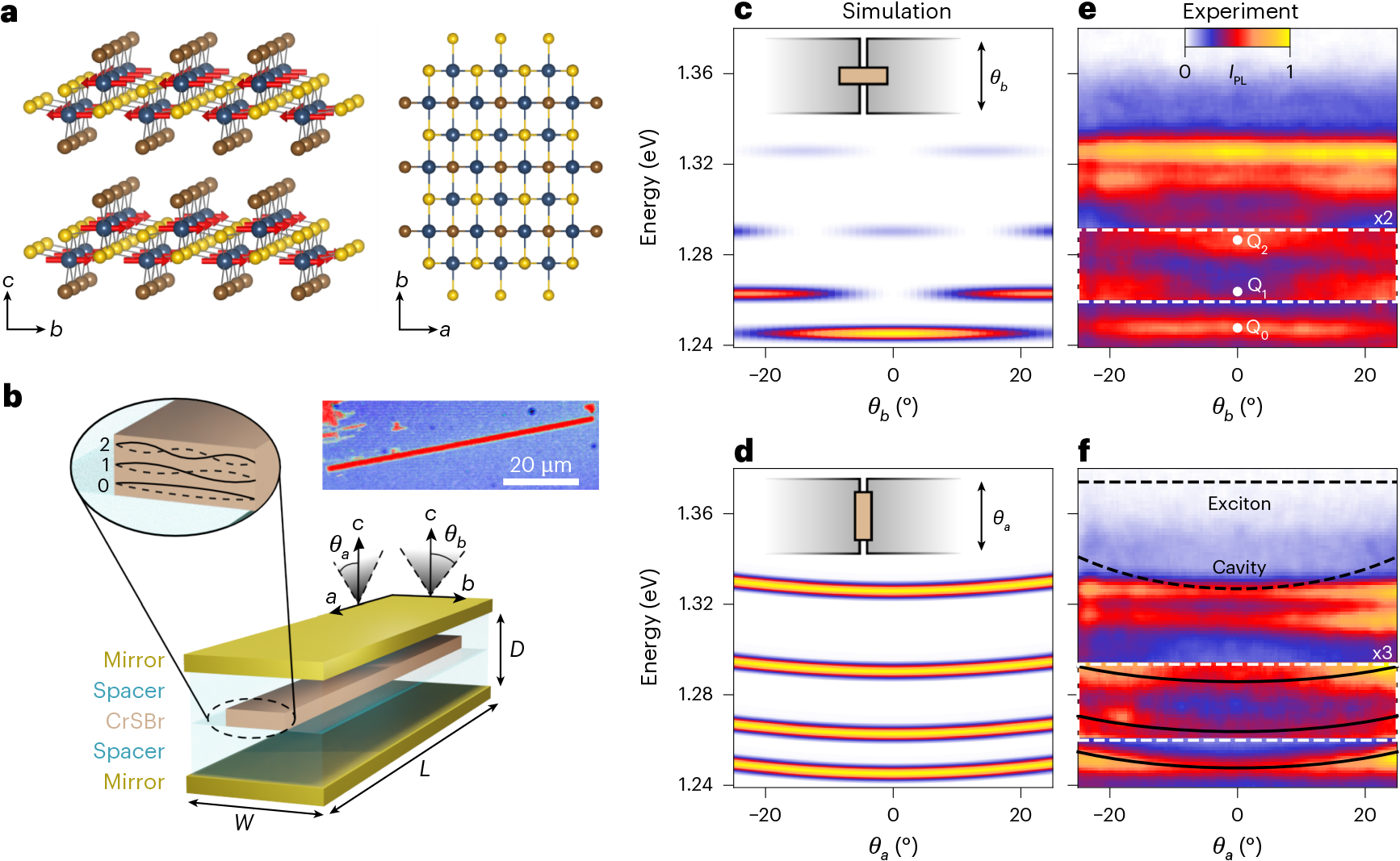
- CrSBr is built from atomically thin layers whose electron spins all point one way within a layer and the opposite way in the next.
- The team created polaritons in CrSBr structures with ultrashort laser pulses and raised their density until the particles began oscillating in sync.
- The study appears in Nature Materials, led by Rupert Huber, Fabian Mooshammer and Jan Wilhelm at Regensburg, Florian Dirnberger at TUM and Zdenek Sofer at UCT Prague.
Compiled by The ScientistSomething wrong?How this is made
Why it matters
- capability Emission energy becomes adjustable on a finished sample by changing an external field, with the control coming from the crystal's own magnetism.
- constraint As demonstrated, the condensate is switched on by ultrashort laser pulses, so a source built on it needs a pulsed laser as well as a magnet.
- decision The little-or-no-cooling advantage is claimed for polariton condensates as a class, so judging CrSBr for devices outside cryogenic labs has to wait for the paper's measurement temperature.
Before any magnet was applied, the team had to show that the polaritons had condensed. Their test pairs a jump in brightness with order in the light waves, and the first author treats the order as the decisive part [8]. "Once the condensation threshold is reached, the intensity of the emitted light suddenly increases more than a hundredfold. At the same time, the light waves become ordered and, in a sense, oscillate in step with one another. This so-called coherence provides clear evidence of condensation," said Heng Zhang, the study's first author [8].
Then came the field. As it increased, the energy of the light emitted by the condensate shifted, and phys.org attributes the shift to the alternating magnetic order of CrSBr [2]. The team chose this layered magnetic semiconductor over conventional semiconductor materials to put that order inside the sample [1].
The cooling question needs care. The first Bose-Einstein condensates formed in atomic gases close to absolute zero, and the cooling was costly and confined to specialised laboratories [5]. Polariton condensates can form with significantly less external cooling, in some cases with none [4]. That claim covers the class of condensate. For this experiment, phys.org does not report the measurement temperature, the size of the energy shift, or the field strength that produced it [2].
The polaritons here were created with ultrashort laser pulses [7]. A light source built on the demonstration as it stands would pair a pulsed laser with a magnet. The account names quantum communication, quantum optics and quantum computing as eventual uses [11]. I'd expect those to depend on stable output at a temperature a device can hold, and this experiment was built to answer an earlier question: whether a field moves the emission at all [2].
Phys.org describes control of the condensate and its light as "a challenge that has now been overcome" [10]. I think that overstates one result. The experiment shows that one property of the light, its energy, follows an applied field in a crystal chosen for its magnetism [2].
What to watch
- The sample temperature reported in the Nature Materials paper, and whether condensation and field tuning hold without cryogenic cooling.
- The size of the energy shift per unit field and the field strength required, which decide whether a small permanent magnet could do the tuning.
- Any demonstration of the CrSBr condensate driven by something other than ultrashort laser pulses, such as continuous or electrical pumping.
Clarity's read
What the record supports and how the coverage leans. The claims behind it follow.
Reality
- Evidence45
- Adoption
- Insufficient
- Hype gap+30
- Incentives
- Insufficient
- Confidence40
Claim ledger
Ranked by verification strength, evidence, and original report placement.
- [1]
An international research team showed that exciton-polariton condensates can be controlled through the magnetic properties of the material, using the layered magnetic semiconductor chromium sulfide bromide (CrSBr) instead of conventional semiconductor materials.
- [2]
As the applied magnetic field increased, the energy of the light emitted by the condensate shifted; phys.org attributes this to the unusual magnetic order in CrSBr. The account does not report the size of the shift, the field strength, or the measurement temperature.
- [3]
Exciton-polaritons are excitons coupled to the light field of an optical resonator to reduce their effective mass; being lighter, they can more easily be brought into a collective quantum-mechanical state.
- [4]
An exciton-polariton condensate can form with significantly less external cooling, in some cases even without any external cooling at all.
- [5]
The first Bose-Einstein condensates were observed in ultracold atomic gases close to absolute zero; the cooling was technically demanding, costly and restricted to specialised laboratories.
- [6]
The CrSBr crystal consists of many atomically thin layers; electron spins are aligned in the same direction within each layer and point in opposite directions in neighbouring layers.
- [7]
The researchers excited exciton-polaritons in CrSBr structures using ultrashort laser pulses; as particle density increased, the particles eventually got close enough to oscillate in sync with their neighbours.
- [8]
"Once the condensation threshold is reached, the intensity of the emitted light suddenly increases more than a hundredfold. At the same time, the light waves become ordered and, in a sense, oscillate in step with one another. This so-called coherence provides clear evidence of condensation,"
- [9]
The team was led by Rupert Huber, Fabian Mooshammer and Jan Wilhelm of the University of Regensburg, Florian Dirnberger of the Technical University of Munich, and Zdenek Sofer of the University of Chemistry and Technology Prague; the study is published in Nature Materials.
- [10]
Phys.org describes controlling the properties of the condensate and the light it emits as a key challenge, "a challenge that has now been overcome".
- [11]
Exciton-polariton condensates are considered a promising platform for future applications in quantum communication, quantum optics and quantum computing.
Sources
1 independent publisher whose own reporting we read for this story.
- phys.orgLayered semiconductor unlocks magnetic control of light emitted by quantum condensates
1 article · October 8, 2026
Topics and entities
Follow any of these and your For You feed starts watching them — no settings page required.
Topics
Entities
- CrSBrFollow
- University of RegensburgFollow
- Technical University of MunichFollow
- University of Chemistry and Technology, PragueFollow
- Nature MaterialsFollow
- Rupert HuberFollow
- Heng ZhangFollow