Product1 publisher2 min readPublished
CCNY imprints microwave signals on laser light across 300MHz without a resonator
Physicists at The City College of New York used the layered magnet CrSBr to convert microwave signals into an optical output over roughly 300 megahertz of bandwidth. Moving a single quantum state is the step still ahead.
The Product Desk · Product desk
What happened
- Physicists at The City College of New York demonstrated microwave-to-optical conversion in chromium sulfide bromide, a layered magnetic semiconductor written as CrSBr.
- They measured the conversion across a microwave bandwidth of roughly 300 megahertz, and moved the operating frequency by applying an external magnetic field.
- The experiment showed the conversion happening, and stopped short of transferring individual quantum states, the step a quantum link actually requires.
- The study appears in Nature Materials, from CCNY's Laboratory for Nano and Micro Photonics, with postdoctoral researcher Pratap Chandra Adak leading the work in Vinod M. Menon's group.
Compiled by The Product DeskSomething wrong?How this is made
Why it matters
- constraint The frequency interface is what stands between microwave processors and optical fibre, so the schedule for linking two machines tracks transducer progress.
- capability Because the operating frequency moves with an applied magnetic field, one interface design could be retuned to a given processor.
- contradiction The resonator-free result is presented as flexibility for early device work, while the same team's route to stronger conversion puts resonators and high-quality cavities back into the design.
An engineer specifying a transducer asks two numbers before any others: what fraction of the input converts to output, and how much noise leaves with it. Neither number is reported [18]. Efficiency and noise are also the two requirements the team names as the hard part still ahead, because quantum communication demands extremely high efficiency and very little added noise [11].
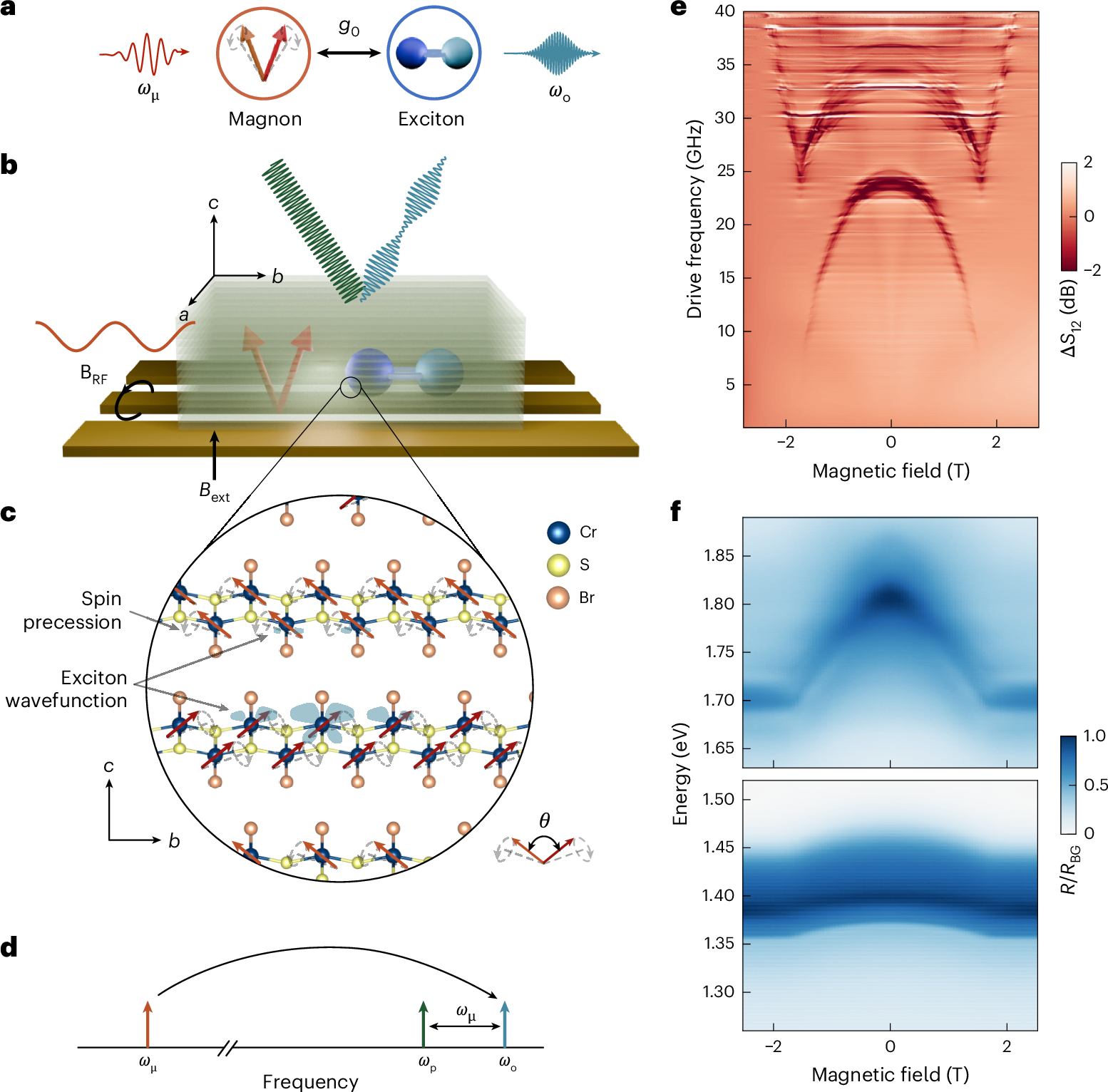
Inside the crystal the chain has three links. A microwave signal sets the material's magnetic moments moving together, and that collective motion produces quasiparticles called magnons [2]. The magnons interact with excitons, which form when an electron binds to a hole and which couple strongly to light near specific optical resonances [3]. Laser light reflected off the crystal then follows the original microwave excitation coherently [4].
The build was bare. The demonstration used a bulk crystal with no resonators [7], and resonators are the standard way to sharpen interactions in frequency-conversion systems; the researchers argue that leaving them out gives more flexibility during early device development [8]. The improvements they list run the other way: thinner CrSBr layers, microwave resonators, high-quality optical cavities, and exciton-polaritons to hold down optical losses [12].
Thinning is the part that bears on packaging. CrSBr keeps its magnetic and optical behaviour when reduced to only a few layers [9]. Pratap Chandra Adak, the postdoctoral researcher who led the study, said the material's structure creates opportunities for stronger interactions and tighter integration [13]. Vinod M. Menon said CrSBr combines strong optical interactions with microwave-frequency magnetism in one crystal [14].
Nothing here goes into a quantum processor this quarter. The audience is whoever will specify the interconnect layer several results from now, and the discipline that helps them is keeping two claims apart. One is that a conversion path exists and behaves coherently, which is what the reflected-light measurement shows [4]. The other is that a device meets a link's specification, meaning a single quantum state through it at tolerable loss and noise [10]. Menon's proposed next move is a wider search: he said expanding research into layered magnetic materials could reveal other combinations suited to opto-magnonic devices [20].
What to watch
- A follow-up that reports conversion efficiency and added noise for a few-layer CrSBr device.
- An experiment that adds microwave resonators or an optical cavity to CrSBr and attempts transfer of a single quantum state.
- Results from other layered magnets showing comparable magnon-exciton coupling at different operating frequencies.