Invest3 publishers2 min readPublished
LG rides a startup's CubeSat to test five off-the-shelf parts from three affiliates in orbit
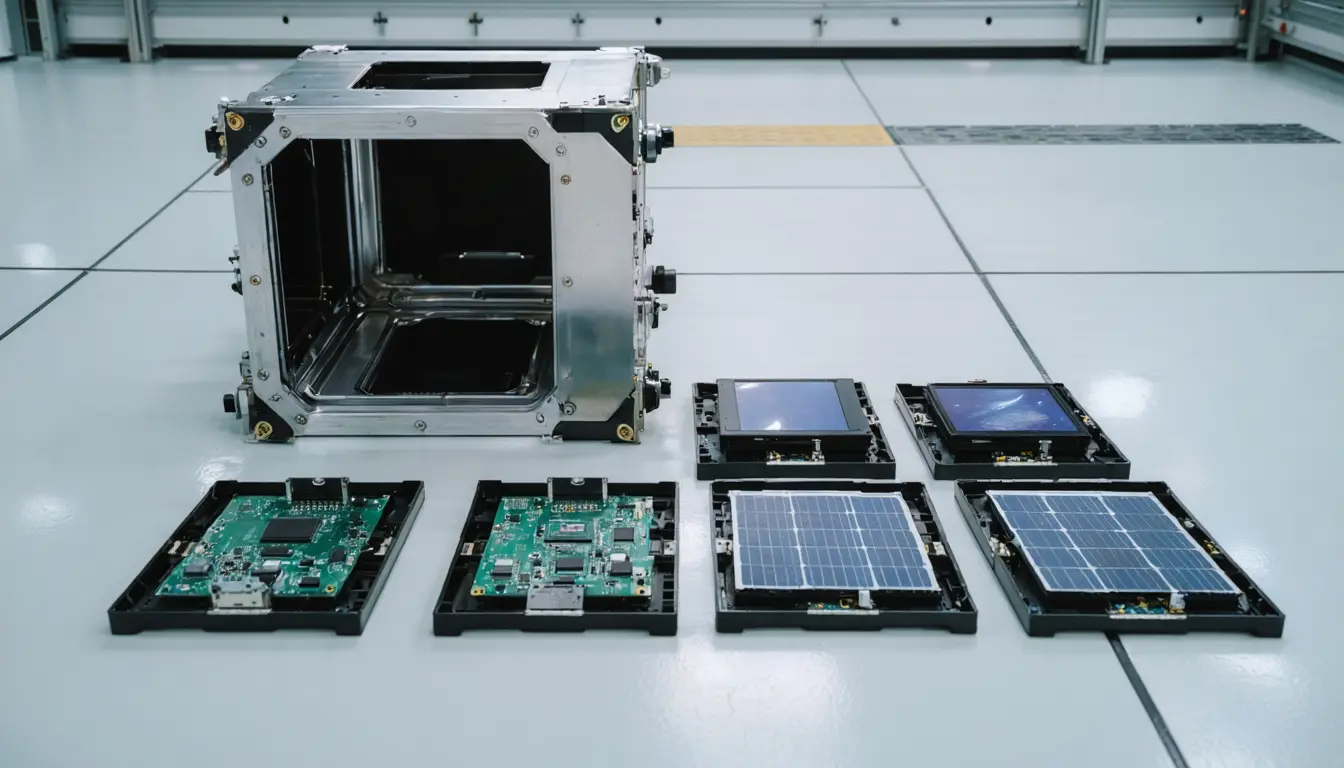
LG is flying five components from three affiliates on a startup's CubeSat aboard Nuri, the group's first joint test of its hardware in space. The parts are ground-proven commercial designs, so the flight tests whether existing LG products can serve satellites.
The Investor · Invest desk
Drafted by a language model from the sources cited here and checked against its claim ledger before publication. How we use AISend a correction
What happened
- Nuri is scheduled for its fifth launch at 7:30 a.m. Wednesday from the Naro Space Center in Goheung, about 330 kilometres south of Seoul.
- If Nuri reaches orbit, the CubeSat will spend about 60 days at 570 kilometres testing the components one after another.
- LG also plans to test its own satellite payload technologies, with a goal of launching its own CubeSat in 2028.
- LG Energy Solution partnered with US startup South 8 Technologies in November 2025 to develop aerospace battery cells.
Compiled by The InvestorSomething wrong?How this is made
Why it matters
- exposure LG Electronics' parts carry the satellite's power, orientation and communications, so a fault in one of them would also cost LG Innotek and LG Energy Solution their flight data.
- capability A clean 60-day run would give three affiliates flight data on adapted commercial parts, which is the record a satellite builder would ask for before buying.
- precedent A pass would show other private Korean firms a cheaper way into space supply: adapt existing parts and fly them on a startup's CubeSat aboard Nuri.
Sort the parts list by function and only one item is a payload in the usual sense. The power module and attitude-control actuator will manage the satellite's power and orientation, and the battery pack will supply its electricity [9]. The antenna will be the primary communications link for the whole mission and will not get a separate test [10]. Four of the five components are the satellite's own operating systems, and LG Electronics built three of those four [17][16].
The parts are commercial off-the-shelf designs, already proven reliable on the ground and adapted for space [11]. The Korea Herald reports that the approach can significantly cut development costs and lead times [18]. The obvious way into satellite supply for affiliates that already make camera modules, batteries and power electronics is to sell adapted versions of those products [3]. LG Sciencepark said it will check whether the components work under real space conditions and use the flight data to improve them [6].
"This launch is the first step in seeing how LG's technologies actually perform in the space environment," said LG Sciencepark President Chung Sue-hyun [4].
So far the commitment sits with the research arm. The project runs through LG Sciencepark, the group's research and innovation hub [7]. The satellite was prepared with Unmanned Exploration Laboratory, a lunar-rover startup LG picked for its Superstart open innovation programme in 2023 [2][13]. The ride is a government rocket on its fifth flight [5]. LG did not disclose what the mission cost or what any affiliate plans to spend on space hardware.
The flight can end three ways. Nuri may not reach orbit, and the 60-day test plan depends on it doing so [8]. The parts may hold up, which would give the affiliates flight data to show satellite builders. Or some may need redesign. Each redesign eats into the cost and lead-time savings that were the reason to use off-the-shelf parts in the first place [18].
I think the record shows a coordinated test across three affiliates. It does not yet show a business line. The counter-case is fair: an aerospace battery partnership and a dated plan for LG's own CubeSat are steps a pure side project would skip [15][12]. A supply contract with an outside satellite maker, or a disclosed budget for the 2028 satellite, would settle it in favour of the supply-chain reading.
What to watch
- Confirmation from LG Sciencepark that the CubeSat has separated from Nuri and is sending data down over the LG Electronics antenna.
- The results LG Sciencepark publishes from the test sequence, especially any component that needs redesign before it flies again.
- Whether LG's talks with the Korea AeroSpace Administration, under way since last year, turn into a formal cooperation agreement.