InvestIndependently confirmed2 publishers2 min readPublished
Nuri's fifth flight gives CubeSat customers a 90% deployment rate from a sample of one
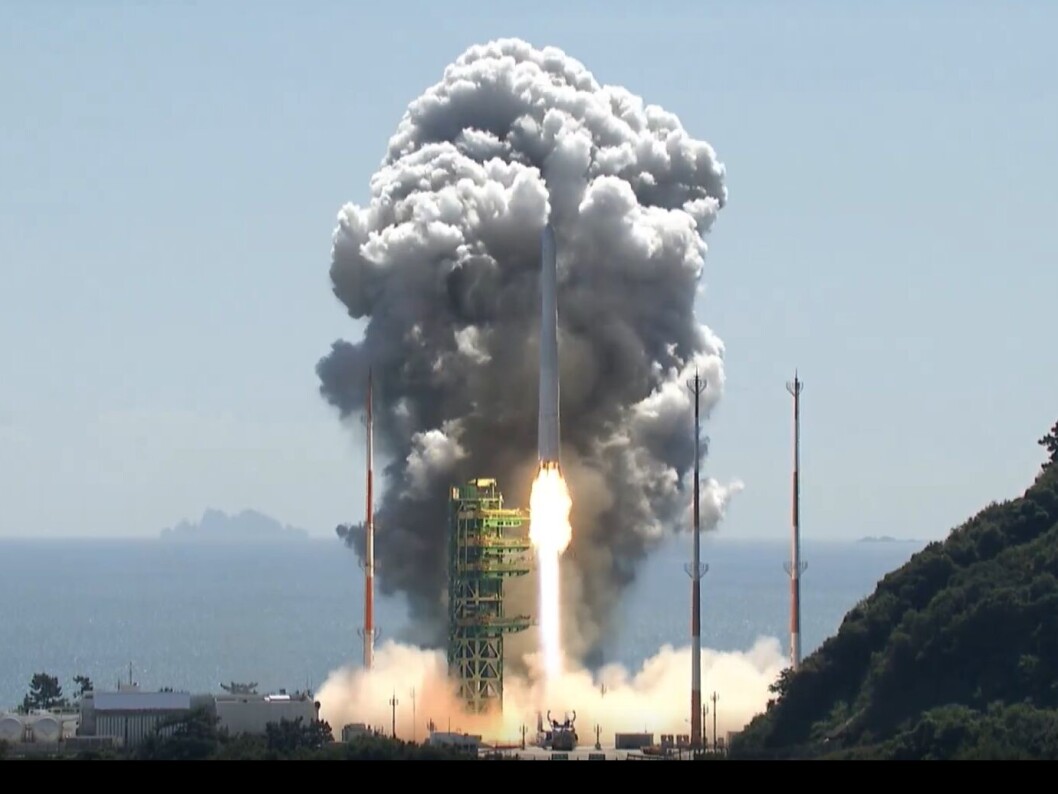
Korea's Nuri rocket put nine of ten CubeSats into orbit on its fifth flight, and all nine have made ground contact, KASA and KARI said. Ten satellites from one flight cannot separate a 90% launcher from an 80% one.
The Investor · Invest desk
Key figures: a hypothetical launcher with an 80% per-satellite deployment rate would deploy nine or more of ten CubeSats about 38% of the time. Nuri's fifth flight deployed nine of ten, a 90% rate, from 10 CubeSats carried as secondary payloads.
| Figure | Value | Note | Claim |
|---|---|---|---|
| Chance an 80% launcher deploys nine or more of ten | 38% about | 16 | |
| Nuri's fifth-flight rate | 90% deployed | 15 | |
| Secondary payloads | 10 CubeSats | 7 |
What happened
- Nuri's main payload was five Neonsat microsatellites for an Earth observation constellation, with 10 CubeSats from companies, local governments, universities and research institutes alongside.
- Quaternion's Persat02 was the one CubeSat that failed to deploy; the rest reached orbit normally, according to Korea JoongAng Daily.
- Six of the nine deployed CubeSats have two-way communication with ground stations, and stations are still receiving signals or data from the other three.
Why it matters
- cost If Quaternion wants another Nuri ride for Persat02, the next scheduled flight is in the second half of next year, and its stated cargo is five more Neonsats.
- constraint With government Neonsats as the main payload on the fifth and sixth flights and one launch a year planned to 2032, private CubeSat operators fly on a calendar the Neonsat programme sets.
- contradiction Korea JoongAng Daily writes that Nuri "has completed its job of delivering satellites to space", yet one of ten CubeSats never left it; the phrase describes the nine in contact, not the full manifest.
Ten satellites on one flight is a small sample, and the 90% [15] is a count more than a rate. Take a hypothetical launcher that deploys 80% of its CubeSats: it would still put nine or more of ten into orbit about 38% of the time, from 10 x 0.8^9 x 0.2 (0.268) plus 0.8^10 (0.107) [16]. That treats every satellite as an independent draw, and a single cause behind the miss would break the assumption. The agencies did not say why Persat02 failed to deploy [2], how long contact took on the fourth launch, or what any CubeSat customer paid.
The better evidence for the rocket is orbital placement, and the sources give it as speed of contact. Oh Tae-seok, head of the Korea AeroSpace Administration, said the agency made contact with the cube satellites in "far less time than during the fourth launch" [4]. He gave the reason: "This was achieved because the launch vehicle placed the satellites into their target orbits more precisely and provided more accurate satellite position data, which means our technical maturity has risen another notch." [5] The last of the six two-way contacts, DaejeonSat-1, came about 11 p.m. on the 8th, roughly 34.5 hours after liftoff [18], and JAC-007 returned a beacon on its first attempt and later completed a data downlink [11]. The comparison with the fourth launch is the administrator's own, made by the agency that launched the rocket [6].
The CubeSats rode as secondary payloads [7], so the commercial question sits behind a policy one. An Hyoung-joon, head of the space and public-sector team at the Science and Technology Policy Institute, said that connecting Nuri's success to commercialization requires a Korean-style space transportation industrial policy, one that sits between leaving it to the market and having the government develop launch vehicles itself, and that combines long-term public procurement with competitive support for the private sector [14]. Procurement of that kind commits public money for years, and the deployment evidence in these two reports is one flight and ten CubeSats [1].
In our view the flight shows Nuri can deliver secondary payloads, and one flight cannot show it does so reliably. Other readings are open. If Persat02's failure traces to the satellite, the rocket's own count is ten of ten. If it traces to the rocket, 90% is a real miss. If the fourth-flight comparison holds, the trend matters more than either figure. We would be wrong if the sixth launch releases every secondary payload it carries and contact times keep falling.
What to watch
- Whether KASA or KARI attribute Persat02's failed deployment to the rocket or to the satellite.
- The sixth Nuri launch in the second half of next year: five more Neonsats, whether every secondary payload deploys, and whether contact times fall again.
- Whether the government adopts the long-term procurement framework An Hyoung-joon describes, and at what launch volume.
Clarity's read
What the record supports and how the coverage leans. The claims behind it follow.
Reality
- Evidence60
- Adoption
- Insufficient
- Hype gap+20
- Incentives55
- Confidence70
Claim ledger
Ranked by verification strength, evidence, and original report placement.
- [1]
Nuri's main payload on its fifth flight was five Neonsat microsatellites for an Earth observation constellation, and it also carried 10 CubeSats built by companies, local governments, universities and research institutes.
ReportedSupportedSource: Korea JoongAng Daily2 sources— create a free account to open themView cited source - [2]
One of the CubeSats, Quaternion's Persat02, failed to deploy, while the rest reached orbit normally.
ReportedSupportedSource: Korea JoongAng Daily2 sources— create a free account to open themView cited source - [3]
Six of the nine CubeSats have established two-way communication with ground stations, and stations are still receiving signals or data from the other three.
ReportedSupportedSource: Korea JoongAng Daily2 sources— create a free account to open themView cited source - [4]
Oh Tae-seok, head of the Korea AeroSpace Administration, said: "In this fifth Nuri launch, we established contact with the cube satellites in far less time than during the fourth launch."
ReportedSupportedSource: Oh Tae-seok, head of the Korea AeroSpace Administration, quoted by Seoul Economic Daily2 sources— create a free account to open themView cited source - [5]
Oh Tae-seok said: "This was achieved because the launch vehicle placed the satellites into their target orbits more precisely and provided more accurate satellite position data, which means our technical maturity has risen another notch."
ReportedSupportedSource: Oh Tae-seok, quoted by Seoul Economic Daily2 sources— create a free account to open themView cited source - [6]
The Korea AeroSpace Administration and the Korea Aerospace Research Institute launched the fifth Nuri rocket and said on the 13th that all nine deployed secondary payload satellites had made contact.
ReportedSupportedSource: Seoul Economic Daily (en.sedaily.com)2 sources— create a free account to open themView cited source - [7]
The 10 cube satellites were carried as secondary payloads on the fifth Nuri launch.
ReportedSupportedSource: Seoul Economic Daily (en.sedaily.com)2 sources— create a free account to open themView cited source - [8]
The fifth Nuri rocket launched at 12:25 p.m. on the 7th.
- [9]
Four satellites (Space Lintec's BEE-1012, the Unmanned Exploration Laboratory's Ulysses, Space&Bean's SDOneSat and Chosun University's optical communications satellite) achieved two-way contact around 2 p.m. on the 7th.
- [10]
The Korea Aerospace Research Institute's component verification platform made two-way contact around 2:30 p.m. on the 7th, and Daejeon City's DaejeonSat-1 at about 11 p.m. on the 8th.
- [11]
Cosmo Works' JAC-007 received a beacon signal on its first contact attempt around 2 p.m. on the 7th and later completed a data downlink; KAIST's GBSat and O&B Space's SLEDGE received beacon signals and data between the 7th and the 9th.
- [12]
The government plans to put five more Neonsats into orbit on Nuri's sixth launch in the second half of next year, bringing the number launched on Nuri to 10 and completing the constellation.
- [13]
The government plans to launch Nuri at least once a year through 2032.
- [14]
An Hyoung-joon, head of the space and public-sector team at the Science and Technology Policy Institute, said: "To connect Nuri's success to commercialization, we need a Korean-style space transportation industrial policy that sits between leaving it to the market and having the government develop [launch vehicles] itself and combines long-term public procurement with competitive support for the private sector."
ReportedSupportedSource: An Hyoung-joon, Science and Technology Policy Institute, quoted by Korea JoongAng DailyView cited source - [15]
Nine of the ten CubeSats deployed, a 90% deployment rate on one flight.
- [16]
A hypothetical launcher with an 80% per-satellite deployment rate, treating satellites as independent, would deploy nine or more of ten about 38% of the time.
- [17]
The first four two-way contacts came about 95 minutes after liftoff.
- [18]
DaejeonSat-1's two-way contact came roughly 34.5 hours after liftoff.
- [19]
Korea JoongAng Daily wrote that, with all nine separated CubeSats in contact, Nuri "has completed its job of delivering satellites to space."
ReportedContestedSource: Korea JoongAng Daily3 sources— create a free account to open themView cited source
Sources
2 independent publishers whose own reporting we read for this story.
- en.sedaily.comAll Nine Cube Satellites From Nuri Launch Make Contact
1 article · October 12, 2026
- koreajoongangdaily.comNuri’s CubeSats signal successful orbit delivery, so what is next for Korea's space industry?
1 article · October 12, 2026
Topics and entities
Follow any of these and your For You feed starts watching them — no settings page required.