InvestNot yet confirmed elsewhere1 publisher3 min readPublished
Korea's land ministry plans to cut developers' rezoning payments to turn office sites into housing
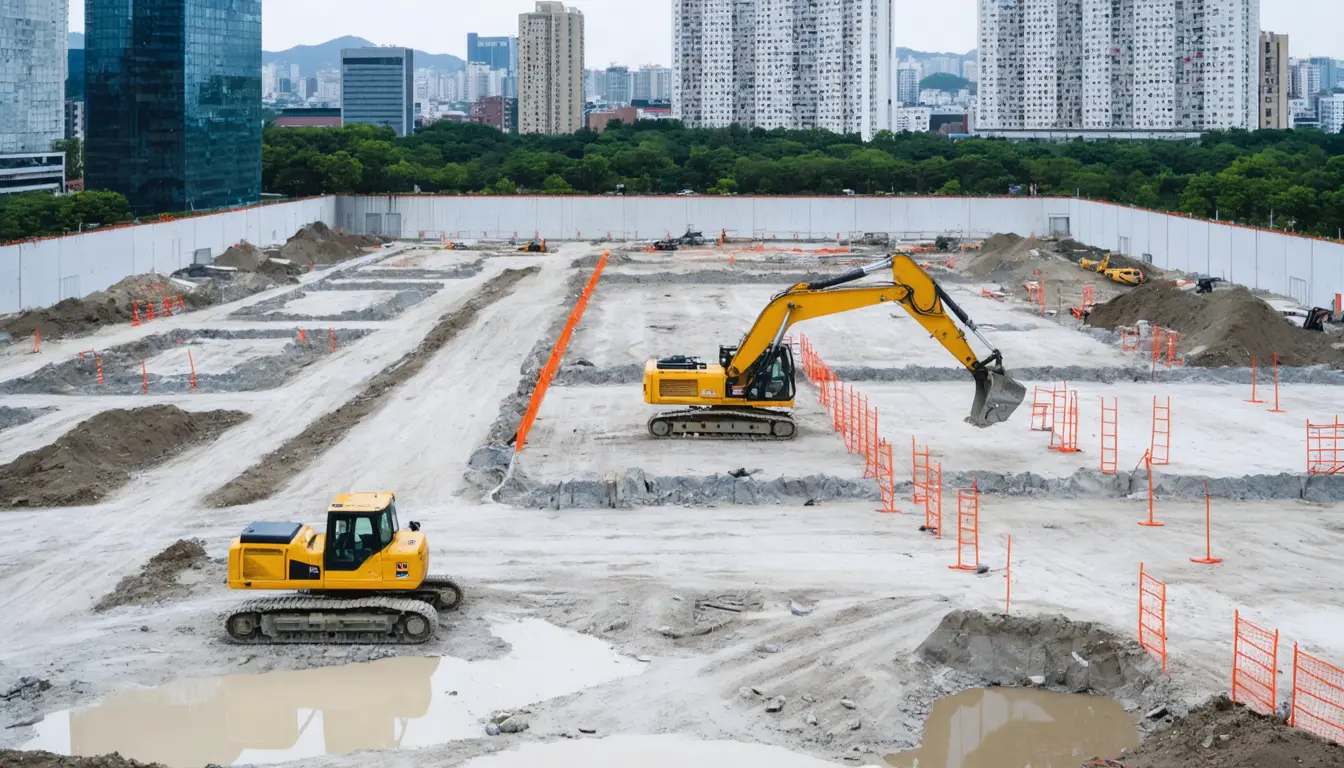
Korea's land ministry plans to cut developers' rezoning payments to bring about 1 million square meters of unbuilt Seoul sites into housing. It also plans the first legal basis for charging on upgrades within a zone, so what developers gain depends on the rate its study sets.
The Investor · Invest desk
What happened
- The land ministry is commissioning a study, Research on Flexible Urban Planning Measures to Expand Housing Supply, to set the level of profit recapture and the tools for converting land use.
- Completions in Seoul from January through August fell 19% to 25,630 homes, from 31,695 a year earlier.
- Starts rose 41% to 20,679 units, but July supplied 6,386 of them, and without that month starts were roughly level with last year.
Why it matters
- cost The public pays for faster supply in forgone recapture, because every point off the rate is facilities, land or cash that developers no longer hand over.
- constraint Local governments that now set within-zone upgrade rates on their own would be working under a national legal basis once the ministry writes one.
- decision Owners of unbuilt sites in Seoul's 11 districts can apply under the city's 30% program now or wait for a national rate whose level and timing are unset.
The plan cuts in two directions at once. The ministry wants developers to pay less when land is rezoned [1]. It also wants a legal basis for charging them on zoning upgrades and changes in permitted use inside a single use zone, where no such basis has existed [2]. Under the National Land Planning and Utilization Act, contributions can be levied only when land moves between zone categories, such as residential to commercial, so local governments have set their own rates for everything else [6]. A ministry official said the aim is "to help make it easier to convert commercial and office land into residential land" [7].
A contribution is the part of a rezoning gain that a developer hands back as public facilities, land or cash when a plan change raises the floor area ratio [5]. Seoul has already made the large cut. If its July rate is a share of the gain, a developer in the 11 districts now keeps 70% instead of 40%, or 1.75 times as much [12][18]. The same month the city cleared a knowledge industry center site on the former CJ factory grounds in Gayang-dong for about 960 apartments [13].
The supply count explains the hurry. Seoul finished 6,065 fewer homes in the first eight months than a year earlier [19]. The starts figure is thinner than its 41% headline. Take out July and the other seven months produced 14,293 starts, close to the roughly 14,700 that the 41% gain implies for all eight months of last year [20][21]. Land Minister Hong Ji-sun told a National Assembly audit on the 7th that "housing starts have fallen markedly over the past three years, and it is also true that move-ins are being delayed" [11].
The government is choosing conversion over new land. Officials say new development in city centers is difficult and redevelopment takes years [16]. The ministry counts about 1 million square meters of unbuilt city-center land in Seoul and 750,000 square meters across 15 regulated areas of Gyeonggi Province, 1.75 million in all [8][17]. It says those sites could take housing immediately through use-zone changes, yet they have sat undeveloped for long periods [8].
The study could set a national rate below what local governments now charge, raising returns and restarting stalled projects as officials intend [15]. It could instead put a national charge on within-zone upgrades that leaves some projects paying more than local practice asks [2]. Or the research could run long enough that the sites stay idle while it does. The request for proposals asks for recapture levels "that allow projects to proceed while blocking claims of preferential treatment" [4].
I think the bigger cut for Seoul developers came from the city in July, and the national study is mostly about standardising rates, or rather about giving the ministry a statute to charge where it now has none. Seongnam has also trimmed burdens without waiting, lowering the mandatory rental share in redevelopment to 10% from 12% [14]. The ministry has not published a target rate or a timeline, and its material does not mention REITs; the only sites it sizes are unbuilt land [8]. This view is wrong if the national rate lands below Seoul's 30% [12], or if Seoul starts outside one-off months begin to climb.
What to watch
- The contribution rate the ministry's study recommends for within-zone upgrades, set against Seoul's 30%.
- Seoul housing starts from September onward, to see whether the flat trend outside July breaks.
- Applications to convert any of Seoul's 1 million square meters of unbuilt city-center land under the city's July program.
Clarity's read
What the record supports and how the coverage leans. The claims behind it follow.
Reality
- Evidence42
- Adoption
- Insufficient
- Hype gap+20
- Incentives55
- Confidence55
Claim ledger
Ranked by verification strength, evidence, and original report placement.
- [1]
The government plans to reduce the public contributions developers must pay when land is rezoned, aiming to speed up housing supply by making it easier to convert commercial and office sites in city centers into apartment sites.
ReportedSupportedSource: Seoul Economic Daily, citing the Ministry of Land, Infrastructure and Transport2 sources— create a free account to open themView cited source - [2]
The government will establish a legal basis for imposing public contributions on zoning upgrades and changes in permitted uses within the same use zone, which has been absent until now.
ReportedSupportedSource: Seoul Economic Daily2 sources— create a free account to open themView cited source - [3]
The Ministry of Land, Infrastructure and Transport will commission a study titled "Research on Flexible Urban Planning Measures to Expand Housing Supply," focusing on redefining the public contribution framework, determining an appropriate level of profit recapture, and devising tools for converting land use.
ReportedSupportedSource: Ministry of Land, Infrastructure and Transport, via Seoul Economic Daily2 sources— create a free account to open themView cited source - [4]
The request for proposals states the study will "examine appropriate levels and tools for profit recapture that allow projects to proceed while blocking claims of preferential treatment, in order to spur conversions to medium- and high-density residential land."
ReportedSupportedSource: Ministry request for proposals, via Seoul Economic Daily2 sources— create a free account to open themView cited source - [5]
Public contributions are a system under which developers hand over part of their gains, as public facilities, land or cash, when urban plans are changed to raise floor area ratios and other limits.
ReportedSupportedSource: Seoul Economic Daily2 sources— create a free account to open themView cited source - [6]
The National Land Planning and Utilization Act provides grounds for imposing contributions only on changes between use-zone categories, such as converting a residential zone to a commercial zone; as a result, contribution rates for zoning upgrades or changes in permitted uses vary by local government.
ReportedSupportedSource: Seoul Economic Daily2 sources— create a free account to open themView cited source - [7]
A ministry official said the aim is "to help make it easier to convert commercial and office land into residential land."
ReportedSupportedSource: Unnamed Ministry of Land, Infrastructure and Transport official, via Seoul Economic Daily2 sources— create a free account to open themView cited source - [8]
Unbuilt sites in city centers total about 1 million square meters in Seoul alone and 750,000 square meters across 15 regulated areas in Gyeonggi Province; they could be used for housing immediately through use-zone changes but have been left undeveloped for extended periods.
ReportedSupportedSource: Ministry of Land, Infrastructure and Transport, via Seoul Economic Daily2 sources— create a free account to open themView cited source - [9]
Housing completions in Seoul from January through August came to 25,630 units, down 19% from 31,695 units a year earlier.
ReportedSupportedSource: Seoul Economic Daily2 sources— create a free account to open themView cited source - [10]
Seoul construction starts from January through August rose 41% to 20,679 units, but July alone accounted for 6,386 units, 30% of the total; excluding July, starts were roughly level with last year.
ReportedSupportedSource: Seoul Economic Daily2 sources— create a free account to open themView cited source - [11]
Land Minister Hong Ji-sun said at a National Assembly Land, Infrastructure and Transport Committee audit on the 7th that "housing starts have fallen markedly over the past three years, and it is also true that move-ins are being delayed."
ReportedSupportedSource: Hong Ji-sun, via Seoul Economic Daily2 sources— create a free account to open themView cited source - [12]
In July the Seoul Metropolitan Government introduced "Win-Win Development Pre-Negotiation Plus," cutting the public contribution rate to 30% from 60% for 11 districts in northern and southwestern Seoul when urban plan changes raise permitted floor area ratios, while sharply increasing the share allotted to housing.
ReportedSupportedSource: Seoul Economic Daily2 sources— create a free account to open themView cited source - [13]
In July Seoul decided to convert a knowledge industry center site on the grounds of the former CJ factory in Gayang-dong, Gangseo District, into an apartment site to supply about 960 units.
ReportedSupportedSource: Seoul Economic Daily2 sources— create a free account to open themView cited source - [14]
Seongnam announced it would lower the mandatory rental share applied to redevelopment projects to 10% from 12%.
ReportedSupportedSource: Seoul Economic Daily2 sources— create a free account to open themView cited source - [15]
The central and local governments want to ease development burdens, raising the returns available to developers and prompting stalled projects to resume.
ReportedSupportedSource: Seoul Economic Daily2 sources— create a free account to open themView cited source - [16]
With new land development difficult in city centers and redevelopment projects taking years, officials argue that conversions of non-residential and low-density residential land into medium- and high-density housing land must be encouraged.
ReportedSupportedSource: Officials, via Seoul Economic Daily2 sources— create a free account to open themView cited source - [17]
Unbuilt city-center sites in Seoul and Gyeonggi's 15 regulated areas total about 1.75 million square meters.
- [18]
Treating the contribution rate as a share of the rezoning gain, Seoul's cut to 30% from 60% raises the developer's retained share from 40% to 70%, 1.75 times as much.
- [19]
Seoul completed 6,065 fewer homes in January through August than a year earlier.
- [20]
Excluding July, Seoul's January-August starts were 14,293 units.
- [21]
The 41% rise implies about 14,700 Seoul starts in January-August last year (41% is a rounded figure).
Sources
1 independent publisher whose own reporting we read for this story.
- en.sedaily.comKorea to Ease Public Contribution Rules for Land Rezoning
2 articles · October 8, 2026
Topics and entities
Follow any of these and your For You feed starts watching them — no settings page required.
Topics
Entities
- Seoul Metropolitan GovernmentFollow
- Hong Ji-sunFollow
- SeongnamFollow
- Ministry of Land, Infrastructure and TransportFollow
- National Land Planning and Utilization ActFollow
- Korea Land & Housing CorporationFollow