ProductNot yet confirmed elsewhere1 publisher2 min readPublished
Kairos bets the hard part of advanced nuclear is precast, welding and printed parts
A new Oak Ridge memorandum puts a national lab, a university, two community colleges and a school district behind one reactor developer's manufacturing problem. Nothing is costed yet.
The Product Desk
What happened
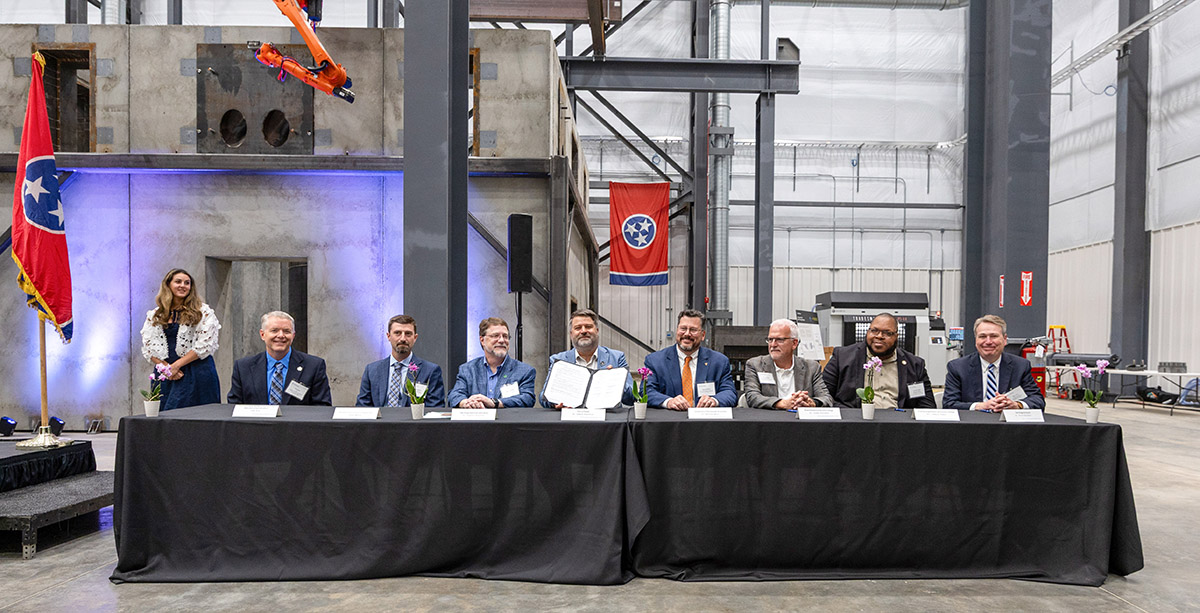
- Kairos Power signed a memorandum of understanding creating the Nuclear Center for Advanced Manufacturing and Precast, or NuCAMP.
- The centre will sit at Kairos Power's Reactor Demonstration Campus in Oak Ridge, Tennessee, home to its fluoride salt-cooled reactor work.
- Planned facilities cover precast concrete production, assembly, welding and additive manufacturing, according to Nuclear Newswire.
Why it matters
- constraint Qualification, not headcount, sets the ceiling: a trained electron beam welder adds nothing until a code path exists for the joint, which is why the partners put code gaps in scope alongside training.
- decision Universities, colleges and a school district must now decide how much curriculum to build against a centre with no stated budget, enrolment target or final structure.
- exposure With four education bodies and one contractor in the memorandum, the teaching capacity is being committed well ahead of any demonstrated order book to absorb it.
- precedent If factory-based nuclear construction becomes a named master's discipline, rival developers can hire those graduates without having paid for the programme.
The gating item here is not the syllabus. It is the line about code and qualification gaps that could stop these methods being adopted at all [8]. A welder trained on electron beam equipment produces a joint that somebody has to accept before it goes into a reactor vessel, and Kairos has already made that choice once, using electron beam welding rather than conventional arc welding on the vessel for Engineering Test Unit 3 [9]. Training people to repeat a process is cheap next to getting the process qualified. Putting both into the same memorandum is the interesting part: the partners intend to look at the qualification obstacles alongside the technologies themselves [8].
The rest of the design is visible in the signatory list. Of the seven counterparties Kairos named, four are educational institutions and exactly one is a construction contractor [16]. Oak Ridge National Laboratory brings research capability through the Department of Energy's Manufacturing Demonstration Facility [10], the University of Tennessee is weighing two master's programmes, one in manufacturing engineering for factory-based nuclear construction and one in precast concrete construction [11], the two community colleges are scoping nuclear pipe welding, precast production and skid manufacturing [12], and Oak Ridge Schools is looking at middle and high school trades pathways [13]. That is a pipeline drawn from age thirteen upward, aimed at a set of building methods Kairos has so far used on its own Hermes work: precast shielding structures and 3D-printed large composite structures [9].
What is missing is any number. The seven parties have agreed to a 12-month exploratory phase to decide which technologies, training programmes and career pathways to develop [5], the final structure of the centre is undetermined [15], and no budget, enrolment target or build date appears anywhere in the announcement [17]. Ed Blandford, Kairos cofounder and chief technology officer, framed the problem as one that a good design does not solve on its own [6]. That is a fair reading of the constraint, and it is also a year of scoping before anyone commits a dollar.
Two commercial names sit outside the memorandum: Kairos says it will separately work with Samsung C&T Engineering & Construction Group and Cambridge Vacuum Engineering on advanced manufacturing and construction [14]. Those are the relationships that would tell you whether factory-built nuclear construction has a customer beyond one campus in Tennessee [3]. Until then, Kairos is paying to define a labour market it is currently the main occupant of, and any developer that later adopts precast shielding or wire-arc additive parts [7] gets the trained welders without having funded the curriculum.
What to watch
- Whether the 12-month phase closes with a named budget, a built facility and enrolment numbers, or with another memorandum.
- Whether any code or qualification body takes up electron beam welded vessels and large-format additive parts for nuclear service.
- Whether the Samsung C&T and Cambridge Vacuum Engineering work moves from exploratory to contracted scope.
Clarity's read
What the record supports and how the coverage leans. The claims behind it follow.
Reality
- Evidence34
- Adoption24
- Hype gap+29
- Incentives66
- Confidence52
Claim ledger
Ranked by verification strength, evidence, and original report placement.
- [1]
Kairos Power has launched a collaboration called the Nuclear Center for Advanced Manufacturing and Precast (NuCAMP) through a signed memorandum of understanding.
- [2]
The NuCAMP memorandum of understanding was signed with Oak Ridge National Laboratory, the University of Tennessee-Knoxville, the Institute for Advanced Composites Manufacturing Innovation (IACMI), Barnard Construction, Roane State Community College, Chattanooga State Community College, and Oak Ridge Schools.
- [3]
NuCAMP will be hosted at Kairos Power's Reactor Demonstration Campus in Oak Ridge, Tennessee, where the company is developing facilities for its high-temperature, fluoride salt-cooled reactor technology.
- [4]
According to Nuclear Newswire, the centre will focus on manufacturing development, workforce training and collaboration, with facilities supporting precast concrete production, assembly, welding and additive manufacturing.
- [5]
The participating organisations have agreed to an initial 12-month exploratory phase to determine which technologies, training programmes and career pathways should be developed.
- [6]
Kairos cofounder and chief technology officer Ed Blandford said: "Delivering affordable advanced reactors at scale will require more than a strong design."
- [7]
Kairos will work with ORNL, the University of Tennessee and IACMI to explore precast concrete construction, large-format additive manufacturing, wire-arc additive manufacturing and electron beam welding.
- [8]
The partners will also examine potential code and qualification gaps that could prevent these technologies from being widely adopted in the nuclear industry.
- [9]
Kairos has used precast concrete for shielding structures and 3D-printed large composite structures while constructing and testing its Hermes reactor facilities, and opted for electron beam welding instead of conventional arc welding when fabricating the reactor vessel for Engineering Test Unit 3.
- [10]
Through the Department of Energy's Manufacturing Demonstration Facility, ORNL will contribute research capabilities to help mature advanced manufacturing and construction methods for nuclear applications.
- [11]
The University of Tennessee will evaluate two potential master's programmes, one focused on manufacturing engineering for factory-based nuclear construction and one specialising in precast concrete construction.
- [12]
Roane State and Chattanooga State community colleges will explore specialised training for careers such as nuclear pipe welding, precast production and skid manufacturing.
- [13]
Oak Ridge Schools will examine opportunities to expand advanced manufacturing and skilled trades pathways at middle and high school levels.
- [14]
Kairos will also work with Samsung C&T Engineering & Construction Group and Cambridge Vacuum Engineering to explore advanced manufacturing and construction opportunities.
- [15]
NuCAMP remains in an early exploratory phase and its final structure has yet to be determined.
- [16]
Four of the seven named NuCAMP counterparties are educational institutions (University of Tennessee-Knoxville, Roane State Community College, Chattanooga State Community College, Oak Ridge Schools), while one is a construction contractor (Barnard Construction).
- [17]
The announcement of NuCAMP contains no budget figure, no enrolment or hiring target, and no completion date beyond the initial 12-month exploratory phase.
Sources
1 independent publisher whose own reporting we read for this story.
- interestingengineering.comKairos launches NuCAMP to train America’s next generation nuclear workforce
1 article · August 21, 2026
Topics and entities
Follow any of these and your For You feed starts watching them — no settings page required.
Topics
Entities
- Kairos PowerFollow
- Nuclear Center for Advanced Manufacturing and PrecastFollow
- Oak Ridge National LaboratoryFollow
- University of Tennessee, KnoxvilleFollow
- Institute for Advanced Composites Manufacturing InnovationFollow
- Barnard ConstructionFollow
- Roane State Community CollegeFollow
- Chattanooga State Community CollegeFollow
- Oak Ridge SchoolsFollow
- Ed BlandfordFollow
- HermesFollow
- Engineering Test Unit 3Follow
- DOE Manufacturing Demonstration FacilityFollow
- Samsung C&T Engineering & Construction GroupFollow
- Cambridge Vacuum EngineeringFollow
- US Department of EnergyFollow