A JAX tensor-LEED code gives surface-structure fits gradients and a GPU path
Imre, Haidegger, Kraushofer and colleagues report that a new Python/JAX tensor-LEED implementation cuts computing time by more than an order of magnitude. A parameter tree skips redundant evaluations, and the code exposes gradients of the R factor.
The Scientist · Science desk
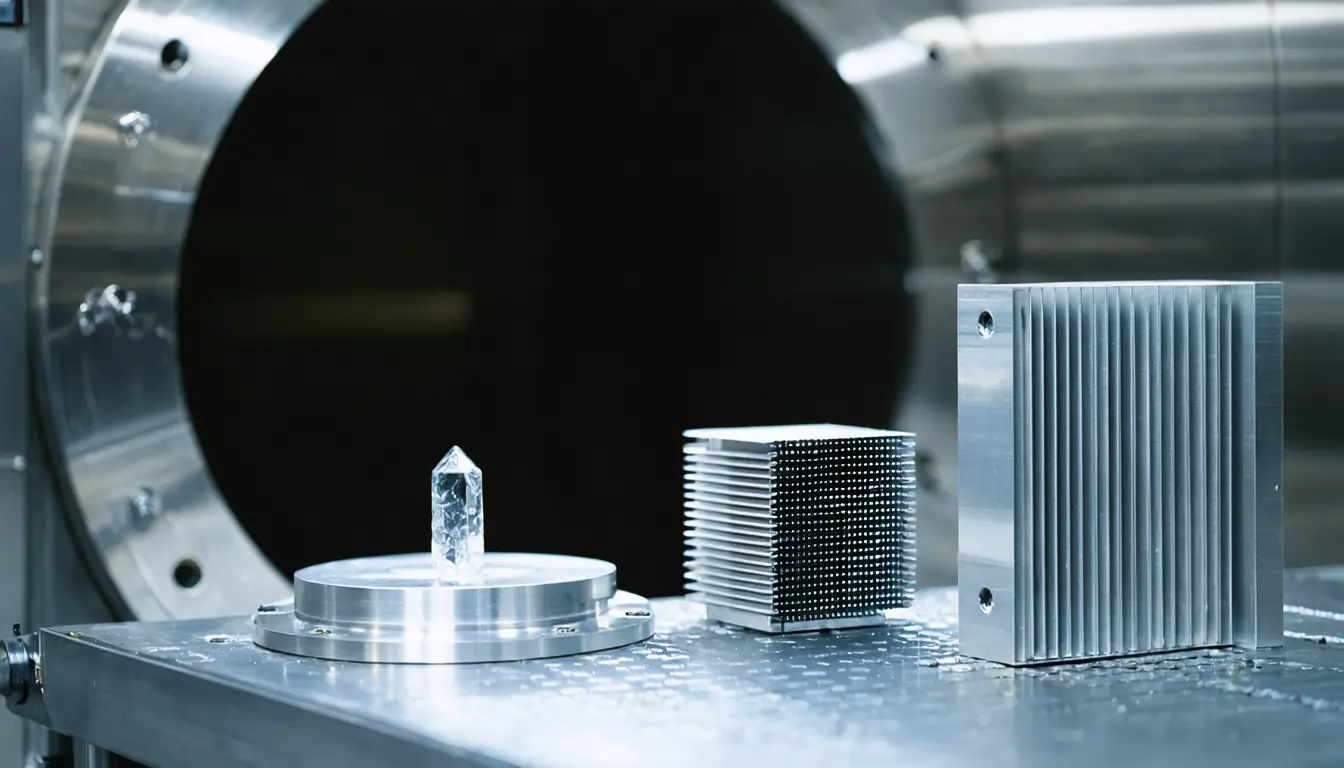
What happened
- Quantitative LEED I(V) determines a surface structure by comparing experimental I(V) data with computed values for a structure model.
- Even with the tensor-LEED approximation, which treats small deviations from a reference structure perturbatively, the optimization stays computationally expensive.
- Earlier algorithms searched a grid of precomputed values; the new code computes intensities on the fly.
- The implementation supports execution on graphics processing units.
Why it matters
- What it costs cost Each candidate structure model needs its own local optimization before it can be judged, so a saving in the optimizer repeats across every model a group tests.
- What's now possible capability On-the-fly intensities and R-factor gradients open the fit to the optimization algorithms the authors call state-of-the-art. The grid-based search was the limitation they set out to remove.
- Who has to decide decision Groups running grid-based tensor-LEED fits have a porting decision to weigh, and the evidence for it is one summary figure from the authors.
The speedup figure bundles three kinds of saving. The tree removes repeated work [4]. In our reading, dropping the precomputed grid removes a constraint on where the search can go, though the abstract describes the older limitation only as grid-based search with precomputed values [5]. Gradients and GPUs make each remaining step cheaper or better informed [7][8].
The authors write that the developments reduce computing time by more than an order of magnitude [9]. The abstract does not give the baseline. Is the comparison against the earlier grid-based code on the same processors? On how many structural parameters, and on which surfaces? How much of the gain comes from the tree, how much from the on-the-fly evaluation and how much from the GPUs? A GPU run set against a single-core CPU run would be a hardware comparison as much as an algorithmic one.
Tensor-LEED also depends on a reference structure, with the optimization treating deviations from it perturbatively [3]. If the quoted timing covers only the optimization loop, a user's saving per surface is smaller than if it covers the whole pipeline.
In our view the design is sound on its face, since each change goes after a cost the abstract names: redundant evaluations [4], the grid [5] and raw computing time [9]. The order-of-magnitude figure, which gets a single sentence in the abstract [9], is the authors' own result on whatever systems they tested. Until other groups reproduce it on their own surfaces, it is a research-benchmark number.
What to watch
- Whether the full paper names the baseline code, hardware and test surfaces behind the order-of-magnitude timing.
- Whether fits with the new optimizers reach the same best-fit structures as grid-based fits on the same data.
- Whether groups other than the authors run the code on their own surfaces and report their timings.
Clarity's read
What the record supports and how the coverage leans. The claims behind it follow.
Reality
- Evidence45
- Adoption
- Insufficient
- Hype gap+10
- Incentives
- Insufficient
- Confidence50
Claim ledger
Ranked by verification strength, evidence, and original report placement.
- [1]
Quantitative low-energy electron diffraction [LEED I(V)] determines surface structure by directly comparing I(V) data from experiment with computations for a structure model.
- [2]
Diffraction intensities are highly sensitive to subtle structural changes, so local structure optimization is essential for assessing the validity of a structure model and finding the best-fit structure.
- [3]
The tensor-LEED approximation accelerates optimization by a perturbative treatment of small deviations from a reference structure, but the optimization process is still computationally expensive.
- [4]
The new implementation reformulates surface-structure optimization using a tree-based data structure, which helps to avoid redundant function evaluations.
- [5]
Intensities are computed on the fly, eliminating limitations of previous algorithms that used grid-based search with precomputed values.
- [6]
Computing intensities on the fly enables the use of state-of-the-art optimization algorithms.
- [7]
Implemented in Python with the JAX library, the method provides access to gradients of the R factor.
- [8]
The method supports execution on graphics processing units (GPUs).
- [9]
According to the authors, the developments reduce the computing time by more than an order of magnitude.
Get this ledger inside ChatGPT. Ask about any of our stories and the answer brings its figure, each claim’s verdict and the sources. Free, no account.
Sources
1 independent publisher whose own reporting we read for this story.
- nature.comStructural optimization in TensErLEED using a parameter tree and <i>R</i>-factor gradients
1 article · October 13, 2026
Topics and entities
Follow any of these and your For You feed starts watching them — no settings page required.
Topics
- GPU ComputingFollow
- Surface ScienceFollow
- Computational materials scienceFollow