ProductNot yet confirmed elsewhere1 publisher3 min readPublished
The UK plant that went dark for four days was too small to have to tell anyone
The government confirmed the July outage and formally blamed nobody. The site sat below the level at which reporting cyber activity becomes a legal duty.
The Product Desk
What happened
- A cyber attack kept a small British power plant offline for four days in July.
- A government spokesperson confirmed the incident to The Register, saying a small-scale generator was affected and the wider energy system was never at risk.
- The UK has made no formal attribution, to Iran or to any other government or hacking group.
- The outage coincided with attacks on US water infrastructure that the Telegraph reported reached 12 states.
Why it matters
- constraint Below the reporting threshold the state's only lever is persuasion: the energy department's response was a briefing and advice to chief executives, which binds nobody who decides the spend is not...
- exposure Everything that kept this plant outside the regime is shared by the other peakers, so the tier now known to be reachable is also the tier least able to justify defending itself.
- contradiction US agencies have named Iran over the water intrusions while London names nobody over the generator, leaving one suspected body of activity with two official statuses.
- precedent Confirming an outage while withholding the site, the operator and the attacker sets the disclosure template for the next small-operator incident.
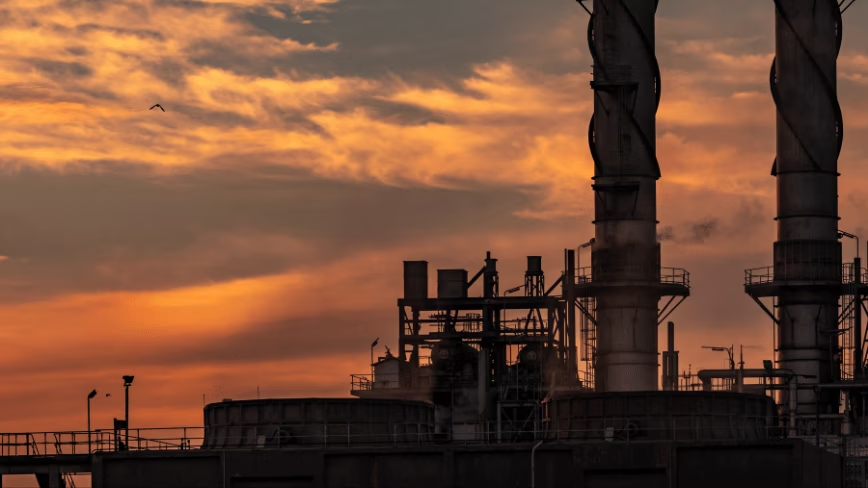
Britain runs dozens of peaker plants, many of them gas-fired and switched on for only a few hours a week, for instance when wind speeds drop [6]. The BBC's Tom Symonds reported that this was not an attack on an essential service of the kind a large station provides [8]. The rulebook reaches the same verdict: a government source told the Telegraph the site sits well below the level at which operators must legally report cyber activity, and called it "a very small-scale site, less than a rounding error compared to grid capacity" [7]. The National Cyber Security Centre, which sits under GCHQ and handles attacks on critical infrastructure, declined to comment, and it does not routinely acknowledge individual incidents in any case [4][5].
Why that class is worth attacking shows up on the American side of the same weeks. Most or all of the US utility intrusions involved internet-connected programmable logic controllers, the small computers that operate pumps and valves, according to The Register [15]. Five federal agencies warned last week that attackers are using AI-generated exploitation scripts against internet-exposed Siemens S7 controllers at water, manufacturing and energy sites, and said "this is not a theoretical risk, it is an active threat" [16]. Cynthia Kaiser, a former FBI cyber analyst now at the Halcyon Ransomware Research Center, told The Register the activity appears to be a continuation of the same suite of activity suspected of being affiliated with Iran targeting PLCs [17]. Where those controllers were attached to something people drink, the results were physical: dozens of wastewater plants affected, flooding, taps losing pressure, and boil-water advice to customers [11].
The scale of that campaign is still being assembled from disclosures rather than read off a register. The Telegraph put it at 12 states [10]. The Register counted more than 30 facilities in Minnesota with similar intrusions later reported in at least 11 other states, which totals at least 12 states once Minnesota is included [13][23]. CNBC reported that the FBI warning covered at least seven [14].
CISA, the FBI and the Environmental Protection Agency blamed Iran for the water intrusions, CNBC reported [14]. Britain has blamed no government or group [3], and the Iranian link on the generator rests on the Telegraph's reporting by Tony Diver, Rozina Sabur and Matt Oliver [25][26]. Officials declined to identify the station, citing security concerns [4]. What remains in the public record of four days of lost generation, then, is a newspaper story and one sentence from a spokesperson [22].
Last year the intelligence and security committee judged an Iranian cyber attack on British infrastructure unlikely, according to the Telegraph, while calling cyber warfare a significant area of asymmetric strength for Iran and noting that Tehran funds hacking groups of hundreds of people each [18][19]. Last month a Cabinet Office assessment put the chance of a serious and successful attack on domestic infrastructure at 5% to 25%, and warned that AI can automate the launching of attacks and lower the barrier to entry [20][21]. The July outage arrived within about a year of the unlikely judgement [24], at the one tier of the energy system where nobody was obliged to file anything.
What to watch
- Whether the UK follows the US agencies in formally attributing either the generator outage or the PLC activity behind it.
- Whether the legal reporting threshold is redrawn to catch peaker-scale generators, or the tier stays voluntary.
- Whether other UK operators of small gas generators disclose intrusions of the same type, and whether any regulator publishes a count.
Clarity's read
What the record supports and how the coverage leans. The claims behind it follow.
Reality
- Evidence55
- Adoption62
- Hype gap+24
- Incentives66
- Confidence52
Claim ledger
Ranked by verification strength, evidence, and original report placement.
- [1]
A cyber attack shut down a small British power plant for four days in July.
- [2]
A British government spokesperson confirmed the incident to The Register on Monday, saying it referred to an incident impacting a small-scale energy generator and that at no point was there a risk to the wider energy system.
- [3]
The government has not formally attributed the attack, to Iran or to any other government or hacking group, The Register reported.
- [4]
Officials declined to identify the power station, citing security concerns, and the National Cyber Security Centre declined to comment.
- [5]
The NCSC sits under GCHQ and handles attacks on critical infrastructure; it does not routinely acknowledge individual incidents.
- [6]
The Financial Times described the site as a peaker plant; Britain has dozens of them according to the Telegraph, many gas-fired and running for only a few hours a week, for example when wind speeds are low.
- [7]
A government source told the Telegraph the site sits well below the level at which operators must legally report cyber activity, calling it "a very small-scale site, less than a rounding error compared to grid capacity".
- [8]
Tom Symonds reported for the BBC that this was not an attack on an essential service such as a large power station; the UK network includes a number of smaller gas generators providing short-term power when needed.
- [9]
UK energy minister Michael Shanks posted about the attack on X, saying his department briefed energy chief executives afterwards and shared advice on the steps companies should take.
- [10]
The outage coincided with a series of attacks on US water infrastructure that reached 12 states and caused concern in the White House, the Telegraph reported.
- [11]
Dozens of wastewater treatment plants were affected; the intrusions caused flooding and a loss of pressure from taps, and some authorities told customers to boil water before drinking it.
- [12]
The first reports emerged in Minnesota on 26 July, followed by Michigan, Georgia, South Dakota and New Jersey.
- [13]
The Register put the Minnesota figure at more than 30 facilities, with similar intrusions later reported in at least 11 other states.
- [14]
CNBC reported that the FBI warned about attacks in at least seven states, and that CISA, the FBI and the Environmental Protection Agency blamed Iran.
- [15]
Most or all of the US utility attacks involved internet-connected programmable logic controllers, the small computers that operate physical equipment such as pumps and valves, The Register reported.
- [16]
Five federal agencies issued a warning last week that attackers are using AI-generated exploitation scripts to break into internet-exposed Siemens S7 controllers at water, manufacturing and energy sites, saying "this is not a theoretical risk, it is an active threat".
- [17]
Cynthia Kaiser, a former FBI cyber analyst now at the Halcyon Ransomware Research Center, told The Register: "This appears to be a continuation of the same suite of activity we suspect is affiliated with Iran targeting PLCs."
ReportedSupportedSource: Cynthia Kaiser, Halcyon Ransomware Research Center, to The RegisterView cited source - [18]
The intelligence and security committee reported last year that an Iranian cyber attack on British infrastructure was "unlikely", according to the Telegraph.
- [19]
The same committee called cyber warfare a "significant area of asymmetric strength" for Iran, and said Tehran spends tens of millions of dollars on hacking groups, each containing hundreds of people.
- [20]
A Cabinet Office risk assessment published last month put the chance of a serious and successful attack on domestic infrastructure at 5% to 25%.
- [21]
The same Cabinet Office assessment warned that "AI can automate the process of launching cyber attacks, making them faster, more efficient and lower the barrier for entry".
- [22]
Because the site sat below the mandatory reporting level and officials would not name it, the public record of the four-day outage consists of the Telegraph's account plus the spokesperson's confirmation to The Register.
- [23]
The Register's count implies at least 12 US states, matching the Telegraph's figure and exceeding the at-least-seven states in the FBI warning reported by CNBC.
- [24]
The confirmed July outage came within roughly a year of the intelligence and security committee's judgement that an Iranian attack on British infrastructure was unlikely.
- [25]
Hackers affiliated with the Iranian regime were responsible, according to the Telegraph.
ReportedContestedSource: The Telegraph2 sources— create a free account to open themView cited source - [26]
Tony Diver, Rozina Sabur and Matt Oliver broke the story on Saturday; they wrote it is thought to be the first time hackers linked to Tehran have closed such a facility in the UK, and described it as the most successful attack of its kind.
Sources
1 independent publisher whose own reporting we read for this story.
- thenextweb.comIran-linked hackers shut down a UK power plant for four days
1 article · August 24, 2026
Topics and entities
Follow any of these and your For You feed starts watching them — no settings page required.
Topics
- Critical Infrastructure CybersecurityFollow
- AI-Assisted Offensive ToolingFollow
- OT/ICS and PLC ExposureFollow
- State-Linked Cyber OperationsFollow
- Cyber Incident Disclosure ThresholdsFollow
Entities
- National Cyber Security CentreFollow
- GCHQFollow
- Michael ShanksFollow
- Cynthia KaiserFollow
- Halcyon Ransomware Research CenterFollow
- CISAFollow
- Federal Bureau of InvestigationFollow
- Environmental Protection AgencyFollow
- Siemens S7 PLC familyFollow
- Cabinet OfficeFollow
- Intelligence and Security CommitteeFollow
- The TelegraphFollow
- The RegisterFollow
- CNBCFollow
- BBCFollow
- Financial TimesFollow