Trapped-ion simulation finds gluon strings break first at the edges
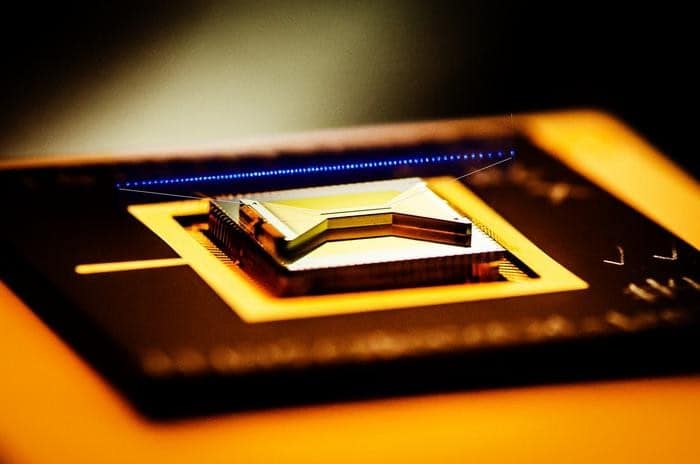
Christopher Monroe's Duke team simulated gluon string breaking on trapped ions and got results similar to earlier neutral-atom and superconducting work. The team found the break starts at the edges, contrary to Schwinger's predictions.
The Scientist · Science desk
What happened
- The team modelled quarks as domain walls, which are regions where adjacent ions in the trap have opposite spins.
- An external magnetic field stood in for the rising energy of the gluon field, and past a threshold, De said, two domain walls became more particles.
- In 2025 Google Research simulated simplified string-breaking dynamics on its Sycamore processor, which uses superconducting qubits.
- Also in 2025, Innsbruck, Harvard and QuEra researchers set up rubidium atoms with lasers so their interaction mimicked quarks, skipping the discrete time steps.
Why it matters
- constraint Blinov says the system is too small to beat a supercomputer, so for now the experiment tests the method and the physics, not any speed advantage.
- capability More qubits and deeper circuits would let the team put domain walls farther apart and attempt the inverse problem, string formation when particles collide.
- precedent String breaking often underpins particle formation in colliders and its details are poorly understood, so an edge-first onset that holds up would correct a picture colliders already depend on.
The agreement with earlier work and the departure from theory rest on different evidence. Physics World says the ion results are similar to neutral-atom and superconducting findings obtained independently [2]. The comparison it spells out is with the QuEra group's neutral-atom work [4]. Google's superconducting calculations were a simplified version of the dynamics [8], and the Innsbruck group took a slightly different tack [9]. In our view, agreement across three platforms makes a hardware quirk an unlikely explanation for whatever the runs share.
The observable in the ion experiment is a count of domain walls. Arinjoy De, who was Monroe's PhD student and now works at QuEra, said of the count after the Hamiltonian is applied: "We show that the number actually increases." [6]
The departure from theory is narrower than the agreement. Physics World says the results suggest traditional models of string breaking need to be modified slightly [3]. The change it describes is an onset at the edges, where coupling to the quantum vacuum reduces the energetic cost of creating new particles, before the break propagates inwards to the bulk [10]. Schwinger first outlined the theory in 1951 [11]. The article credits the edge-first finding to Monroe's team; whether the other platforms saw the same pattern is not stated.
Boris Blinov of the University of Washington said the work is "significant in its own right as a demonstration of the potential of a quantum simulator in the future to do things faster than any classical analogue of it." [13]
The thing this doesn't tell you is whether the edge effect survives in a longer chain. In a small system the edges are a large fraction of the whole, so an effect that begins at the edges needs a size check before it amends the canonical theory.
What to watch
- A larger ion run, with more qubits and deeper circuits, that tests whether the edge-first onset persists as domain walls are placed farther apart.
- Whether the neutral-atom or superconducting groups report the same edge-first pattern in their own data.
Clarity's read
What the record supports and how the coverage leans. The claims behind it follow.
Reality
- Evidence58
- Adoption
- Insufficient
- Hype gap−5
- Incentives
- Insufficient
- Confidence55
Claim ledger
Ranked by verification strength, evidence, and original report placement.
- [1]
Christopher Monroe at Duke University and colleagues in the US and Belgium modelled string breaking on a trapped-ion quantum computer.
- [2]
The trapped-ion results are similar to previous findings obtained independently using neutral-atom quantum simulators and superconducting quantum computers.
- [3]
The result suggests that traditional models of string breaking need to be modified slightly.
- [4]
Monroe's team achieved similar results to the QuEra group using trapped ions instead of neutral atoms.
- [5]
Monroe's team modelled the behaviour of quarks using domain walls, which are regions where adjacent ions have opposite spins.
- [6]
Arinjoy De, who was Monroe's PhD student and now works at QuEra, said of the domain-wall count after the Hamiltonian is applied: "We show that the number actually increases."
- [7]
To simulate the increasing energy in the gluon field as a quark is pulled away, the researchers used an external magnetic field; De said that beyond a certain threshold the system goes from two domain walls, or two particles, to creating more particles.
- [8]
In 2025 scientists at Google Research and colleagues performed simplified calculations of the dynamics of string breaking on their Sycamore processor, which uses superconducting qubits.
- [9]
Also in 2025, researchers at the University of Innsbruck with colleagues at Harvard and QuEra used lasers to initialize rubidium atoms so that their interaction would be analogous to quarks, instead of breaking the quantum chromodynamic equations into discrete time steps.
- [10]
Contrary to the predictions of Schwinger, the researchers found that string breaking is initiated at the edges, where coupling to the quantum vacuum reduces the energetic cost of new particle creation, before propagating inwards to the bulk.
- [11]
The theory of string breaking was first outlined in 1951 by Julian Schwinger.
- [12]
The researchers hope that with more qubits and greater circuit depth they can look at domain walls farther apart, which would let them study the inverse problem of string formation when particles collide.
- [13]
Boris Blinov of the University of Washington said the work is "significant in its own right as a demonstration of the potential of a quantum simulator in the future to do things faster than any classical analogue of it."
- [14]
Blinov says the current system is too small to outperform what can be achieved with a supercomputer.
- [15]
String breaking often underpins the formation of new particles in colliders, but its fundamental details remain poorly understood.
Get this ledger inside ChatGPT. Ask about any of our stories and the answer brings its figure, each claim’s verdict and the sources. Free, no account.
Sources
1 independent publisher whose own reporting we read for this story.
- physicsworld.comGluon string breaking is simulated using trapped ions
1 article · October 13, 2026
Topics and entities
Follow any of these and your For You feed starts watching them — no settings page required.
Entities
- Christopher MonroeFollow
- Duke UniversityFollow
- QuEra Computing Inc.Follow
- Google ResearchFollow
- Julian SchwingerFollow
- Boris BlinovFollow
- Arinjoy DeFollow
- Nature PhysicsFollow