Science1 publisherNot yet confirmed elsewhere3 min readPublished
A couple dozen white roofs in Makassar, and a 5-degree ceiling on what paint can do
Stanford researchers are coating informal-settlement roofs in Indonesia to cut indoor heat by up to 5F. The defence offered is physiological rather than comfort, and the cost is still unpriced.
The Scientist · Science desk
What happened
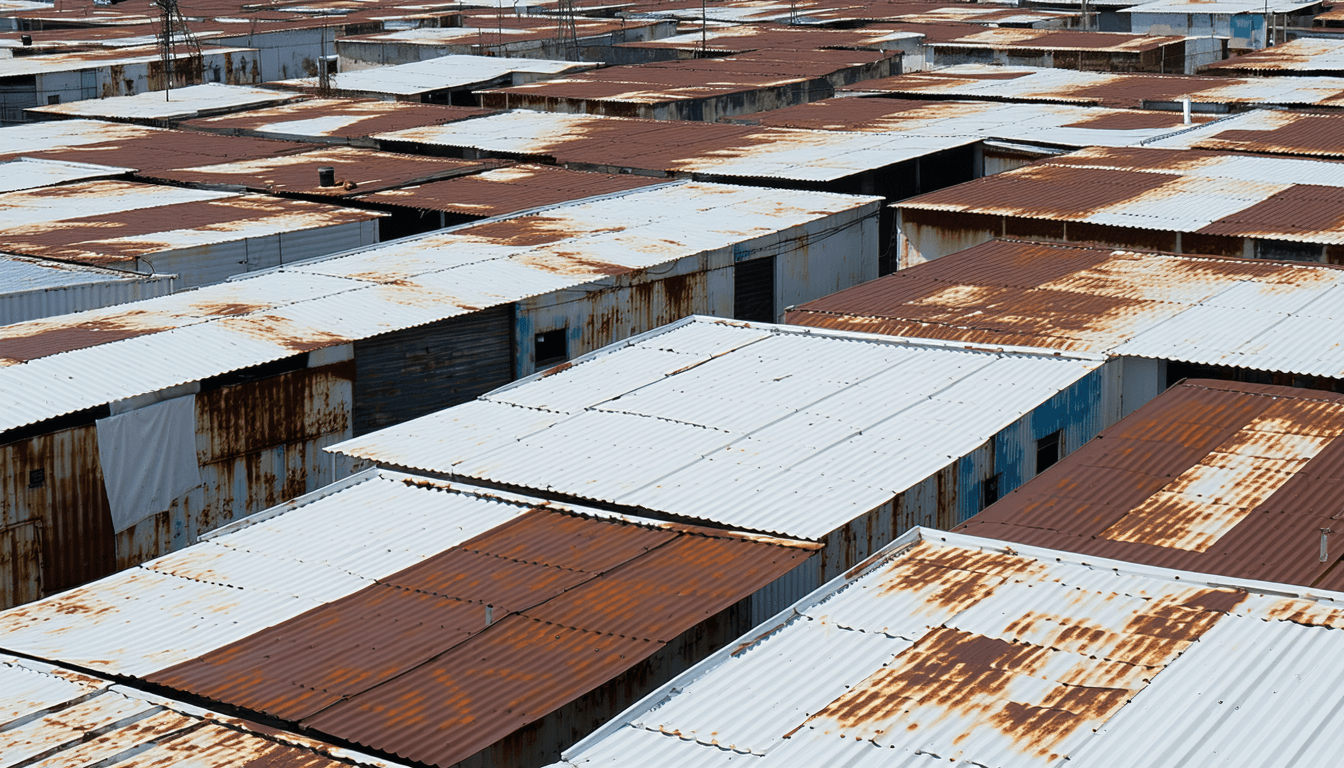
- A Stanford Doerr School of Sustainability project will coat a couple dozen roofs in a Makassar informal settlement with highly reflective white paint in the coming months.
- About 40% of Makassar's population lives in such settlements, without basic municipal services or air conditioning, and routinely above 90F.
- The coating is presented as one of the cheapest available tools, capable of lowering indoor temperatures by as much as 5 degrees Fahrenheit.
- The stated rationale is physiological: past the point where sweat can no longer cool the body, the heart, kidneys and other organs take up the load.
Compiled by The ScientistSomething wrong?How this is made
Why it matters
- constraint Because 5F is the best case rather than the average, the intervention buys margin on marginal days and does little on the days when humidity has already defeated sweating.
- cost No price per roof appears anywhere in the account, so a city budget office cannot yet weigh coatings against shade planting or cooling subsidies.
- contradiction Speed is the case for paint, but the same researchers expect extremes to keep accelerating, which makes a fixed few degrees of relief worth less each decade.
- decision Cities with almost no residential air conditioning and heat-retaining building stock now have to decide whether a fast surface fix applies to them at all.
Five degrees Fahrenheit is about 2.8 degrees Celsius [17], and the figure as reported is a ceiling, not a mean: the coating lowers indoor temperatures "by as much as" that much [5], which is the language of a best case [19]. That distinction matters more here than in most retrofit arithmetic, because the quantity being defended is not comfort. When air is hot and humid enough that evaporating sweat can no longer hold core temperature, the heart, kidneys and other organs take up the load [7], and that strain aggravates cardiovascular disease, diabetes and asthma, and can kill people who were otherwise young and healthy [8]. The useful metric is therefore hours spent past that limit, not degrees averaged over a season.
The trial is sized to measure, not to cool a city. A couple dozen roofs [4] sits against a settlement population that accounts for roughly 40% of Makassar's residents [2], so the output is an effect size, not coverage [20]. There is a local reason to want that number: in Makassar, heat waves already track with surges in work absenteeism and in dengue cases [9], which means the eventual test of white paint is whether indoor gains show up in records kept by employers and clinics.
The word doing the heaviest lifting is "cheapest" [5]. The account carries no price per roof, no coating specification and no measured result yet [21]. Cheap relative to what is left to the reader, and a municipality comparing coatings against shade planting or an air-conditioning subsidy has nothing yet to put in the second column.
Two Stanford framings in the same account pull against each other. John Openshaw, who co-leads the roofs project, argues that big interventions take decades and people are suffering from heat now, so the priority is what can be deployed quickly [10]. Climate scientist Noah Diffenbaugh, in the same piece, says extreme events will accelerate even if decarbonisation succeeds, and the hard problem is leapfrogging to conditions worse than today's [15]. A fixed 2.8C of relief is a depreciating asset under that second view. Some regions now see 50 more heat-stress days a year than in 1950 [11], roughly seven extra weeks [22], and heat wave frequency in major US cities has gone from two events a year to six [12], four more than the old baseline [18]. Paint converts a certain number of dangerous days into tolerable ones, and that number falls as the distribution moves right.
Transfer is not automatic either. Makassar's exposure is thin corrugated metal over homes with no air conditioning [1][3]. The mild-climate cases named in the same work, San Francisco, London and Paris, are described as places with little residential air conditioning and building stock designed to retain heat [16], compounded by dark asphalt and impervious surfaces that push urban temperatures well above nearby rural ones [14]. Absorbed solar gain on a metal sheet and stored heat in masonry are not the same failure, and there is no evidence here that they take the same remedy.
What to watch
- Whether the Makassar trial publishes measured indoor temperature deltas alongside a cost per roof and a coating specification.