Science1 publisher3 min readPublished
A front in the Chukchi Sea drives dying phytoplankton to the seafloor four times faster
Kevin Arrigo's Stanford lab sampled an Arctic bloom from rise to decline in the summer of 2023, and two new papers trace its remains to a place where cold under-ice water dives beneath warmer open water.
The Scientist · Science desk
What happened
- Two papers from the Stanford lab of biological oceanographer Kevin Arrigo appeared in the Journal of Geophysical Research: Oceans, the first of them lead-authored by doctoral student Claudette Proctor on Sept. 23.
- Across much of the Chukchi Sea, phytoplankton sank at about half a meter a day once their blooms had peaked, but at a front where currents converge the average rate was roughly four times higher.
- Beneath ice up to 2 meters thick, the team recorded one of the densest phytoplankton blooms ever measured anywhere.
- Sunlight coming through cracks in that ice was sufficient to power photosynthesis, according to the measurements taken during the summer of 2023.
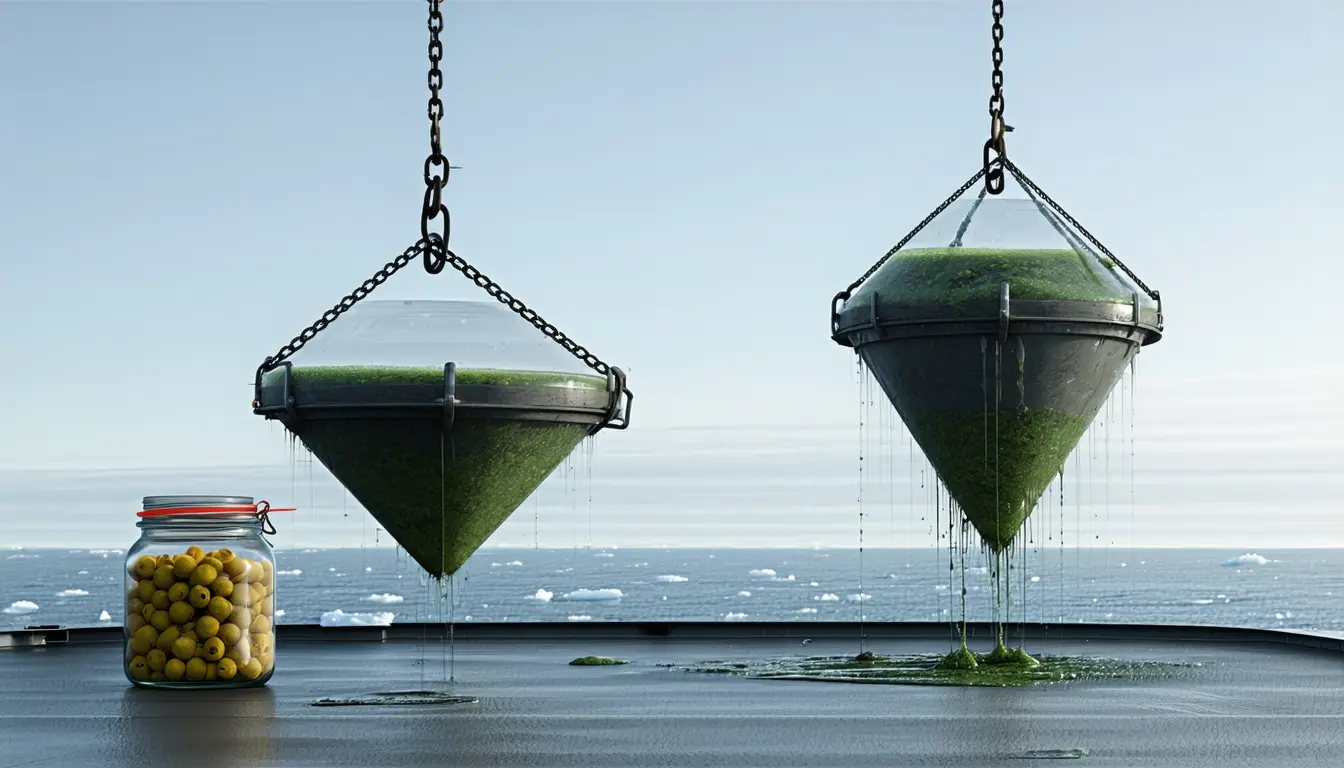
- The sampling used floating sediment traps set both in open water and in holes cut in the ice, plus seawater nutrient measurements and carbon and chlorophyll from seafloor sediment.
Compiled by The ScientistSomething wrong?How this is made
Why it matters
- capability A single-visit cruise cannot resolve the end of a bloom; sampling that ran across nearly a whole growing season under the ice gives a rise-peak-decline record, so the end of this bloom can be tied to the nutrients it exhausted.
- constraint The two figures carrying the story are different kinds of number, a ceiling for density and an average for sinking speed, and neither scales cleanly into a basin-wide multiplier for Arctic carbon export.
- exposure If Lauer's explanation holds, the food supply of those seafloor clam and brittle star patches depends on where a current boundary sits, and it moves when the front moves.
- constraint Blooms under the ice became possible as the ice thinned and cracked and let more light through, so the thing being measured is changing with ice cover, and a 2023 flux will not hold as a stable baseline.
Four times half a meter a day comes out near two meters a day [23]. Across most of the ocean, the trip from the sunlit surface layer to the seafloor takes weeks [3]. At the front that trip is compressed, and the compression happens at a boundary: cold water carrying plankton out from under the ice drifts south, meets warmer opposing currents in open water, and the plankton go down with the colder mass [18].
"That cold, salty water mass takes a dive, and the warmer, fresher water mass rides up on top," said James Lauer, an Earth system science doctoral student and lead author of the paper on how currents affect the blooms [19][20].
The density number needs more care than the sinking rate. Under-ice blooms were up to 10 times more concentrated than blooms sampled a month later in open water, after seasonal melting had begun to open the ice [7]. Those two sets of samples differ in place, in date, and by a month of bloom development. "Up to 10 times" is a ceiling; the four-fold difference in sinking is reported as an average across locations [5][7].
Sunlight filtering through cracks in the ice was enough to power photosynthesis, the 2023 measurements suggest [8]. "We're observing phytoplankton in huge populations underneath substantial sea ice," said Claudette Proctor, lead author of one of the two papers [9]. "They are growing in an environment that we previously thought was inhospitable," she said [10].
The blooms drew down nutrients until they ran short, nitrate in particular, then withered and began to sink [16]. Catching that took traps in the right places and a long enough stay. Few missions have sampled phytoplankton under the ice, and fewer have followed them across almost an entire growing season [12]. "We got to see the bloom come up, peak and then start to come down," said Arrigo, senior author of both papers [13]. "You almost never get a chance to do that" [14].
Earlier surveys had turned up patches of Arctic seafloor with unexpectedly large populations of clams and brittle stars, along with the walruses and whales that feed on them [21]. "The discovery that this front is rapidly enhancing rates of sinking helps to explain where the food sources to support that benthic biomass might be coming from," said Lauer [22].
A revised Arctic carbon budget would take more than a sinking rate, a density ratio and a nutrient drawdown. It would need the front's extent, whether it forms the same way in other summers, and how much of the shelf it reaches; the samples come from one sea in the summer of 2023 [2]. Arrigo's group first found blooms under Arctic ice on a 2011 mission [11], and the season-long follow-up came 12 years later [24].
What to watch
- Whether a second field season finds the front in the same place moving material down at the same rate.
- A quantitative match between what the sediment traps caught and the carbon and chlorophyll in seafloor sediment beneath the front.
- Whether existing Arctic benthic biomass surveys line up with mapped front locations. That comparison is the test of Lauer's food-supply explanation.