Science1 publisher3 min readPublished
Purdue's touch probe attacks the prep bench, not the mass spectrometer
A patent-pending Purdue method presses a solvent probe onto intact surfaces and reads them by LC-MS/MS, skipping mixing, centrifuging and drying, and leaving the specimen reusable.
The Scientist · Science desk
Drafted by a language model from the sources cited here and checked against its claim ledger before publication. How we use AISend a correction
What happened
- A patent-pending method developed and tested for multiple applications at Purdue University eliminates sample preparation, a bottleneck that currently dominates a laboratory scientist's time and budget, and enables spatial analysis using liquid chromatography-tandem mass spectrometry (LC-MS/MS).
- The method is called surface touch extraction imaging (STEi), and could benefit food scientists, toxicologists and other laboratory scientists spatially analyzing samples with irregular surfaces for metabolites, lipids, environmental compounds and proteins using diverse instrumentation to generate multiomics data.
- Christina Ferreira, research assistant professor at Purdue's Bindley Bioscience Center with a courtesy appointment in the Department of Food Science, and Ryan Hilger, assistant director of the Jonathan Amy Facility for Chemical Instrumentation in the Department of Chemistry, lead the team that created STEi.
- Ferreira said sample preparation for traditional LC-MS/MS analysis requires several steps, including mixing, centrifuging, transferring and drying.
- Ferreira: "That destroys the sample and throws away spatial information about where a chemical was found in the sample. Also, if scientists want to spatially analyze an irregular surface such as a piece of liver tissue or a fish fillet, they must section it and make it flat to be able to extract the chemicals before the analysis."
Compiled by The ScientistSomething wrong?How this is made
Why it matters
Purdue University has disclosed a patent-pending sampling method that removes sample preparation from liquid chromatography-tandem mass spectrometry work and adds the spatial information the conventional workflow discards [1]. The choice of target matters more than the mechanism: the mass spectrometer absorbs the capital, but preparation absorbs the hours, and Purdue describes prep as the bottleneck that dominates a lab scientist's time and budget [1].
Conventional LC-MS/MS prep runs through mixing, centrifuging, transferring and drying, according to Christina Ferreira, a research assistant professor at Purdue's Bindley Bioscience Center who leads the team with Ryan Hilger of the Jonathan Amy Facility for Chemical Instrumentation [3][4]. "That destroys the sample and throws away spatial information about where a chemical was found in the sample," Ferreira said, adding that an irregular object such as a piece of liver tissue or a fish fillet must be sectioned and flattened before chemicals can be extracted [5].
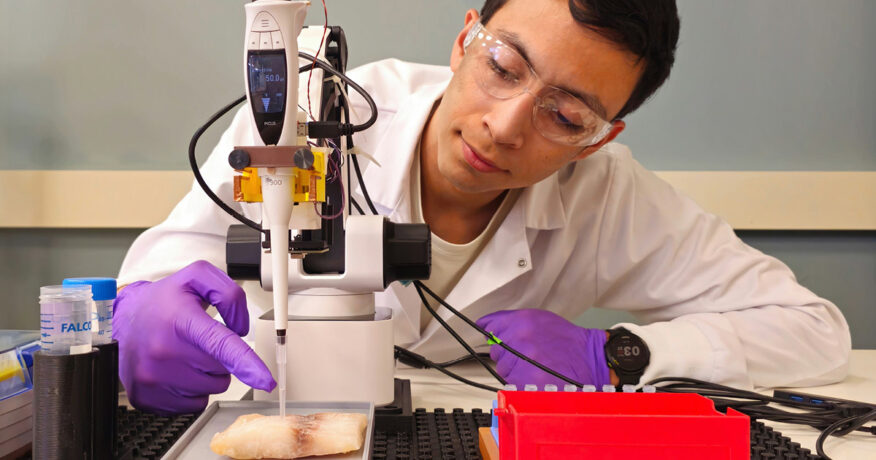
The method, surface touch extraction imaging, starts with an intact, unprocessed sample placed on the instrument stage with no flattening or grinding [2][7]. An integrated camera and imaging module scan the surface, and software computes a path determining where the extraction probe touches and in what order [8]. A fine tip descends to each point, forming a liquid bridge with a solvent that can be water, acetonitrile or a mixture, while a force and pressure sensor holds contact consistent regardless of surface shape [9]. The software then registers the molecular data back to the original surface coordinates, producing heat maps of where lipids, contaminants, proteins or metabolites concentrate [11]. Ferreira said the pressure-controlled probe's tolerance for uneven surfaces is the critical differentiator against flat-surface methods [10].
Each touch takes roughly 5 to 15 seconds [12]. On that arithmetic alone, a hundred-point map is about 8 to 25 minutes of contact time [13], against what Ferreira characterises as a half-day destructive assay for a food safety scientist [14].
Three second-order consequences are worth more attention than the speed number. First, the collected material is instrument-agnostic in principle: Ferreira said the approach opens the way to imaging surfaces using a high-performance liquid chromatography autosampler and running imaging experiments on LC-MS/MS [15]. Second, because only the surface is sampled, the specimen stays largely intact and can be resampled over time [16], which permits repeat measurement of one object rather than parallel destruction of many. Third, the labour argument: because the process is automated and pressure-controlled, Purdue says less experienced staff can run samples reliably [17]. That is a staffing line item, not a novelty claim.
For toxicology, Ferreira frames the gain as drug distribution across an organ instead of an average concentration [18]. Purdue says the applications begin with food safety [19].
What to watch. The announcement carries no spatial resolution, detection limits, recovery comparison against conventional extraction, or per-sample cost [20], so the trade between touch sampling and a full destructive extraction is unquantified in public. The intellectual property is at the application stage: Ferreira disclosed the method to the Purdue Innovates Office of Technology Commercialization, which applied for a patent [6]. And the scope is set by the physics: this reads surfaces [16], so anything sitting in the interior of a fillet or a biopsy stays outside the map until someone cuts.