Science1 publisher3 min readPublished
In rats, SWANS routes a front-paw signal through tissue to a hind-leg nerve implant
SWANS, described in Science, sent faint pulses about 40 centimeters through a rat's tissue to switch on a nerve-stimulating implant in its hind leg. Dropping the radio shrinks the devices to syringe size, though that range was measured only in rats.
The Scientist · Science desk
What happened
- Messages are kept close to a yes or no, so the implants draw next to nothing while they wait for a signal.
- The team estimates that an actuator triggered once a day would run for about a year before it needs replacing.
- Hugh Lee of Purdue, who was not involved, said fattier and bulkier human bodies could further limit how far the pulses travel.
Compiled by The ScientistSomething wrong?How this is made
Why it matters
- constraint The insulin-pump case, a buried sensor telling a distant implant what to do, rests on a demonstration in which the sensing was done by a worn hub.
- cost If the one-year estimate holds, each patient would need a procedure every year to remove spent implants and inject replacements.
- exposure A wearable that commands implants becomes a point of attack: anyone able to spoof it could fire devices that should stay off.
- constraint Any amplification needed to reach across a human body has to fit inside electronics small enough to inject, the property the design depends on.
In the rat, the sensing was done by worn sensors, not implanted ones. Sensors on the front paws reported to a wearable hub, and the hub sent the command to a stimulator hooked up to the sciatic nerve in the hind leg [3]. The command got across because salty tissue conducts electricity. A tiny voltage pulse from the hub spread through the animal until it reached the implant [4]. "The body is not just where the devices sit," said Yoon Jae Lee, a computer scientist at Georgia State University and a co-author of the study. "It's become a part of the communication network." [17]
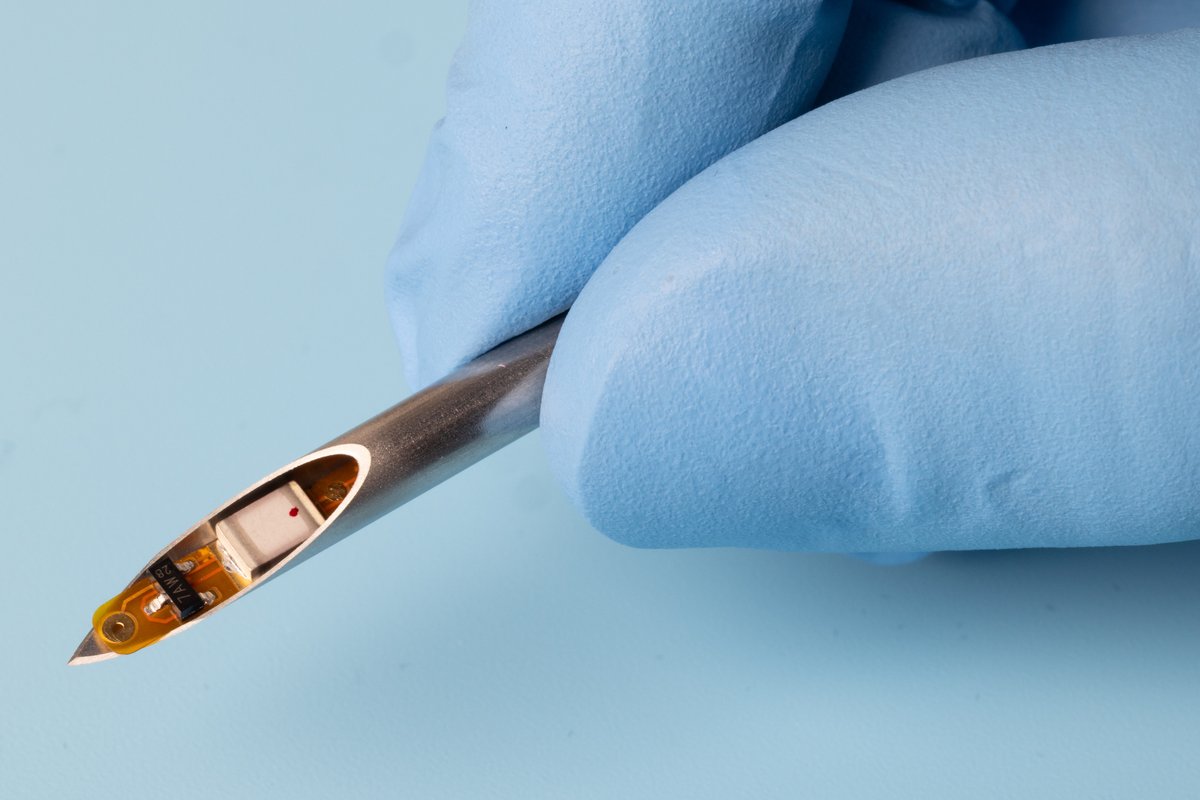
The motivation is practical. Treatments such as insulin pumps have to sense in one place and act in another, and today that link often runs over Bluetooth [6]. A radio needs a battery, and the sites where sensors would be most useful, deep in the gut or in muscle, have little room for a bulky one [5]. Skipping conventional wireless let the team make devices small enough to inject with a syringe [7]. Smaller implants are also less likely to disturb the tissue around them, according to Hugh Lee, a Purdue University biomedical engineer and program manager at ARPA-H who was not involved in the study [8]. "The body doesn't really like when you jab things into it," he said [8].
The power budget depends on keeping each message close to a yes or no instead of a data stream. While they wait, the implants draw next to nothing [9]. By the team's estimate, an actuator triggered once a day could last about a year [10]. That comes to roughly 365 firings before a doctor pulls the dead implant and injects a new one [1][10].
Range is the open problem for people. In the study the signals traveled about 40 centimeters, enough to cross a rat but short for human treatments [11]. Hugh Lee said human bodies, fattier and bulkier than a rat's, could cut that reach further [12]. Amplifying the signals could help, as long as the electronics stay small [13]. That condition is the hard part, because small size is the reason the team dropped the radio in the first place [7][13].
Security is the other problem. "If you have some way of spoofing a wearable device to be able to activate things that are not supposed to be activated, that could be problematic," Hugh Lee said [14]. In the rat setup, the wearable hub was the device giving the commands [3]. Alex Abramson of the Georgia Institute of Technology, the study's senior author, said the pulses are basically imperceptible, comparable to what a pacemaker sends to the heart [15].
"We have this ability to decode information in one spot and shuttle it all the way to another area where it's needed," Abramson said [16]. The authors see uses in drug delivery and prosthetic limbs [20]. I think the Science paper shows the channel working at rat scale, from a worn hub to one implant [1][3][11]. A network of buried sensors and implants signalling one another has not yet been demonstrated. The published account of the experiment does not say how many rats were tested or how often a pulse got through. An earlier line of injectable microstimulators, the Bionic Neuron, or BION, made it into human trials but never received approval [18].
What to watch
- A range test in a larger animal or human-scale tissue, since 40 centimeters was measured only across a rat.
- A demonstration in which an implanted sensor, instead of a worn one, triggers a distant actuator.
- Whether the team publishes a way to authenticate the hub so a spoofed wearable cannot fire implants.