Science1 publisher2 min readPublished
Baking sodium out of a boride leaves a porous boron 10 million times more conductive than common boron
Chemists baked the sodium out of sodium boride to make Imma-B60, a porous boron that conducts about 10 million times better than the common form. Its flexibility figure is shakier, given in the same report as both 23% and 32% strain, the higher from compressing nanopillars.
The Scientist · Science desk
What happened
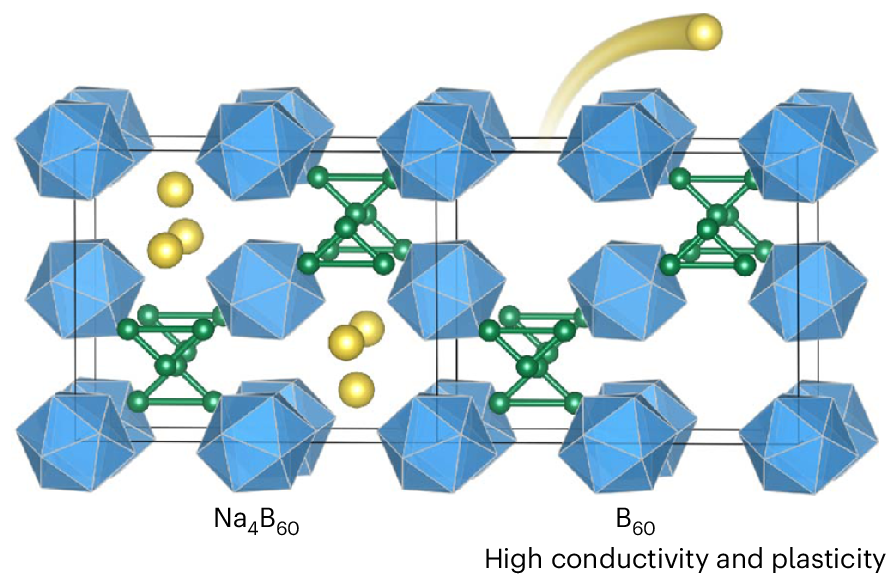
- Chemists vacuum-baked large sodium boride (Na4B60) crystals at 900 degrees Celsius for two days, drawing out the sodium to leave a pure boron form, Imma-B60, reported in Nature Chemistry.
- What remains is a porous framework of 12-atom boron cages joined by 3-atom triangular units, unlike the dense packing of standard elemental boron.
- Compression tests on nanopillars of Imma-B60 reached about 32% strain without the material fracturing.
Compiled by The ScientistSomething wrong?How this is made
Why it matters
- contradiction The same account also gives 23% as the strain the framework survives, so no single flexibility figure for Imma-B60 can be quoted with confidence until the paper's own value is checked.
- constraint Strain measured by squashing nanopillars says little yet about bending, or about how pieces large enough to shape into a component would behave.
- capability Chemists now have a two-step route to open boron frameworks, a structure type the standard one-step high-pressure method cannot produce because it forces boron into dense crystals.
Chemists had tried for more than a decade to make a plastic, highly conductive form of elemental boron, which until now existed only in theory and first-principles calculations, according to the phys.org account of the work [6]. The standard synthesis is a single high-pressure, high-temperature step, and it forces boron atoms into dense, tightly packed crystals [7]. The way to an open framework is to build it around temporary guest metal atoms and then drive the guests out. That extraction often failed. Boron is electron-deficient and bonds tightly to metals, so the guests stayed put [8].
The new route fixed the stage before extraction. Earlier work had produced only tiny, low-quality sodium boride crystals, and degassing them was difficult [9]. Adding zinc interlayers during growth gave large crystals in which the sodium sat inside open channels running between interconnected boron cages [9]. Under vacuum, the sodium left through those channels and the framework stayed intact [10].
The conductivity figures in the account are internally consistent. It gives roughly 900 siemens per metre at room temperature, about seven orders of magnitude above standard rhombohedral boron [11]. Ten million is seven orders of magnitude, so the headline ratio and the measurement agree [4]. The ratio is large partly because the baseline is so low. Dividing 900 by ten million puts common boron at about 0.00009 siemens per metre [15], the conductivity of a poor conductor with a bandgap above 1.5 eV [5]. Imma-B60's gap is under 0.2 eV [4].
The deformation figures are less tidy. Early in the account, the framework deforms by 23% without shattering [3]. Later, compression tests on nanopillars reach about 32% strain without fracture [12]. They are the same two digits in reverse order [3][12]. The account does not reconcile them or describe tests on anything larger than a nanopillar. It does describe how the material gives: high-resolution imaging showed dislocation-mediated slip, with atomic planes sliding smoothly past one another under stress [13].
Conventional elemental boron is still superhard, brittle under stress and a poor conductor [5]. Imma-B60 behaves differently because its atoms sit in an open framework of 12-atom cages linked by 3-atom triangular units [2]. Making it confirms what calculations had proposed for years [6]. The researchers believe it could be a foundation for designing mechanically resilient, functional inorganic materials [14].
What to watch
- The Nature Chemistry paper's own value for strain before fracture, 23% or 32%, and the size of the samples it was measured on.
- Bending or tension tests on crystals larger than nanopillars, which would show whether slip-driven plasticity holds outside compression.
- Whether zinc-assisted crystal growth followed by vacuum extraction yields other open-framework boron allotropes from other borides.